Who Really Paid for Grab's First Profit?
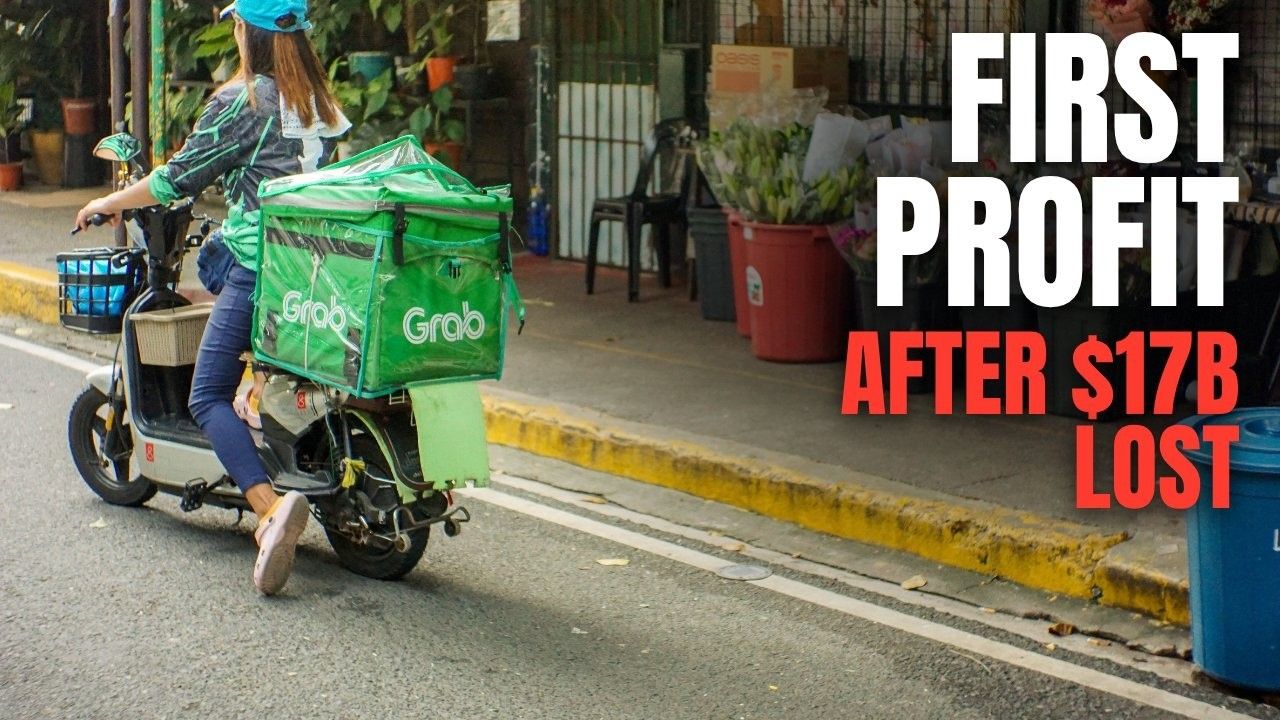
In February 2026, Grab reported its first full-year profit: US$200 million, more than thirteen years after it began as a taxi app in Kuala Lumpur and after US$17.5 billion of losses on its books. We went through every set of results it has published since it listed, to find out how it finally made money and who paid for it.
The chain reaction
From the profit to what to watch
Domino 1
The profit
Of 2025's US$200 million profit, Grab's business (its operating profit) made US$65 million, and interest on its cash brought in US$167 million. From April to June 2026, a one-time US$307 million gain on taking control of Superbank turned a loss into a US$235 million profit.
0:29 Where the profit came fromDomino 2
The cost
Losses on its books reached US$17.5 billion by the end of 2025: at 2025’s profit, more than 60 years to earn back. In the quarter it listed (late 2021), customers ordered almost US$2.5 billion of deliveries and Grab was left with US$1 million of revenue.
1:38 What it costDomino 3
Handing back less
Of every US$100 spent on Grab rides and deliveries, about US$15 came back as discounts and bonuses in 2021, and about US$10 since 2023. At 2021’s rates, 2025 would have cost about US$1 billion more: more than half of it customer discounts, and up to US$400 million of driver and merchant bonuses.
2:55 How the losses stoppedDomino 4
Who paid
Singapore’s ride platform fee went from nothing (until late 2020) to S$1.20 (≈ US$0.94). Vietnam’s platform fees rose in April 2026. Indonesia capped the commission the apps take from a motorbike driver’s fare at 8% from July 2026, down from 20%.
4:04 Who paidDomino 5
The bill comes back
In 2026, the fuel shock pushed discounts and bonuses back up to almost US$11 of every US$100; Vietnam’s competition commission is reviewing Grab’s fees; Taiwan blocked its US$600 million foodpanda deal over its ties to Uber.
6:34 The bill comes backDomino 6
What to watch
Grab reports its third quarter after New York’s close on November 2, 2026: the line to watch is operating profit, US$19 million last quarter.
7:58 What to watch
The story
What this episode explains
In February 2026, Grab reported its first profit for a full year: US$200 million, more than thirteen years after it began as MyTeksi, a taxi app in Kuala Lumpur, and after US$17.5 billion of losses on its books. So how did Grab finally make money, and who paid for it? We went through every set of results it has published since it listed in 2021.
The first surprise: of 2025's US$200 million, Grab's business (its operating profit) made US$65 million. Interest on its cash pile brought in US$167 million. From April to June 2026, a one-time US$307 million gain on taking control of Superbank in Indonesia turned the quarter's loss into a US$235 million profit. Mostly, the losses stopped because Grab hands back less: of every US$100 spent on Grab rides and deliveries, about US$15 came back as discounts and bonuses in 2021, and about US$10 since 2023. At 2021's rates, 2025 would have cost about US$1 billion more, more than half of it in customers' discounts. Then: who paid (Singapore's platform fee, Vietnam's fees and its competition review, what drivers keep, Indonesia's new 8% cap on drivers' commission, restaurants, Malaysia's gig workers law, investors at −72%), the bill coming back in 2026 (fuel, regulators, Taiwan blocking the foodpanda deal), the other side, and what to watch in Grab's next results on November 2.
- US$65M
- What Grab's business made in 2025 (operating profit), out of a US$200 million profit for the year
- ≈US$1B
- What 2025 would have cost Grab more at 2021’s rate of discounts and bonuses (our calculation from its filings)
- −72.5%
- Grab's share price on October 28, 2026 (US$2.75) against its US$10 listing price
Read it instead
The full transcript
Read all 9 chapters
0:00A first profit
In February Grab, the app tens of millions of us use for a ride, a meal or a payment reported its first profit for a full year, $200 million. It had taken more than 13 years and losses of more than $17 billion on its books.
So how did Grab finally make money? And who paid for it? We went through every set of results it has published since it listed in 2021.
This is Dominomics. We follow the chain reaction all the way to your money.
0:29Where the profit came from
Here's the first surprise. Of that 200 million dollars, Grab's actual business, the rides, the deliveries, the payments and the loans made 65 million. That's less than 2 cents on every dollar of revenue.
Most of the rest came from interest on its cash. Grab holds billions of dollars, much of it raised from investors, and in 2025 that interest brought in 167 million. Without it, the year's profit would have been about 33 million dollars.
This year, the gap got wider. Between April and June, Grab reported a profit of $235 million. The business made 19 million of it. The biggest piece was a one-time gain of $307 million from taking control of Superbank, a bank in Indonesia. Without that gain, the quarter was a loss.
To be fair, the business itself is getting better. It has made an operating profit five quarters in a row, but the market isn't convinced. Grab's shares were priced at $10 when it listed in New York. On October the 28th, it closed at $2.75. That's 72% below its listing price, and 45% down this year alone.
1:38What it cost
To see who paid, start at the beginning. In 2012, two Malaysian classmates from Harvard Business School launched MyTeksi, a taxi booking app in Kuala Lumpur. One of them, Anthony Tan, still runs Grab. It moved its headquarters to Singapore and went to war with Uber and then Gojek across the region.
That war was fought with discounts for customers and bonuses for drivers. In 2018, Uber gave up and sold its Southeast Asian business to Grab in exchange for a stake in Grab. Singapore's competition watchdog ruled that the deal had cut competition and fined the two companies about 13 million Singapore dollars.
But the spending went on. At the end of 2021, in the quarter it listed, the business itself lost more than half a billion dollars in three months. That quarter, people ordered almost two and a half billion dollars of food, groceries, and parcels through Grab. After paying for the discounts and bonuses, Grab was left with one million dollars of revenue.
Add up every year and the losses on Grab's books reached 17.5 billion dollars by the end of 2025. Not all of that was cash. Billions were accounting charges on shares it sold before it listed. But at last year's profit, it would take Grab more than 60 years to earn it back.
2:55How the losses stopped
So how did the losses stop? Mostly Grab gave less away. In 2021, of every hundred dollars spent on Grab rides and deliveries, about 15 came back as discounts for customers and bonuses for drivers and restaurants. By 2023, it was about 10, and it has stayed there since.
We worked out what that's worth. If Grab still handed back what it did in 2021, it would have spent about a billion dollars more last year. More than half of that is discounts that customers no longer get. Up to 400 million is bonuses its drivers and restaurants no longer get. Remember, the business made 65 million.
The second lever was people. In June 2023, Grab cut about a thousand jobs, 11% of its staff. Anthony Tan told employees, we are not doing this as a shortcut to profitability.
And the third was fewer rivals. After Uber left, Gojek pulled out of Vietnam in 2024, though a homegrown electric taxi firm has grown fast there. Across Southeast Asia, Grab now handles about 55% of all food delivery by value, according to Momentum Works.
4:04Who paid
So who paid? Start with what you pay. In Singapore, Grab had no platform fee on rides until late 2020 because of the conditions set after the Uber deal. Now it's one Singapore dollar 20 a ride. Grab ties the fee to the cost of its drivers' new retirement savings under a law that took effect last year. And since April, there's a 90-cent fuel surcharge on top, as on rival apps, which goes to the driver.
In Vietnam, Grab raised its platform fees in April, even as fuel prices were easing. It said the money would help run the app and fund support for its drivers. But in September, drivers called on each other to switch off the app for two days, and Vietnam's National Competition Commission began reviewing Grab's fares, fees, and commissions.
What do drivers keep?
In one Vietnamese example, a long trip on Grab's cheapest motorbike service paid the rider about 2,500 dong a kilometre, around 10 US cents. In Indonesia, a drivers' union gave an example, without naming the app. After every deduction, the rider kept about two-thirds of what the passenger paid. Grab says its cut pays for insurance, the app and support for drivers. And Fairwork, an Oxford University project that scores gig platforms on working conditions, has never given Grab in Indonesia a point for fair pay.
Indonesia has now pushed back hardest. On May Day, President Prabowo told drivers, It's just not right that you're the one sweating while they're the ones making the money. Since July, the commission the apps take from a motorbike driver's fare is capped at 8%, down from 20. Grab's finance chief called it not a small change, but said Grab has enough levers to cushion it.
restaurants pay too. In Thailand, Grab has said its commission on food orders runs from 15 to 30 percent, and that most of it goes to pay its delivery riders.
In Malaysia, Grab's biggest market by revenue, partly because it owns supermarkets there, a gig workers' law took full effect in March. Its new council's first job is to set minimum rates of pay for riders and drivers. And in its October budget, the government said that from 2027, it and Grab would fund a package of 160 million ringgit to raise their incomes.
And then there are the investors. Anyone who bought at $10 has lost almost three-quarters. Grab has authorised $1.75 billion of share buybacks since 2024, saying its shares are undervalued. And in March, shareholders agreed to double the votes on the founders' special shares.
6:34The bill comes back
This year, the bill has started coming back. When the war sent fuel prices soaring, Grab had to spend more on its drivers again. In the June quarter, almost $11 of every hundred went back out as bonuses and discounts. Indonesia cut its commission. Vietnam is asking questions.
And on October the 21st, Taiwan's Fair Trade Commission blocked Grab's $600 million purchase of foodpanda Taiwan, which would have been its first market outside Southeast Asia. The reason: Grab's ties to Uber, which still owns about 13% of it, the stake Uber got for leaving this region in 2018. The deal that made Grab dominant at home has now stopped it abroad.
7:17The other side
There's another side. Grab's business is bigger than ever. Revenue grew 20% last year to $3.37 billion. On the measure Grab prefers adjusted EBITDA, which leaves out share-based pay and other costs. It earned $500 million, and it expects up to $740 million this year. It also reports $5.4 billion of net cash.
Grab says the people who paid are getting some of it back. By its count, drivers' earnings rose 4% in the year to June, and it has committed about $7 million to fuel support since March. And a profitable Grab is one less likely to pull out, as Uber did.
7:58What to watch
The next domino falls on Monday, November 2, after the market closes in New York. Tuesday morning in Southeast Asia. Grab reports its third quarter. Watch one line: operating profit, what the business itself makes before the bank interest and the one-off gains. Last quarter it was 19 million dollars.
Then watch the rules. Indonesia is writing rules for food delivery next, due by December. Vietnam's review is open. And in Malaysia, minimum rates for riders are on the table. Each one decides how much of the next dollar stays with Grab.
8:34So, who paid?
So how did Grab finally make money? Mostly by handing back less. Fewer discounts for customers. Smaller bonuses for drivers and restaurants. Higher fees. A thousand jobs cut. And help from the interest on its investors' cash. Who paid? The people who use Grab and the people who work for it. And the investors who bought in at $10. The business itself is only just profitable.
Tell us in the comments, where are you watching from, and has Grab got more expensive where you live?
This is Dominomics. See you at the next Domino.
Sources & notes
Where the numbers come from
Sources
- Grab Holdings: Form 20-F (FY2021–FY2025), F-4/A (2021) and quarterly results on Form 6-K, via SEC EDGAR and Grab Investor Relations
- Yahoo Finance (share prices, exchange rates)
- Competition and Consumer Commission of Singapore (2018)
- Ministry of Manpower and CPF Board (Singapore)
- The Straits Times
- Tuoi Tre
- Vietnam's National Competition Commission
- Indonesia's DPR and Presidential Regulation 27/2026
- Reuters
- Antara
- Bisnis.com
- Fairwork (Oxford Internet Institute)
- Momentum Works
- Taiwan Fair Trade Commission via Focus Taiwan (CNA)
- The Edge Malaysia
- Our analysis: research notes on dominomicsofficial.com
Please note
For educational purposes only. Not financial advice. Figures as of October 28, 2026. Grab's forecasts are Grab's, not ours. "Operating profit" and "profit for the year" are Grab's IFRS figures; adjusted EBITDA is Grab's own measure. The incentive calculation (2025 at 2021's rates) is our illustration from Grab's reported figures. Single-trip driver examples are examples, credited to whoever reported them. US$ at 28 Oct 2026 exchange rates.
Spotted a mistake?
Tell us at business@dominomicsofficial.com. Corrections are logged on our corrections page.
The next domino
Keep following the chain
Which Southeast Asian Economy Will China's Crash Hurt Most?
AI rallyBear marketShoppersYour marketFour linksThe yuan
Which Asian Stock Market Crashed the Most?
TrustOil ▲AI chipsForeign sellingThe tableYour money
Which Southeast Asian Economy Is Really Winning?
Oil ▲CurrenciesSize in dollarsThe tableFour tablesYour money
Don't miss the next one
Get the next chain reaction in your inbox.