Which Southeast Asian Economy Will China's Crash Hurt Most?
China's main stock index fell into a bear market on October 22, 2026, after 11 losing weeks in a row, and its AI-heavy tech board is down about 40% since June. Yet Southeast Asia's stock markets barely moved. We tested China's 25 worst days since 2014, ranked six economies on four links to China, and followed the chain to tourism, metals, factories and the yuan.
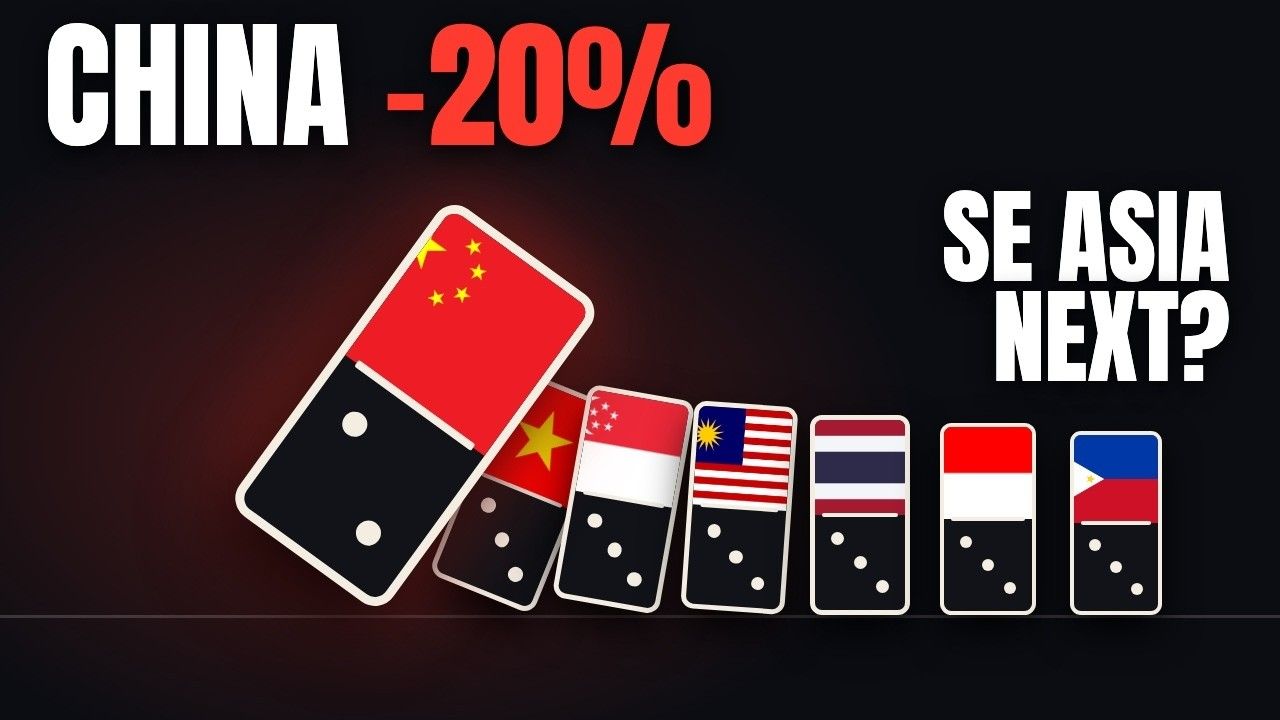
The chain reaction
From AI rally to the yuan
Domino 1
AI rally
From September 2024 to June 2026 the CSI 300 rose 60%; Shanghai's tech board, the STAR 50, rose 76% in three months to its June 30 high.
0:59 The rally that crackedDomino 2
Bear market
On October 22 the CSI 300 closed 20.2% below its June 22 high, after 11 straight weekly losses, the longest streak since the index began in 2005. The tech board is down about 42% from its peak.
0:00 China, a fifth downDomino 3
Shoppers
China grew 4.5% in the third quarter and its September exports rose 29.6%, but retail sales rose just 1.1%, car sales fell 21.2% and property investment is down 20.6% this year.
0:59 The rally that crackedDomino 4
Your market
On China's 25 worst days since 2014, Southeast Asia's markets fell only 0.5–1.5% on average. Since China's June high, Singapore's market is up about 4% and Thailand's is flat.
3:00 Your market barely noticedDomino 5
Four links
Trade, dependence, tourists and the yuan: the most exposed is Vietnam (sales to China ≈14% of GDP; one visitor in four is Chinese), then Singapore. The least exposed is the Philippines.
4:13 Four links to ChinaDomino 6
The yuan
In August 2015, China devalued the yuan mid-crash and the ringgit lost about 6% in three weeks. This time the yuan is up almost 5% against the dollar this year.
6:13 The domino to watch: the yuan
The story
What this episode explains
On Thursday, October 22, 2026, China's main stock index, the CSI 300, closed 20% below its June high: a bear market, after 11 losing weeks in a row, the longest streak since the index began. China's tech board, home of its AI stocks, is down about 40%. So which Southeast Asian economy will China's crash hurt most?
The first surprise is in our data: on the day China entered a bear market, the stock markets of Jakarta, Kuala Lumpur, Bangkok and Ho Chi Minh City closed higher, and on China's 25 worst days since 2014, Southeast Asia's markets fell only 0.5–1.5% on average. The chain runs another way: through Chinese shoppers, tourists and factories, and through the yuan. So we ranked Malaysia, Singapore, Indonesia, Thailand, Vietnam and the Philippines on four links to China (trade, dependence on China as a buyer, Chinese tourists, and how closely each currency moves with the yuan), recalled what happened in August 2015, and followed it to tourism jobs, nickel, factories and prices.
- −20%
- China's CSI 300 from its June 22 high at the October 22 close: a bear market
- −0.5%
- Kuala Lumpur's average move on China's 25 worst stock-market days since 2014 (Singapore −1.2%, Jakarta −0.7%)
- ≈14%
- Vietnam's sales to China as a share of its economy, the highest of the six (2025)
Read it instead
The full transcript
Read all 10 chapters
0:00China, a fifth down
On Thursday, October 22, China's main stock index closed 20% below its June high. A bear market. By Friday, it had fallen 11 weeks in a row, its longest losing streak ever. And China's tech board, home of its AI stocks, has lost more than 40% since June.
So which Southeast Asian economy will China's crash hit hardest? We measured all six, four different ways.
This is Dominomics. We follow the chain reaction all the way to your money.
0:31The first surprise
And here's the first surprise. That same Thursday, as China fell, the stock markets in Jakarta, Kuala Lumpur, Bangkok and Ho Chi Minh City all closed higher.
Since China's peak in June, Singapore's market is up about 4%, and Thailand's has barely moved. So far, the danger isn't in your stock market. It travels another way, through Chinese shoppers, tourists, and factories, and through the yuan. But first, why is China falling?
0:59The rally that cracked
It began with a rally. In September 2024, Beijing launched a burst of stimulus, and China's market rose by a third in three weeks. Then investors piled into AI. By June 2026, the main index was 60% above where it started.
The fastest climbers were China's tech stocks. Shanghai's tech board, where its chip and AI makers trade, rose 76% in three months, to a peak on June 30. Even today, according to Goldman Sachs, AI stocks make up 42% of the value of China's and Hong Kong's stock markets and 57% of all trading.
Then it cracked. In one week in July, the tech board fell 17%, and through the autumn, a global sell -off in AI stocks spread one doubt. Will all this spending on AI ever pay for itself?
Since that peak, the tech board has lost 42%. And it's now below where it started the year. Korea's market, Asia's other big bet on AI chips, peaked on the same day as China's main index, and has fallen by a third.
Under the AI story is a simpler one. Chinese shoppers aren't spending. China's economy is still growing about 4.5% and its exports jumped almost 30% in September. But retail sales rose just 1%, car sales fell by a fifth, and investment in property is down by a fifth this year.
Company profits are disappointing too, squeezed by price wars. And Beijing has offered small doses of stimulus, not the big package investors hoped for. So the state seems to have stepped in. In the week to October the 23rd, almost 130 billion yuan, about 19 billion dollars, poured into the stock funds that China's state-backed investors use, according to Bloomberg. That Friday, the index jumped almost 2%.
It's still about a fifth below its high. Bloomberg counts about $2.4 trillion of value lost by China's mainland stocks since May.
3:00Your market barely noticed
So does China's crash drag Southeast Asia down with it. We took China's 25 worst days since 2014 and checked what the region's markets did on the same days. Hong Kong fell almost 3% on average. Singapore about 1%. Kuala Lumpur about half a percent. And Jakarta a little more.
Over the past four months, while China's market lost a fifth, Singapore's rose and Thailand's held still. Indonesia's fell too, but mostly for reasons of its own. And we have no daily history for the Philippines market, so it's not on this chart.
It has happened before. From early 2021 to early 2024, China's market lost 45%. Over the same three years, Jakarta rose 17%, Singapore 9%, and India's market 45%. China's three-year slide didn't drag them down.
Part of the reason is that China's stock market is mostly a domestic affair. About 250 million people in China have trading accounts. And individuals make about nine-tenths of the trades, according to HSBC. When they lose, the loss mostly stays at home. But the reason they're losing doesn't.
4:13Four links to China
Chinese households are buying fewer cars and fewer homes and barely more of anything else. And what they don't spend, Southeast Asia doesn't sell. So we ranked the 6 on 4 links to China, using official trade and tourism figures for 2025.
First, trade. What each country sells to China as a share of its whole economy. Vietnam leads, at about 14%, led by computers and phones. Then Singapore, about 10%, though much of that only passes through its port. Then Malaysia at 9%, Thailand 7%, Indonesia 5%, and the Philippines 2%.
Second, dependence. Of everything a country sells abroad, How much goes to China? Here, Indonesia comes first. About one export dollar in every four comes from China, led by steel and nickel from its smelters, and coal.
Third, tourists. In Vietnam, one foreign visitor in four comes from China. In Singapore, almost one in five. In Thailand, about one in seven, down from more than one in four before the pandemic. Chinese arrivals fell from 11 million in 2019 to about 4.5 million last year.
Malaysia went the other way. With visa-free entry for Chinese visitors. It welcomed about 4.7 million last year, more than before the pandemic.
Fourth, money. We measured how closely each currency moves with the yuan, day by day over the past year. The Singapore dollar moves with it most. Then the baht and the ringgit. The peso and the rupiah less, and Vietnam's dong hardly at all. Its central bank keeps it close to the US dollar.
Put the four together and the most exposed is Vietnam. First for trade and for tourists. Then Singapore, near the top on almost every link. Then Malaysia and Thailand tied. Then Indonesia which relies on China for a quarter of its exports. And the least exposed is the Philippines.
6:13The domino to watch: the yuan
There's one link that could matter more than all four. In China's last big crash, in the summer of 2015, Beijing let the yuan fall. On August 11, it cut the currency's value overnight. The next day, the ringgit passed four to the US dollar, for the first time since 1998.
Within three weeks, the ringgit had lost about 6% against the dollar, and the rupiah 4. By the end of 2015, the ringgit had lost almost a fifth of its value, though falling oil prices and the 1MDB scandal did much of that.
This time, the yuan has gone the other way. It's up almost 5% against the dollar this year. Even as China's stocks fell. As long as Beijing holds it there, one of the fastest ways China's trouble can reach. Your money stays shut.
7:02Where it reaches you
So where does it reach you? Start with Thailand and tourism. By Thai counts, Chinese visitors spend more than 40,000 baht each per trip. Every million who don't come is more than 40 billion baht that hotels, drivers, and shops never see.
In Indonesia and the Philippines, through what the ground produces. China buys their nickel and Indonesia's coal. And nickel is near a nine-month low, below $16,000 a tonne.
In Vietnam and Malaysia, through factories. Vietnam buys 41% of all its imports from China and sells it about a seventh of its exports. Malaysia sells it electronics, metals, and palm oil products. When Chinese demand slows, those factory orders feel it.
And everywhere through prices. When Chinese households buy less, Chinese factories sell more abroad and cheaper. That's good for shoppers and hard on local factories. In the first quarter of this year, Thailand counted more factory closures than openings. For the first time in ten quarters, and its industry federation has been warning about cheap Chinese imports.
8:10Why it may not be so bad
There's another side. An IMF study in 2016 estimated that when China's growth slows by one point, growth in the big Southeast Asian economies slows by a fifth to a half of a point. A real hit, but a fraction. And this year much of the growth in Malaysia, Singapore, and Vietnam comes from somewhere else. The AI boom in their chip and electronics factories.
Singapore's central bank, in its October statement, named two big risks to growth, higher interest rates, and a sharper pullback in AI investment. China wasn't mentioned.
8:46What to watch
The next dominoes come in November. China's October spending figures arrive on November 16. Two days later, China hosts the APEC Summit of Asia-Pacific Leaders in Shenzhen. And the trade truce between America and China now runs only until January 10. Morgan Stanley warned on October 25 that Chinese shares listed in Hong Kong could fall another 10-15%.
9:12So, who's hit hardest?
So which Southeast Asian economy will China's crash hit hardest? Not through the stock market. The region's markets have barely noticed. It comes through trade and tourists. And there the most exposed is Vietnam, then Singapore. The least exposed is the Philippines. And the domino to watch is the yuan.
Tell us in the comments, where are you watching from and do you feel China's slowdown where you live?
This is Dominomics. See you at the next domino.
Sources & notes
Where the numbers come from
Sources
- China Securities Index Co. (CSI 300, STAR 50 daily closes)
- National Bureau of Statistics of China
- China Securities Depository and Clearing
- Yahoo Finance, VNDirect, Stock Exchange of Thailand (index closes)
- European Central Bank (euro reference rates)
- UN Comtrade
- Malaysia's MITI and DOSM
- Vietnam Customs and National Statistics Office
- IMF (World Economic Outlook, October 2026; Dizioli et al., Working Paper 16/170)
- Thailand's Ministry of Tourism and Sports
- Singapore Tourism Board
- Tourism Malaysia
- BPS-Statistics Indonesia
- Philippine Department of Tourism
- Monetary Authority of Singapore
- NESDC (Thailand)
- Bloomberg, Reuters, CNBC, Caixin, Goldman Sachs and Morgan Stanley (as reported)
- APEC 2026 (gov.cn)
Please note
For educational purposes only. Not financial advice. Figures as of October 28, 2026. Forecasts quoted are the named firms', not ours. Index changes are in local currency; exchange rates are ECB mid-market reference rates. "Exposure" is our ranking of four measurable links, not a forecast of growth.
Spotted a mistake?
Tell us at business@dominomicsofficial.com. Corrections are logged on our corrections page.
The next domino
Keep following the chain
Which Asian Stock Market Crashed the Most?
TrustOil ▲AI chipsForeign sellingThe tableYour money
Which Southeast Asian Economy Is Really Winning?
Oil ▲CurrenciesSize in dollarsThe tableFour tablesYour money

Who Really Paid for Grab's First Profit?
The profitThe costHanding back lessWho paidThe bill comes backWhat to watch
Don't miss the next one
Get the next chain reaction in your inbox.