Which Asian Stock Market Crashed the Most?
Same war, same AI boom. We ranked twelve of Asia's stock markets in US dollars this year, from last place to first, and followed what it means for your savings and your pension.
The chain reaction
From trust to your money
Domino 1
Trust
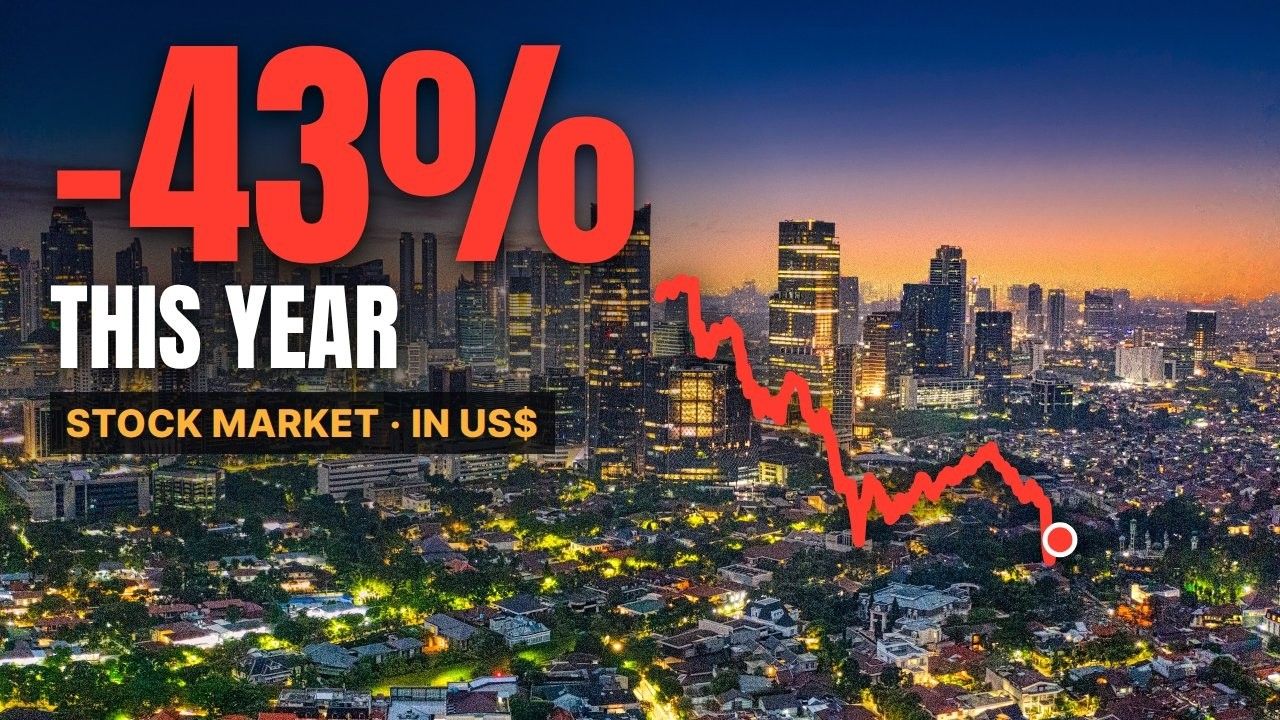
On October 15, MSCI proposed moving Indonesia out of its emerging-markets index. The next day Jakarta fell 11.6%, its steepest one-day drop since January 1998.
1:26 Last place: IndonesiaDomino 2
Oil ▲
Dear oil pushed up prices and pulled down the currency in the markets that buy it abroad. India and the Philippines sit near the bottom; Brent is still above $100 a barrel.
2:34 India and the PhilippinesDomino 3
AI chips
AI data centres need huge amounts of memory chips, and Samsung and SK hynix make most of them. By June 22, Korea's KOSPI had more than doubled. Then it fell 40%.
6:16 Korea's round tripDomino 4
Foreign selling
Foreign investors sold ₩209 trillion (≈ US$143 billion) of Korean shares and about US$68 billion of Taiwanese shares this year. Local money bought.
7:09 Number one: TaiwanDomino 5
The table
Taiwan (+53.7% in US dollars) and Korea (+41.4%) lead. Indonesia (−42.8%) is last by a long way, with India (−17.8%) and the Philippines (−14.1%) just above it.
0:39 The scoreboardDomino 6
Your money
US$1,000 put into each market on New Year is worth about US$1,537 in Taiwan and US$572 in Indonesia. Korea's National Pension Service owns more than 7% of both Samsung and SK hynix.
8:06 Where it reaches you
The story
What this episode explains
On June 22, 2026, South Korea's stock market closed at a record, more than double where it started the year. Four months later it is 40% below that peak. Indonesia's market has lost more than a third of its value this year; Taiwan's is up almost 60%.
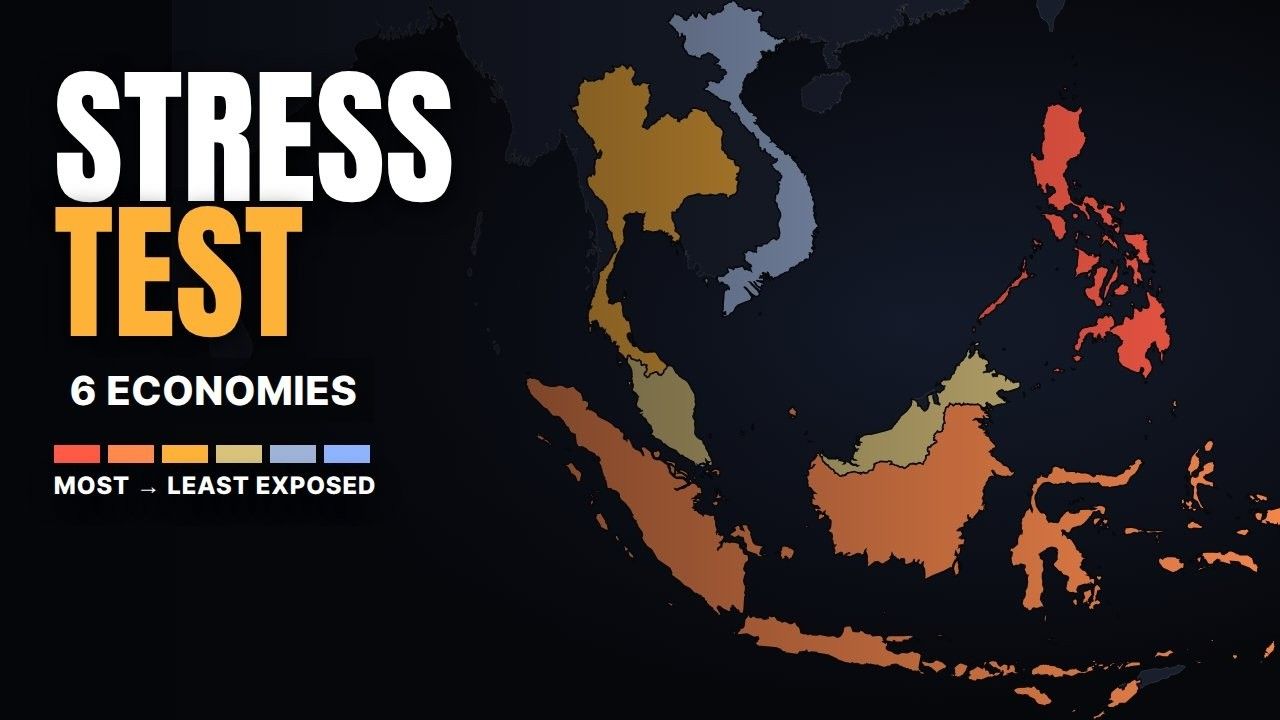
Same war, same AI boom. So which of Asia's stock markets are winning 2026 so far, which are losing, and what does it mean for your savings and your pension? We ranked twelve of them, from last place to first: each market's main index, from the last close of 2025 to October 26, 2026 (Taiwan: October 22), measured in US dollars at the ECB's reference rates, as in our ranking of Asia's currencies (Taiwan dollar at Taipei's interbank close, dong at the market rate). Our own analyses: the league table in US$ and in local money; Korea's round trip (+116% to June, −40% since, still second for the year); the change since the war began; what US$1,000 put in on New Year is worth in each market; foreign selling against local buying.
- +53.7%
- Taiwan's TAIEX in US dollars this year, first of twelve (+59.0% in Taiwan dollars, to October 22)
- −40%
- Korea's KOSPI since its June 22 record; it is still second for the year
- −42.8%
- Indonesia's Jakarta Composite in US dollars, last of twelve
Read it instead
The full transcript
Read all 11 chapters
0:00Same war, same AI boom
On June 22, South Korea's stock market closed at a record, more than double where it began the year. It's now 40% lower.
Indonesia's market has lost more than a third of its value this year. Taiwan's is up almost 60%.
Same war. Same AI boom. So which of Asia's stock markets are winning 2026? Which are losing? And what does it mean for your savings and your pension? We ranked 12 of them, from last place to first.
This is Dominomics. We take one big story and follow its chain reaction all the way to your money.
0:39The scoreboard
Here's the scoreboard. Each market's main index, the one its own news reports, from the last trading day of 2025 to Monday. October the 26th. Taiwan's stops on the 22nd. Its market closed for a typhoon, then for a holiday.
We measured them in US dollars, the way an investor from abroad sees them, using the European Central Bank's official rates as we did for Asia's currencies. The Taiwan dollar and the dong use their own market rates. A falling currency can shrink a gain or deepen a loss. In each country's own money, the top two and the bottom two stay the same, though a few in between swap places.
Three forces split this table. The boom in AI chips, the price of oil, and how much investors trust each market. But start at the bottom.
1:26Last place: Indonesia
Last place by a long way. Indonesia. The Jakarta Composite is down 38% this year and 43 in US dollars. A thousand dollars put in on New Year is worth about 570 now.
It began in January. The index company MSCI froze Indonesia's place in its indexes, worried about how few shares are really for sale and about suspected coordinated trading. The market fell 7% in a day. Trading was halted two days running and the head of the stock exchange resigned.
Then, on October the 15th, MSCI proposed moving Indonesia out of its Emerging Markets Index altogether into a group of its own. The next day, Jakarta fell 11.6%, its steepest one-day drop since January 1998. On October the 19th it closed below 5,000 for the first time in six years.
Foreign investors have sold about $4.9 billion of Indonesian shares this year, on track for the biggest outflow in at least 16 years. President Prabowo answered MSCI directly. The Indonesian nation fears no one and will not be cowed.
2:34India and the Philippines
Number 11. India. The Nifty 50 is down 13% and almost 18 in US dollars because the rupee fell too. Its peak came almost at once. The Nifty's record close was on January 2nd, the second trading day of the year.
Foreign investors pulled out more than 3 lakh crore rupees, over 30 billion dollars by mid-October. Already a record. Almost twice what they took out in all of 2025. American 10-year bonds paid more than 5%. The most since 2002, oil kept India's import bill high. And the rupee came close to its record low.
But Indians kept buying. In September, they put a record 32,490 crore rupees, about $3.4 billion, into mutual funds through monthly investment plans, while the market fell.
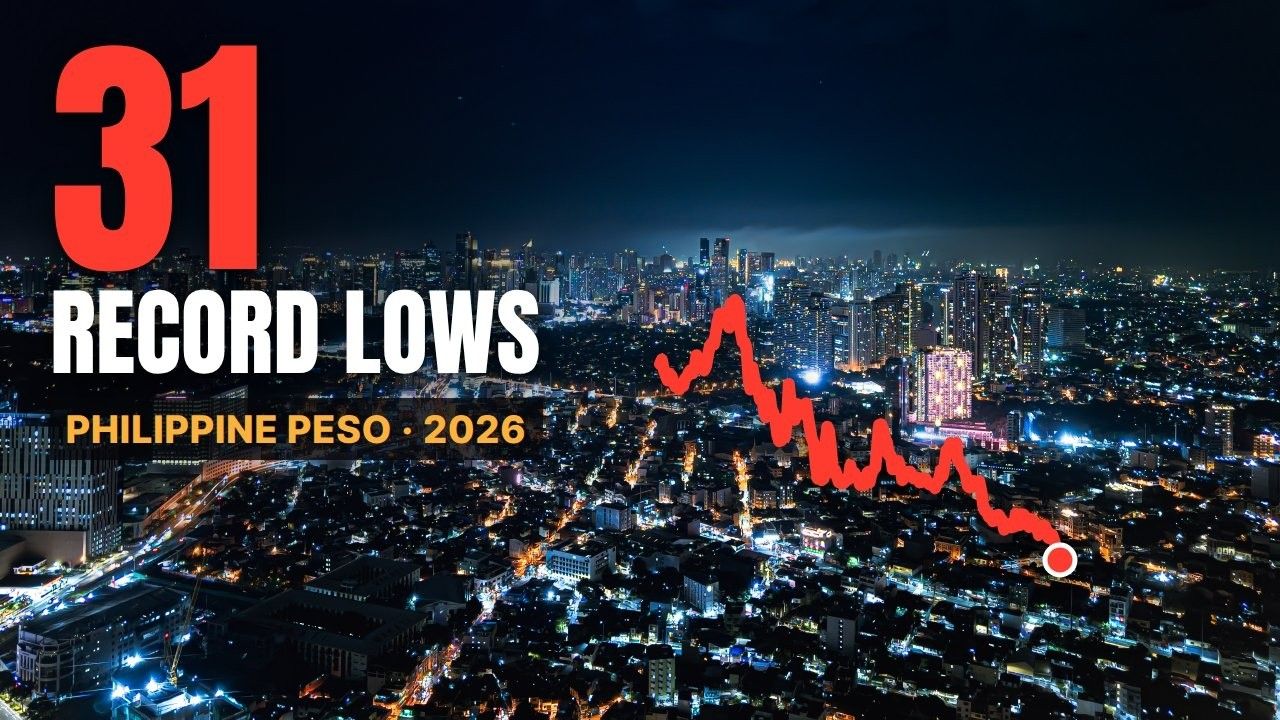
Number 10. The Philippines. The PSEI is down almost 7% in pesos, but the peso's own fall doubles that to 14 in US dollars. On October 8, it closed at its lowest in almost a year, with prices rising 7.2% a year and the economy growing just 2.3% in the second quarter.
Even the biggest stock market debut in the country's history didn't turn it around. On October the 20th, the company behind the GCash app listed after raising 60.9 billion pesos and closed its first day flat.
3:59The middle of the table
Now the middle of the table. Number 9. Hong Kong. Down 10%. Its biggest technology companies have fallen by about a third this year as investors started asking when all the spending on AI will pay off.
Number 8. Malaysia down 5. On October the 19th, the KLCI closed below 1,600 for the first time this year, a week after Genting fell 23% in a single day when it asked shareholders for more money.
Number 7. China, down 7% in yuan, but only 2 in US dollars, because the yuan rose.
On October 22, China's main index of big companies fell into a bear market, 20% below its June high. The next day, trading jumped in funds favoured by China's state investors, fuelling talk that Beijing was buying.
Number 6. Vietnam roughly flat in September. Vietnam's upgrade to an emerging market by the index company FTSE Russell took effect. Foreign investors sold anyway, about $4.6 billion this year.
5:05The top five
Now the top 5 and 4th and 5th place are a photo finish. Number 5, Singapore, up 17%. Its index hit a record on September 4th, carried mostly by its three big banks. Then, in two days in early October, it lost 5%. As American bond yields hit their highest since 2002 and investors took profits.
Number 4, by a whisker, is Thailand. Up 25% in baht. The most of any market in Southeast Asia. Though the baht's fall brings that down to 17.5 in US dollars.
Thailand has one of the slowest-growing economies in the region, and its market rose anyway, helped by February's election. Its star is Delta Electronics, which makes power equipment for data centres. By June, its shares had more than doubled. They are still up almost 40% this year, and it is by far Thailand's most valuable company.
Number 3 is Japan. Up 23% after the Nikkei hit a record on June 25th, as chip stocks boomed and America and Iran agreed to end the fighting. It is 14% below that record now.
6:16Korea's round trip
Number 2. South Korea up 30% in won and 41 in US dollars because the won rose too. But that number hides the wildest ride of the year.
AI data centres need huge amounts of memory chips, and two Korean companies, Samsung and SK hynix, make most of them. By June the 22nd, the KOSPI had more than doubled. Then it fell 40%.
On October the 15th, trading in Seoul was halted for 20 minutes as the index fell almost 8% in a day. SK hynix's shares are down more than half from their June peak, and foreign investors have sold 209 trillion won of Korean shares this year, about $143 billion.
Here's the strange part. Korean TV called it the world's worst market this October. It is still second on our table this year.
7:09Number one: Taiwan
And number one. Taiwan. Up 59% in Taiwan dollars and 54 in US dollars. Its index hit a record on October the 6th and it is only 8% below it.
No company did more of the lifting than TSMC, which makes most of the world's advanced AI chips. It is up 54% this year, and that alone accounts for about two-fifths of the index's gain. Foreign investors sold Taiwanese shares too about $68 billion worth. Local money bought, and TSMC kept reporting record profits.
Line the table up, and it echoes the pattern we found in Asia's currencies.
Near the top, the markets that make AI chips and the machines that make them, where local investors kept buying while foreigners sold.
At the bottom, economies where dear oil pushed up prices and pulled down the currency. And one market, Indonesia, that lost investors' trust.
8:06Where it reaches you
So where does it reach you? Start with your pension. Malaysia's EPF has almost half of its money in shares, though most of this year's gains came from markets abroad. In the Philippines, state auditors found almost 40 billion pesos of paper losses on the SSS pension fund's shares at the end of 2025.
Korea's national pension service owns more than 7% of both Samsung and SK hynix. Between June and mid-October, the value of its stakes of 5% or more in Korean companies fell by an estimated 182 trillion won on paper.
In India, the retirement fund EPFO invests in the Nifty and the Sensex. The two indexes that fell, Singapore's CPF savings are lent to the government, and their interest is guaranteed. So the market's swings don't touch them. Unless members invest their savings themselves.
And millions of new investors have joined this year. In Indonesia, the number of investors grew from about 20 million to 31 million as the market fell. Vietnam now has almost 14 million trading accounts.
And a thousand US dollars put into each market on New Year. About 1,500 today in Taiwan. 1,400 in Korea. Almost 1,200 in Thailand or Singapore. About 950 in Malaysia. 860 in the Philippines. 820 in India. And 570 in Indonesia.
9:34Why it might turn
None of this is fixed. And Korea showed how fast a market built on one boom can turn. The top of this table rests on AI chips and chip stocks around the world have been falling this month.
The next dominoes are close. On October the 28th, America's central bank decides on interest rates, and Samsung and SK hynix report their results that week. MSCI's next review of its indexes comes in November, and its decision on Indonesia by June the 30th next year. And behind all of it is oil, still above $100 a barrel.
10:08So who's winning 2026?
So who's winning 2026 so far? Taiwan and Korea on the AI chip boom, then Japan in Southeast Asia, Thailand and Singapore, neck and neck.
Indonesia is losing by a long way, followed by India and the Philippines.
Same war. Same AI boom. What split them, mostly, was who makes the chips, who was hit hardest by dear oil, and how much the world trusts the market.
Tell us in the comments, where are you watching from and is your money in your own country's stock market?
This is Dominomics. See you at the next Domino.
Sources & notes
Where the numbers come from
Sources
- Bank of Korea (ECOS) and Korea Exchange
- Taiwan Stock Exchange
- Nikkei Inc.
- China Securities Index Co.
- Singapore Exchange
- Stock Exchange of Thailand
- Philippine Stock Exchange
- Indonesia Stock Exchange and OJK
- Bursa Malaysia
- Ho Chi Minh City Stock Exchange (via VNDirect)
- NSE/BSE and India's Ministry of Finance (DIPAM)
- NSDL
- AMFI
- ECB euro reference rates
- Federal Reserve (H.15 via FRED)
- MSCI
- FTSE Russell
- Philippine Statistics Authority
- Commission on Audit (Philippines)
- EPF Malaysia
- CPF Board
- KSEI
- VSDC
- FnGuide (via Hankyung, Newspim)
- Reuters
- Bloomberg
- The Star, Bernama
- Kontan
- JoongAng, SBS, Korea Herald
- GMA, Philstar
- VnEconomy
Please note
For educational purposes only. Not financial advice. Figures as of October 26, 2026 (Taiwan: October 22; its market was closed on October 23 for a typhoon and on October 26 for a holiday). Index changes are price changes (no dividends) in US dollars at ECB reference rates (Taiwan dollar at the Taipei interbank close, dong at the market rate); in local money they differ. Markets can move quickly; rankings change with the date.
Spotted a mistake?
Tell us at business@dominomicsofficial.com. Corrections are logged on our corrections page.
Images, footage and data credits
Charts by Dominomics from the sources above. Photos and footage (cropped, resized, graded; free licences):
- Narubaru7 / CC BY 4.0 (Korea Exchange, Yeouido, 2025)
- 4300streetcar / CC BY 4.0 (Taipei 101, 2026; TSMC Fab 18, Tainan, 2025; TSMC Fab 14B, Tainan, 2025; SK hynix DDR5 Module, Computex, 2025)
- Achabonn / CC BY 4.0 (Xinyi, Taipei, 2024)
- Raimond Spekking / CC BY-SA 4.0 (SK hynix Memory Chips on a Module, 2024)
- Ajay Suresh (Flickr 55314069699) / CC BY 4.0 (MSCI HQ (7 World Trade Center), New York, 2026)
- BSEINDIA / CC BY-SA 3.0 (BSE (Phiroze Jeejeebhoy Towers), Dalal Street, Mumbai, 2013)
- Sailko / CC BY 3.0 (Reserve Bank of India, Mumbai, 2019)
- Ralff Nestor Nacor / CC BY-SA 4.0 (Philippine Stock Exchange Tower, BGC, Taguig, 2023)
- 钉钉 / CC BY-SA 4.0 (Shanghai Stock Exchange Building, Pudong, 2022)
- Diego Delso / CC BY-SA 4.0 (Raffles Place, Singapore, 2023)
- Mrb Rafi / CC BY-SA 4.0 (MAS Building, Singapore, 2023)
- Sry85 / CC BY-SA 4.0 (Stock Exchange of Thailand, Bangkok, 2019)
- Lombroso / CC BY-SA 4.0 (Tokyo Stock Exchange, Kabutocho, Tokyo, 2019)
- S h y numis / CC BY 4.0 (Yeouido, Seoul, 2024)
- Seoul Tourism Organization (Seoul Tourism Archive) / KOGL Type 1 (Downtown Seoul from Inwangsan, 2023)
- patrickroque01 / CC BY-SA 4.0 (Social Security System, East Avenue, Quezon City, 2021)
- KirtiKakad / CC BY-SA 4.0 (NSE Exchange Plaza, Bandra Kurla Complex, Mumbai, 2018)
- Pexels licence: Alex Grant, Esteban M, Tima Miroshnichenko, Johan PamZ, aksinfo7 universe, LayG Traveller, Mohammed Alim, Paul Bill, Pew Nguyen, Timo Volz, Khan ishaan, Micah Watson
- Unsplash licence: Ruben Sukatendel
- CC0: Pixtuqq, YaEeBondZ 002, Travelpleb, Syced, Pimnl, Wiki Farazi
- Public domain: U.S. Embassy Jakarta, Indonesia, Ministry of State Secretariat of the Republic of Indonesia, The White House
The next domino
Keep following the chain
Don't miss the next one
Get the next chain reaction in your inbox.