Is Indonesia Heading for Another 1998?
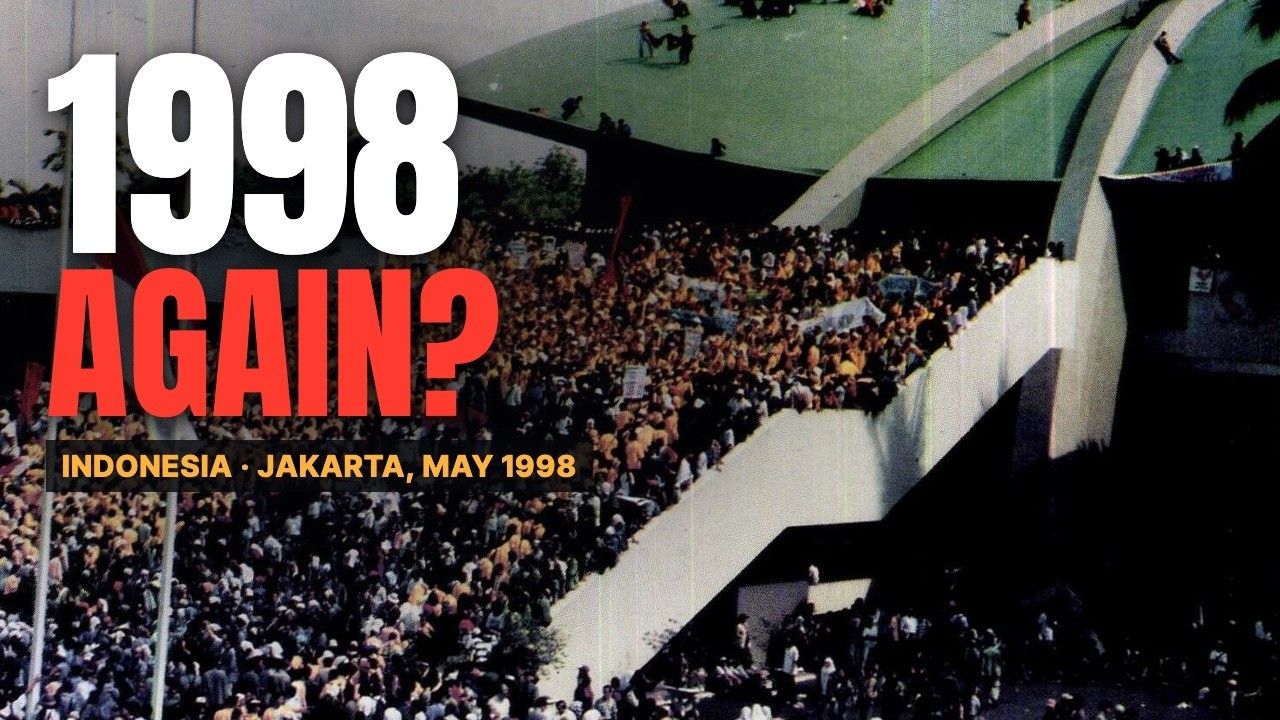
On October 28, 2026, Indonesia's rupiah fell to its weakest ever on Bank Indonesia's reference rate, Rp18,183 to the US dollar (weaker in number than in 1998), as stocks, bonds and the currency were all sold at once. We checked ten of the numbers that broke Indonesia in 1997–98 against today, and followed the fallout to its neighbours.
The chain reaction
From sold three ways to the neighbours
Domino 1
Sold three ways
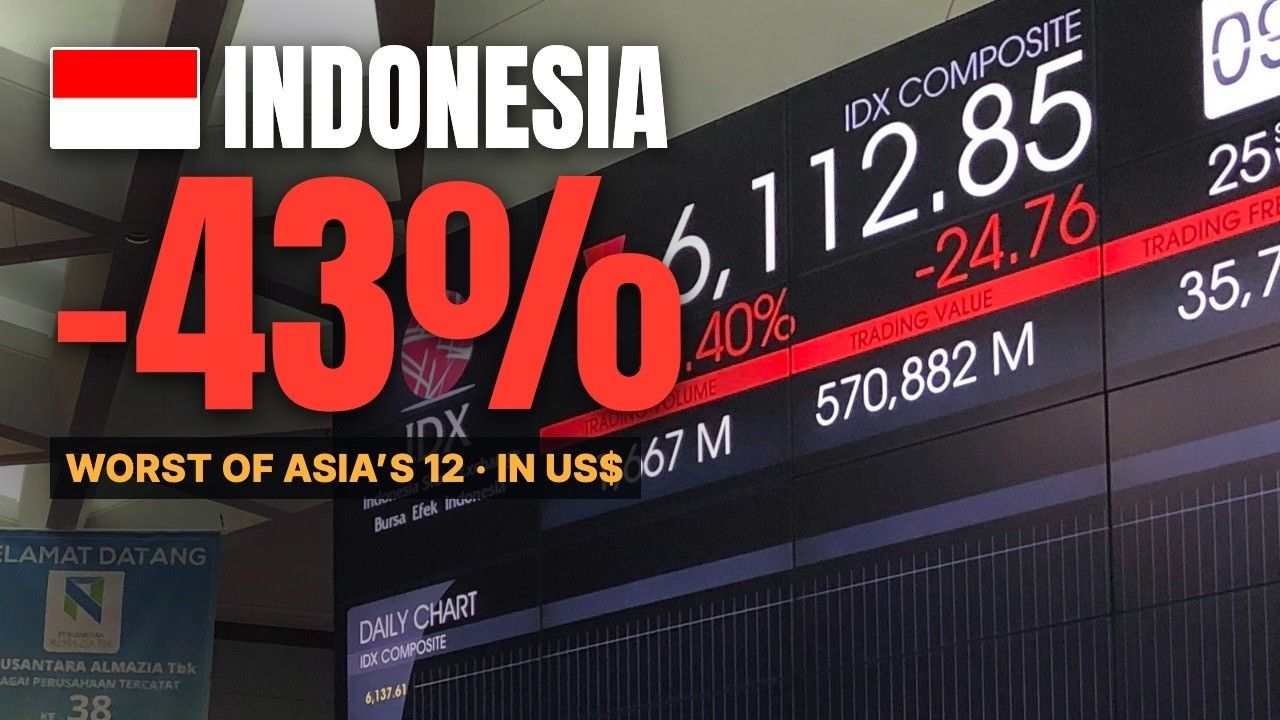
Jakarta’s stock market fell 11.6% on October 16, its worst day since 1998, and is down about 45% from its January peak. Foreigners have sold a net Rp98 trillion (≈ US$5.4 billion) of shares this year; bids at the October 27 bond auction halved.
0:37 Sold three waysDomino 2
1998
In less than a year the rupiah went from about 2,430 to the dollar to 16,800 for a moment in June 1998, losing 85% of its value. Interest rates hit 70%, prices rose 82% in a year and the economy shrank 13%.
1:59 1998: what happenedDomino 3
A different fall
In today’s prices, the rupiah’s worst days of 1998 would be more than Rp40,000 to the dollar. This year it has lost about 8%. On the BIS real measure it is at its weakest since 2005, but still worth more than twice its 1998 low.
3:38 Same number, a different fallDomino 4
The checklist
Of ten 1998 warning signs, eight are nowhere near: short-term foreign debt, dollar reserves (US$18 billion then, US$146 billion now), the currency rule, inflation, interest rates, bad loans, growth and government debt. Two are flashing: the stock market and foreign money leaving.
4:57 Our 1998 checklistDomino 5
What’s different
The budget deficit is expected at 2.85% of GDP against a 3% legal cap; a June change to the central bank law and the governor’s early exit raised questions about its independence; MSCI is asking whether Indonesia’s share prices can be trusted.
6:50 What's different this timeDomino 6
The neighbours
On Indonesia’s ten worst days of 2026, Kuala Lumpur fell about half a percent on average and Singapore and India about a third of one. The links run through banks (CIMB Niaga is about 22% of CIMB’s profit), Singapore’s investment, gas and remittances.
8:37 Does it spread?
The story
What this episode explains
On 28 October 2026, Indonesia's rupiah fell to its weakest ever: Rp18,183 to the US dollar on Bank Indonesia's own reference rate, weaker in number than on the worst day of 1998. Jakarta's stock market has lost about 45% since January, and now government bonds are being sold too. So is Indonesia heading for another 1998? We checked ten of the numbers that broke it then, and followed the fallout to its neighbours.
What we found: in today's prices, the rupiah's worst days of 1998 would be more than Rp40,000 to the dollar, and in 1998 it lost 85% of its value in less than a year (this year: about 8%). Eight of our ten 1998 warning signs are nowhere near: short-term foreign debt, dollar reserves, the currency rule, inflation, interest rates, bad bank loans, growth and government debt. Two are flashing: the stock market and foreign money leaving. They point at dominoes 1998 never had: a stretched budget, a central bank closer to the government, and a market investors don't trust. On Indonesia's ten worst days of 2026, Kuala Lumpur, Singapore and India barely moved.
- Rp18,183
- The rupiah per US dollar on Bank Indonesia’s reference rate on October 28, 2026: its weakest ever
- 8 of 10
- Of our ten 1998 warning signs, the number that are nowhere near 1998 levels today
- −85% vs −8%
- How much of its value the rupiah lost in 1997–98, against 2026 so far
Read it instead
The full transcript
Read all 11 chapters
0:00The rupiah's record low
On October 28, the rupiah fell to its weakest ever: 18,183 to the US dollar, on Bank Indonesia's own reference rate. That's weaker, in number, than on the worst day of 1998. Jakarta's stock market has lost about 45% since its peak in January. And now the government's bonds are being sold too.
So is Indonesia heading for another 1998? We checked ten of the numbers that broke it then, and followed the fallout to its neighbours.
This is Dominomics. We follow the chain reaction all the way to your money.
0:37Sold three ways
It started with the stock market. On October the 15th, MSCI, the company whose indexes steer trillions of dollars around the world, proposed taking Indonesia out of its emerging markets and putting it in a small group it calls standalone. The next day, Jakarta's main index fell 11.5%, its worst day since 1998.
This year, foreign investors have sold about 98 trillion rupiah, more Indonesian shares than they bought. More than 5 billion dollars. On Thursday, October the 29th, the market fell another 3.5 percent, and the shares foreigners sold most were the country's biggest banks.
Then the bonds. On Tuesday, October the 27th, the government offered 30 trillion rupiah of new bonds. Investors bid for about 31 trillion, half as much as two weeks before, and the government sold less than 21. Its 10-year borrowing cost has climbed past 7.5%, the highest in about four years.
And the rupiah. It passed 17,000 to the dollar in March, 18,000 in June. And on October the 28th, it hit a record low on Bank Indonesia's reference rate. Bank Indonesia says it will keep stepping in to steady it.
When a country's stocks, bonds and currency are all sold at once, money is leaving. Indonesians have a name for the last time it left like this. Krismon. The monetary crisis of 1998.
1:591998: what happened
It started next door. On July 2, 1997, Thailand stopped defending the baht. And money ran from every economy that looked like it. In June, the rupiah had been about 2,430 to the dollar. In August, Indonesia let it float.
Then it fell and kept falling. By late January 1998, it was past 14,000. In June for a moment, it touched 16,800. In less than a year, the rupiah lost about 85% of its value.
That fall broke everything it touched. Indonesian companies had borrowed heavily in dollars, much of it short-term and unprotected, and their debts multiplied in rupiah. Sixteen banks were closed in November 1997. By 1999 more than sixty private banks had gone. By the end of 1998 nearly half of all bank loans had gone bad.
Interest rates went to 70%. Prices rose 82% in a year. In 1998, the economy shrank by 13% and millions of people fell back into poverty.
In January 1998, President Suharto signed a tougher rescue deal with the International Monetary Fund. In May, under that deal, the price of petrol went up by 71%. Students protested, and on May 12, four were shot dead at Trisakti University in Jakarta. Riots followed. More than a thousand people died, and Chinese Indonesians, their homes and their shops, were the main targets.
On May 21, 1998, Suharto resigned after more than 30 years in power.
3:38Same number, a different fall
So is today's rupiah worse than 1998's? In number, yes. But a rupiah buys far less than it did then. Since 1998, prices in Indonesia have risen about five times over, and in America, about two. Carried into today's prices, the rupiah's worst days in 1998 would be more than 40,000 to the dollar.
And how fast it falls matters more than where it lands. In 1998, the rupiah lost 85% of its value in less than a year. This year, it has lost about 8%. That's not nothing. On the measure kept by the Bank for International Settlements, against all of Indonesia's trading partners and adjusted for prices, the rupiah is at its weakest since 2005. But on that measure, it's still worth more than twice what it was at its 1998 low.
It isn't even alone. This year the Philippine peso has fallen almost as far as the rupiah, and the Thai baht and the Indian rupee, not much less. Expensive oil and a firmer dollar squeeze the countries that import their energy.
But one number does look like 1997. From July 1997 to September 1998, Jakarta's stock market fell 65%. This time, since its peak in January, it's down 45%.
4:57Our 1998 checklist
A falling currency doesn't break a country on its own. What broke Indonesia was what the fall did to its debts, its banks, and its prices. So we made a checklist. Ten numbers that went wrong in 1997 and 1998, then and now.
1. Short-term debt. At the end of 1996, foreign banks' short -term loans to Indonesia were about 1.8 times its dollar reserves. Now, they're less than a third. Two: the reserves themselves. About 18 billion dollars then. 146 billion now, enough for more than five months of imports.
3. The Currency Rule. In 1997 Bank Indonesia held the rupiah inside a band and spent reserves defending it until it gave up in August. Now the rupiah floats. 4. Inflation. 82% at the peak in 1998. 3.3% now.
Five: interest rates. Seventy percent then. Five point seven five percent now. Six. The banks. Nearly half of all loans went bad in 1998. Today, about two percent are bad, and the banks hold far more capital.
7. Growth. The economy shrank 13% in 1998. This year, Bank Indonesia expects about 5% growth. 8. Government debt. Before the crisis, about 27% of the economy. The rupiah's collapse and the bank rescue pushed it to 96. Now it's about 42. And the law caps it at 60.
9. The stock market. Down by almost half. And 10. Foreign money leaving its shares and investors turning cold on its bonds.
So eight of our ten are nowhere near 1998. Two are flashing red and both are about the same thing. Trust.
6:50What's different this time
That's because this time, the dominoes are different. The first is the budget. The government holds down the price of petrol, and this year oil has cost far more than the $70 a barrel it planned for. By September, its subsidies and compensation payments, mostly for fuel and power, had reached 377 trillion rupiah, up more than half on a year earlier.
By law, the budget deficit can't pass 3% of the economy. The government now expects 2.85. That's under the line. But close, and two of the three big rating agencies have turned their outlook for Indonesia negative. In September, Prabowo named his third finance minister in less than two years.
The second is the central bank. After 1998, Indonesia made Bank Indonesia independent, so that no government could simply print money to pay its bills. In June this year, a change to the law gave parliament the job of judging the bank's performance, and widened its mission to do more for growth and jobs. In July, its governor, Perry Warjiyo, resigned almost two years early. His deputy, Destry Damayanti, took charge. And in September, as Prabowo's only nominee, she became governor.
The third is trust in the market itself. MSCI's complaint isn't about the economy. It's about whether Indonesia's share prices can be trusted, when so many big companies are held by so few hands. Its final decision is due by the end of June 2027.
None of these was the main reason Indonesia broke in 1998. Together, they help explain why investors now want 7.5% or more to lend to its government. As one Jakarta economist put it, the rise reflects Indonesia's own risk more than anything happening abroad.
8:37Does it spread?
In 1997, the crisis jumped borders. The baht lost more than half its value. The ringgit almost half. The peso more than 40%. Kuala Lumpur's stock market fell almost 80%.
So we tested this year. On Indonesia's 10 worst days of 2026. When Jakarta fell about 5% on average, Kuala Lumpur fell half a percent and Singapore and India about a third of one. Their currencies barely moved. And on October the 16th, when Jakarta lost 11.5%, Singapore's and India's markets closed higher.
So far, Indonesia's fall is staying in Indonesia. But it still reaches its neighbours in other ways.
9:20Where it reaches you
In Malaysia, through the banks. CIMB makes about a fifth of its profit through CIMB Niaga, its Indonesian bank, whose profit fell 15% in the first nine months of this year. Maybank and Singapore's OCBC own Indonesian banks too, but they count for far less of their profit.
In Singapore, through investment and energy. More foreign investment reaches Indonesia from Singapore than from anywhere else. More than $17 billion last year, about 30% of the total. And on October the 24th, during a row over the haze, Indonesia cut part of its gas exports to Singapore, saying it needed the gas at home. Singapore's energy regulator says that's less than 2% of the gas the country uses.
For some, the weaker rupiah works the other way. A ringgit or a Singapore dollar now buys about 9% more rupiah than in January, which makes Bali and Batam cheaper. And Indonesians working in Malaysia, who sent home almost $5 billion last year, more than from any other country, now get more rupiah for every ringgit.
And in the Philippines and India. Indonesia is a warning more than a domino. The same oil bill and a firmer dollar are pushing down the peso and the rupee too.
10:34Why it might hold
There are good reasons this may not become 1998. Indonesia's reserves are eight times what they were. Foreigners own only about 13% of its government bonds, down from about 40% a decade ago. So far less money is left that can suddenly run. And Bank Indonesia still has room to raise interest rates. About half the economists surveyed before its October meeting expected it to.
11:00What to watch
Dates to watch. Monday, November 2nd. Indonesia's October inflation. Later that week: its growth figures for the third quarter. November the 17th and 18th: Bank Indonesia's next meeting. And the 31st of December: the end of the promise not to raise subsidised fuel prices this year.
11:20So, is it 1998 again?
So is Indonesia heading for another 1998. On the numbers that broke it then, no, not the debts, not the banks, not the reserves, not prices. Eight of our ten are nowhere close. But the two that are flashing point at different dominoes: a stretched budget, questions about the central bank's independence, and a market investors don't trust. 1998 was a crisis of debt. This time, the danger is trust.
Tell us in the comments: where are you watching from? And has the Rupiah's fall reached you?
This is Dominomics. See you at the next domino.
Sources & notes
Where the numbers come from
Sources
- Bank Indonesia (JISDOR, BI-Rate, reserves)
- Ministry of Finance of Indonesia (APBN KiTa)
- DJPPR
- Indonesia Stock Exchange
- MSCI
- BPS
- OJK
- IMF (Independent Evaluation Office 2003, World Economic Outlook Oct 2026, Historical Public Debt Database)
- World Bank WDI
- BIS (daily and real effective exchange rates)
- OECD Main Economic Indicators
- ECB reference rates
- Radelet & Sachs (1998)
- Fane & McLeod (2001)
- TGPF (1998)
- Energy Market Authority (Singapore)
- BKPM
- The Edge Malaysia
- OCBC
- Kontan
- The Jakarta Post
- Reuters
- Bloomberg
- Yahoo Finance (index closes)
Please note
For educational purposes only. Not financial advice. Figures as of October 30, 2026. Analysts' forecasts are theirs, not ours. "In today's prices" carries 1998's rupiah rates forward with Indonesian and US consumer prices (OECD MEI, BLS); the checklist and the contagion test are our own analysis of the sources above.
Spotted a mistake?
Tell us at business@dominomicsofficial.com. Corrections are logged on our corrections page.
The next domino
Keep following the chain
Which Southeast Asian Economy Will China's Crash Hurt Most?
AI rallyBear marketShoppersYour marketFour linksThe yuan
Which Asian Stock Market Crashed the Most?
TrustOil ▲AI chipsForeign sellingThe tableYour money

Who Really Paid for Grab's First Profit?
The profitThe costHanding back lessWho paidThe bill comes backWhat to watch
Don't miss the next one
Get the next chain reaction in your inbox.