Is the Philippines Heading for a Crisis?
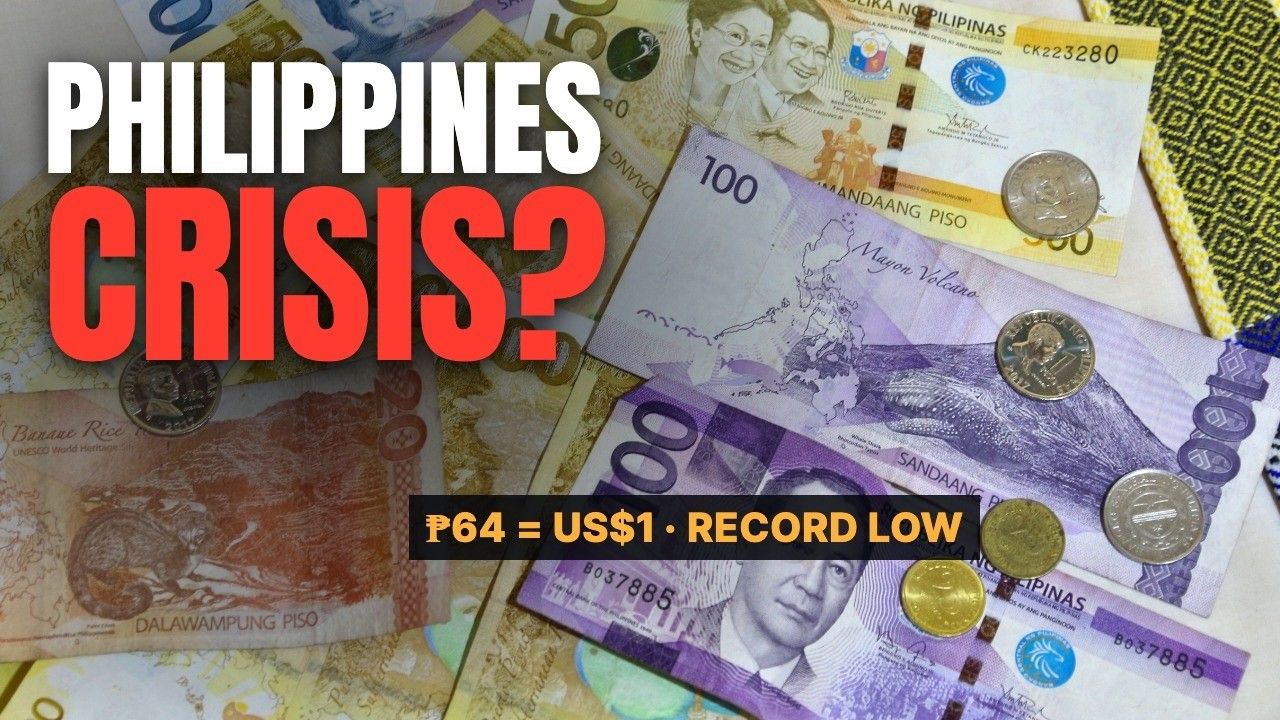
Since New Year, a barrel of oil has cost about 85% more in Philippine pesos, and almost as much more in rupiah and baht. Yet Philippine prices were rising 7.2% a year in September, more than twice as fast as Indonesia's or Thailand's, and on October 27, 2026 the peso closed at its weakest ever, ₱64.17 to the US dollar. We followed the chain reaction from the Gulf to the rice pot, and checked it against 1983 and 1997.
The chain reaction
From the chain to the checklist
Domino 1
The chain
Diesel in Manila went from about ₱55 a litre (≈ US$0.95) before the war to more than ₱150 in April, and is still about ₱93 (≈ US$1.46). Rice is up about 19% in a year, the peso has lost about 9% of its value since the war began, and the central bank has raised rates four times in a row, to 5.5%.
0:36 The chain, domino by dominoDomino 2
The 7.2%
Our breakdown of September’s inflation from the official price index: rice alone added about 1.4 points, a fifth of the total; food, fuel, power and fares together, more than two-thirds.
3:00 What makes up the 7.2%Domino 3
Same war, different bill
Malaysia still sells subsidised RON95 at RM1.99 a litre (≈ US$0.49), Indonesia froze its most popular petrol, Thailand’s oil fund is more than 100 billion baht in the red and Vietnam cut its main fuel taxes to zero. In the Philippines, apart from small payouts, nobody stands between the world price and the pump.
3:52 Same war, different billDomino 4
1983 and 1997
In 1983 the peso was devalued from about 10 to 14 to the dollar, the country stopped repaying the principal on its foreign debts and the central bank had overstated its reserves; prices rose 63% in a year. In 1997–98 the peso fell from 26 to 45, but the economy shrank only half a percent.
5:39 Is it 1983?Domino 5
In today’s money
Carried into today’s prices, the peso’s worst weeks of 1983, 1998 and 2004 were all past ₱70 to the dollar; on the BIS real measure it is back where it was in 2019.
6:59 A record in number, not in valueDomino 6
The checklist
Of ten warning signs from 1983 and 1997, six are nowhere near (reserves, short-term debt, foreign debt, the currency rule, interest rates, the banks), three are closer (inflation, the current-account gap, confidence) and one is flashing: government debt, 66% of the economy.
7:42 Our checklist
The story
What this episode explains
Since New Year, a barrel of oil has cost about 85% more in Philippine pesos, and almost exactly as much more in Indonesian rupiah and Thai baht. Yet prices in the Philippines are rising 7.2% a year, more than twice as fast as in Indonesia or Thailand. Rice is up 20%, and on 27 October the peso closed at its weakest ever, ₱64.17 to the US dollar. So is the Philippines heading for a crisis? And why is it being hit the hardest? We followed the chain reaction from the Gulf to the rice pot.
What we found: the war's oil bill is nearly the same everywhere, but in the Philippines nobody stands between the world price and the pump. Diesel in Manila went from about ₱55 a litre before the war to more than ₱150 in April, and is still about ₱93. Malaysia and Indonesia hold petrol prices down from their budgets, Thailand used an oil fund and Vietnam cut its main fuel taxes. Our breakdown of September's 7.2%: rice alone added about 1.4 points; food, fuel, power and fares more than two-thirds. In today's prices the peso was weaker in 1983, 1998 and 2004. On our ten-point checklist from the 1983 debt crisis and 1997, six signs are nowhere near, three are closer (inflation, the current-account gap and confidence) and one is flashing: government debt, 66% of the economy. 1983 was a crisis of debt. This one is a crisis of the cost of living.
- 7.2%
- Philippine inflation in September 2026, against 1.8% in Malaysia and 3.2% in Indonesia (October)
- ₱64.17
- The peso per US dollar at the close on October 27, 2026: its weakest ever (≈ US$0.0156 per peso)
- 6 · 3 · 1
- Of our ten warning signs from 1983 and 1997: nowhere near, closer, and flashing
Read it instead
The full transcript
Read all 11 chapters
0:00Same oil, twice the inflation
Since New Year, a barrel of oil has cost about 85% more in pesos. In rupiah and baht, almost exactly the same. But prices in the Philippines are rising 7.2% a year, more than twice as fast as in Indonesia or Thailand. Rice is up 20%. And on October the 27th, the peso closed at its weakest ever.
So is the Philippines heading for a crisis? And why is it being hit the hardest? We followed the chain reaction from the Gulf to the rice pot.
This is Dominomics. We follow the chain reaction all the way to your money.
0:36The chain, domino by domino
The first domino fell in the Gulf. When the war with Iran began at the end of February, oil from the Strait of Hormuz, the route for about a fifth of the world's supply, nearly stopped. Brent crude, about $60 a barrel at New Year, was above $115 by the end of March. It eased over the summer, but it has been back above $100 almost every day since early September.
The second domino is the pump. The Philippines imports almost all of its oil, and almost all of its crude comes from the Gulf. Since 1998, the law has let oil companies set pump prices themselves, and they pass on the world price every week. Before the war, a litre of diesel in Manila cost about 55 pesos. In April, it went past 150. It's still about 93.
The third domino: fares and food. Jeepneys, buses, trucks, fishing boats and farm machines all run on diesel. In September, the minimum jeepney fare went up, and so did bus fares. Everything that has to be moved, from vegetables to cement, now costs more to move.
The fourth domino is rice. The Philippines buys more rice from abroad than any other country in the world. A kilo of standard well-milled rice now costs about 56 pesos, almost 19% more than a year ago. In September, rice prices were up 20% on the year.
The fifth domino is the peso. Oil and rice are paid for in dollars. Since the war began, the peso has lost about 9% of its value against the dollar, more than any of its neighbours' currencies. On October the 27th, it closed at 64.17 to the dollar, its weakest ever, and one of more than 30 record lows this year.
The sixth domino is the central bank. Nine days before the war, it cut interest rates. Since then, it has raised them four times in a row, to 5.5%, the last time by half a point. Its governor, Eli Remolona, said: "We wouldn't be doing 50 if we didn't think we were kind of behind the curve."
And the seventh domino is growth. In the second quarter, the economy grew just 2.3%, and investment fell more than nine. When prices rise fast and growth slows at the same time, economists call it stagflation. On whether the Philippines is there yet, the head of a Philippine credit rating agency said: "I think we're almost there."
3:00What makes up the 7.2%
So we took this year's inflation apart, using the official price index and how much of a family's spending goes on each thing. In February, before the war, prices were rising 2.4% a year. By April, 7.2.
In September, rice alone added about 1.4 percentage points: a fifth of all inflation. The rest of the food basket added another 1.2. Petrol and diesel added one, electricity 0.6, cooking gas 0.4, and fares about a quarter of a point. Food, fuel, power and fares together make up more than two-thirds of it.
That's why it hurts where it does. In the Philippines, food is the biggest part of what families spend: almost two pesos in every five, and rice alone almost one in ten. In Malaysia, food is less than a third. In Singapore, about a fifth.
3:52Same war, different bill
But here's the puzzle. Since New Year, Brent crude priced in pesos is up about 85%. In rupiah, 86. In baht, 82. In ringgit and Singapore dollars, about 70. The bill is nearly the same everywhere. So why are Filipinos paying so much more of it?
Because next door, someone else pays first. In Malaysia, the government still sells subsidised petrol to its citizens at RM1.99 a litre, the same price as before the war. In Indonesia, the government has frozen the price of its most popular petrol and pays the state oil company the difference. Thailand's oil fund has spent so much holding down diesel and cooking gas prices that it is now more than a hundred billion baht in the red. Vietnam cut its main fuel taxes to zero.
In the Philippines, apart from small payouts to drivers and farmers, nobody stands in between. Since the war began, diesel at the pump has gone up about 70%. In dollars, a litre of Philippine diesel now costs about three times what Malaysia's subsidised diesel costs and about four times Indonesia's.
So the inflation numbers split. Since February, prices in Malaysia have gone from rising 1.4% a year to 1.8. In Singapore, from 1.2 to 2.2. Thailand, from falling to rising about 3. In Indonesia, leaving out a one-off from last year, from about 2.5 to just over 3. Vietnam, which cut taxes as its fund ran dry, is at about 5. And the Philippines, from 2.4 to 7.2.
Every country is paying for this war. In the Philippines, the bill arrives at the pump the same week. Next door, much of it lands on government budgets and funds, and some of that is borrowed, to be repaid later.
5:39Is it 1983?
The Philippines has been here before. In June 1983, the peso was devalued to 11 to the dollar. On August 21, the opposition leader Ninoy Aquino was shot dead at Manila's airport as he came home from exile. Money fled the country.
In October, the peso was devalued again, to 14, and the government stopped repaying the principal on its foreign debts. Then the worst news: the central bank had overstated its dollar reserves by as much as $1.1 billion, about half of what it reported.
By October 1984, the peso was at 20. Prices rose 63% in a year. Interest rates passed 40%. The economy shrank about 7% in 1984, and again in 1985. In February 1986, the People Power Revolution ended the rule of Ferdinand Marcos.
In 1997, the crisis came from next door. The central bank lost more than $1.5 billion in nine days defending the peso, then let it go. By January 1998, it had fallen from 26 to the dollar to 45. But the Philippines got off lightly. Its economy shrank only half a percent in 1998, against more than seven in Thailand and Malaysia, and 13 in Indonesia.
6:59A record in number, not in value
So is today's peso worse than then? In number, yes: about 64 to the dollar, weaker than ever. But a peso buys far less than it used to. Since January 1998, prices in the Philippines have more than tripled, and in America they have roughly doubled.
Carried into today's prices, the peso's worst weeks in 1983, 1998, and 2004 were all past 70 to the dollar. In today's money, the peso was last as weak as it is now in 2006. And on the measure kept by the Bank for International Settlements, against all its trading partners and adjusted for prices, the peso is only back where it was in 2019. Weak, but not broken.
7:42Our checklist
A falling currency isn't what breaks a country. Debts, banks, and prices are. So we checked 10 numbers that went wrong in 1983 and 1997, then and now.
One: dollar reserves. Less than one month of imports at the end of 1983. Two months in 1997. Now, $99 billion, more than six months, although the pile has shrunk by about 12% since February. Two: short-term foreign debt. In 1983, it was 11 times the reserves. Now, the reserves cover it three times over.
Three: total foreign debt. 73% of the economy in 1983. Now, about 32. Four: the currency rule. Then, a peg that had to be defended and devalued. Now the peso floats. And it has lost about a tenth of its value since February. Not half.
Five: interest rates. Above 40% in 1984, 32% in 1997. Now, 5.5%. Six: the banks. Bad loans reached almost 19% of all loans in 2001. Now, about three.
Seven: inflation. 63% at its peak in 1984. 7.2% now: nowhere near 1984, but close to the 9% it averaged in 1998. Eight: the gap with the rest of the world. In the first half of this year, the Philippines spent 6.4% of its economy more abroad than it earned. That's wider than in 1997, although the central bank expects less than 4% for the whole year.
Nine: confidence. A corruption scandal over flood-control money and the impeachment trial of the vice president. Nothing on the scale of 1983, but in 2001, the collapse of an impeachment trial moved the peso almost 6% in three days. And ten: government debt. 66% of the economy, the highest since 2004, with the deficit running above 5%.
So six of our ten are nowhere near 1983 or 1997. Three are closer: inflation, the gap with the world and confidence. And one is flashing: the government's own debt.
9:58Where it reaches you
So where does it reach you? In the Philippines, at the table and on the road: rice, the jeepney ride, a tank of cooking gas and loans that cost more every time the central bank moves.
For the two million Filipinos working abroad, the war is close to home. More than a third of them work in Saudi Arabia and the United Arab Emirates. Two Filipino women have been killed by missiles in Israel. About 12,000 workers have been flown home, and deployments abroad fell by a third in the first seven months of the year.
Yet the money still comes. Filipinos abroad sent home $23.4 billion in the first eight months, slightly more than a year before. Every dollar now buys about 10% more pesos than before the war. But prices at home have risen 5% since February, and keep rising.
In Singapore, Filipino nurses, engineers and domestic workers now see their pay stretch further at home. In Malaysia, the gain is about as big as the rise in prices. Singapore is the second-largest source of the money Filipinos send home, after America. And for every country next door, the Philippines shows what the same oil bill looks like when it lands all at once.
11:10Why it might turn
There are reasons this could ease. On Monday, November 2nd, Brent fell almost 8%, to about $105, on hopes that talks could end the war between America and Iran. Pump prices follow within weeks. Rice prices have been flat since September, and part of rice's jump is a rebound from 2025, when its price fell for more than a year after import taxes were cut. And with reserves above six months of imports, the central bank has room to steady the peso.
11:40What to watch
Dates to watch. Thursday, November 5: October's inflation, which the central bank expects at 7.1 to 8.1%. Monday, November 9: growth in the third quarter. December 17: the central bank's last meeting of the year. And El Niño: the weather bureau says a strong one is already here and it threatens the next rice harvest.
12:06So, is it 1983 again?
So is the Philippines heading for a crisis like 1983? On the numbers that broke it then, no: not the reserves, not the debts it owes abroad, not the banks. But it is where this war's bill lands fastest on ordinary people, because nothing stands between the world price and the pump. 1983 was a crisis of debt. This one is a crisis of the cost of living.
Tell us in the comments: where are you watching from and what costs you more this year?
This is Dominomics. See you at the next domino.
Sources & notes
Where the numbers come from
Sources
- Philippine Statistics Authority (CPI by commodity group, retail rice prices, national accounts, Survey on Overseas Filipinos)
- Bangko Sentral ng Pilipinas (policy rate, reserves, external debt, remittances, daily rates)
- Department of Energy (pump prices)
- LTFRB / DOTr (fares)
- Bureau of the Treasury
- Department of Migrant Workers
- DFA
- PAGASA
- DOSM (Malaysia)
- BPS (Indonesia)
- Thai Ministry of Commerce
- Vietnam GSO
- SingStat
- USDA FAS
- IMF (World Economic Outlook Oct 2026)
- World Bank WDI
- BIS (daily and real effective exchange rates)
- ECB reference rates
- BLS (US CPI)
- ICE Brent
- Dohner & Intal (NBER, 1989)
- Alburo (1999)
Please note
For educational purposes only. Not financial advice. Figures as of 2 November 2026; inflation to September 2026 (Indonesia: October). Forecasts are attributed to those who made them. "What makes up the 7.2%" multiplies PSA's commodity-group price indexes by their 2018 basket weights; "in today's prices" carries past peso rates forward with Philippine and US consumer prices (PSA, BLS); the checklist is our own analysis of the sources above.
Spotted a mistake?
Tell us at business@dominomicsofficial.com. Corrections are logged on our corrections page.
The next domino
Keep following the chain
Which Southeast Asian Economy Breaks First?
HormuzOil ~$110The FedStress testWho breaks?You
Which Asian Stock Market Crashed the Most?
TrustOil ▲AI chipsForeign sellingThe tableYour money
Which Southeast Asian Economy Is Really Winning?
Oil ▲CurrenciesSize in dollarsThe tableFour tablesYour money
Don't miss the next one
Get the next chain reaction in your inbox.