How One Press Release Crashed Indonesia's Stock Market
At 4:47 a.m. an index company sent a press release. By the close, Indonesia's stock market had its worst day since 1998.
The chain reaction
From the release to who pays
Domino 1
The release
At 4:47 a.m. Jakarta time on October 16, MSCI proposes moving Indonesia to "Standalone".
0:00 A press release at 4:47 a.m.Domino 2
The lists
MSCI's index lists steer more than $1.8 trillion.
1:25 A company that makes listsDomino 3
The crash
The Jakarta Composite closes down 11.57%. 30 of the 50 biggest stocks hit the −15% floor.
2:44 Thirty stocks at the floorDomino 4
The rupiah
Stock selling reaches the currency, Bank Indonesia and borrowing across the country.
7:36 From stocks to the rupiahDomino 5
Who pays
Indonesians: more than 30 million now have an investment account, almost 10 million opened this year.
8:39 Who pays
The story
What this episode explains
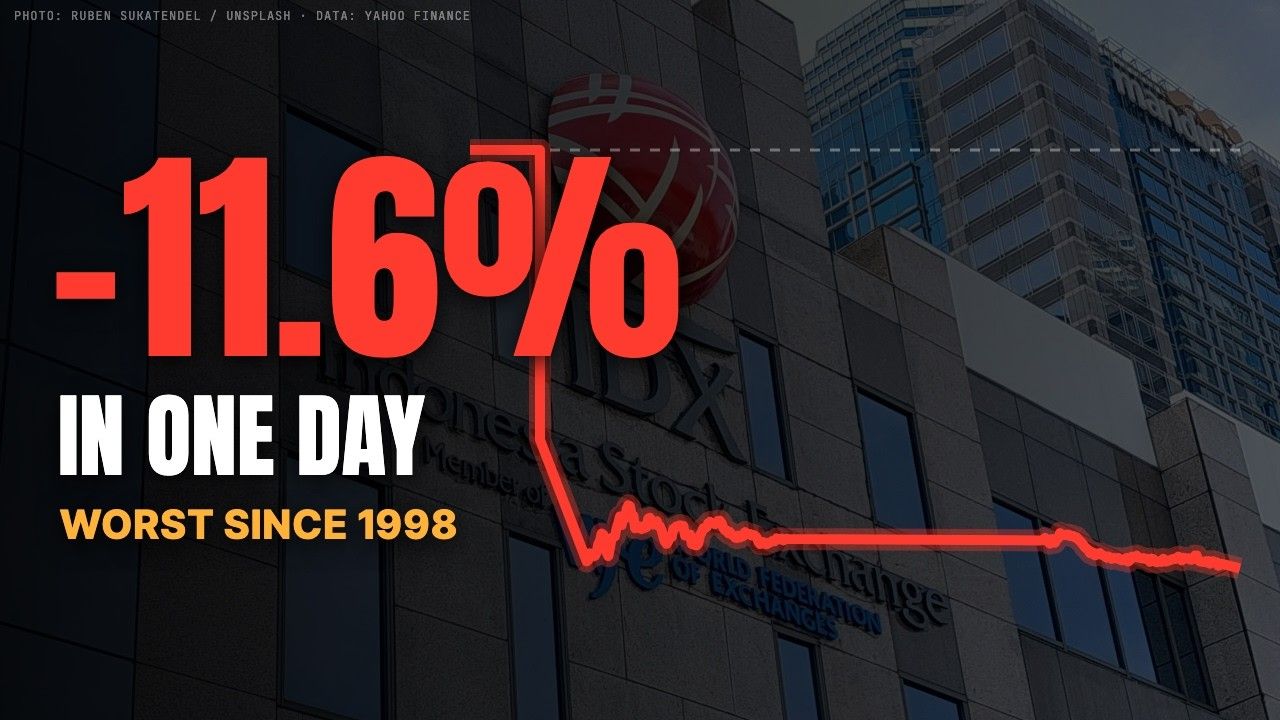
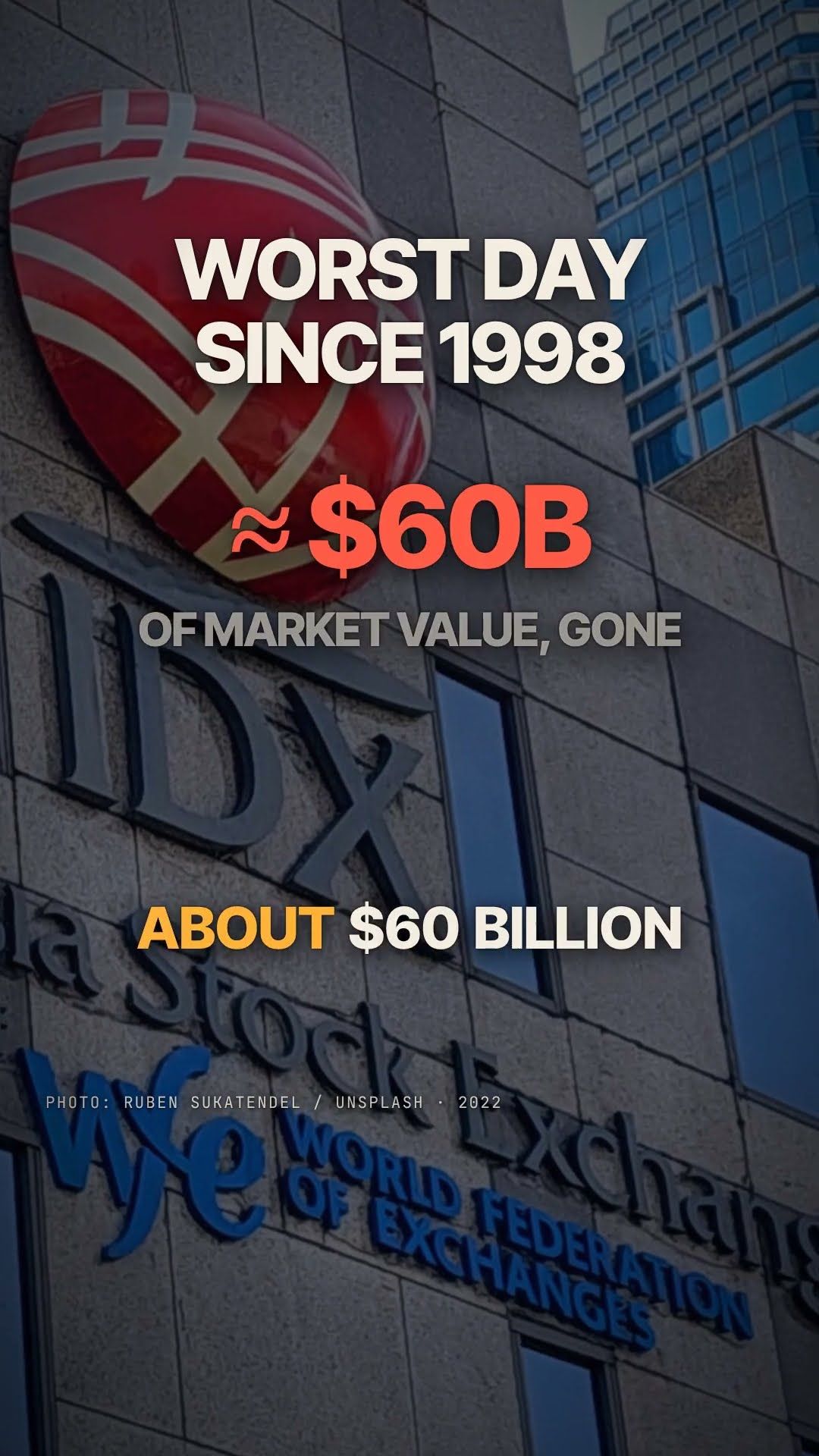
At 4:47 a.m. Jakarta time on Friday, October 16, 2026, the index company MSCI proposed moving Indonesia out of its Emerging Markets index into "Standalone" status. Four hours later the Jakarta Composite opened 8% lower, trading was halted for 30 minutes, and the index closed down 11.57%: its worst day since January 8, 1998, with about $60 billion of market value gone.
We follow the chain reaction: what MSCI is and why its lists steer more than $1.8 trillion; the day minute by minute, and our own analysis of which stocks fell (30 of the 50 biggest closed at the −15% floor; the big banks took the hit while five barely traded tycoon-linked stocks closed almost unchanged); free floats, "goreng saham" and MSCI's complaint about enforcement; what happened to Greece, Pakistan, Argentina, Russia and Nigeria, and how 2026 compares with 1998; how stock selling reaches the rupiah, Bank Indonesia and borrowing across the country; and who pays. Plus three dates to watch: Bank Indonesia on October 21, MSCI's review on November 11, and the April 30, 2027 feedback deadline.
- −11.57%
- Jakarta Composite, the worst day since January 8, 1998
- $60B
- of market value gone in one day
- 30 of 50
- biggest stocks closed at the −15% floor
Indonesia Lost $60 Billion Over One Press Release
Read it instead
The full transcript
Read all 8 chapters
0:00A press release at 4:47 a.m.
At 4:47 in the morning on Friday, October the 16th, Jakarta time, a company in New York published a press release about Indonesia.
Four hours later, Indonesia's stock market opened 8% lower. That trips the exchange's circuit breaker. Trading stopped before it had properly started.
When it restarted, half an hour later, prices fell another 3.5% in the first minute. By the close, the Jakarta Composite was down 11.6%, its worst day since January 1998, in the depths of the Asian financial crisis. About $60 billion of value, gone in a day.
No bank had failed. No war had started. Indonesia's economy was the same on Friday as it was on Thursday. What changed was a label. The company in New York said Indonesia should no longer count as an emerging market.
So how does one company's opinion knock a whole country's stock market down by a tenth in a day? The answer runs through a list most people have never seen, and money that millions of people own without knowing it.
This is Dominomics. We take one big story and follow its chain reaction all the way to your money.
Today we follow a label. From an index company in New York, onto the trading floor in Jakarta, into the hidden owners behind some of Indonesia's most valuable stocks, through the rupiah and the central bank, and into the funds that hold a piece of it.
1:25A company that makes lists
The company is MSCI. It doesn't manage your money, it makes lists. Its indexes sort the world's stock markets into classes. Developed like America and Japan, emerging like China, India and Brazil, and frontier smaller markets like Vietnam or Kenya.
Those lists steer an enormous amount of money. More than $1.8 trillion is benchmarked to MSCI's emerging markets indexes alone. Index funds copy them exactly. If a country is in the emerging markets index, they own it. And if it's taken out, they have to sell. Thousands of other fund managers are judged against the same lists, so they tend to follow too.
And there's one more class outside all three. Standalone. A standalone market isn't part of any of MSCI's global indexes. Right now that's a short list, including Argentina, Lebanon, Nigeria, Ukraine, and Zimbabwe.
In that press release, MSCI proposed adding Indonesia. Not down one step to frontier, but straight past it. In MSCI's words, frontier would not properly recognize the depth of the market problems.
Indonesia is the fourth most populous country on earth. It would be the only standalone market in the Asia-Pacific, and by far the biggest economy in the group.
2:44Thirty stocks at the floor
Here's that Friday, minute by minute. The opening price down 8%. Then 30 minutes, with no trading at all.
When trading came back at 9:28, the selling hit all at once. The index never recovered. It closed at its lowest point of the day.
Why no bounce? Because most stocks couldn't fall any further. That Friday, Indonesia's exchange didn't let any stock fall more than 15% in a day. We checked the 50 biggest companies, 30 of them closed right at that floor, with sellers still waiting.
Now look at who fell. The three biggest banks, Bank Central Asia, BRI and Mandiri, all hit the floor. By our estimate, those three alone account for about a fifth of the index's drop. They're what foreign funds actually own. Financial stocks, mostly those banks, make up almost three-quarters of MSCI's Indonesia index.
And look at these. A data-center company, a coal miner, and three more. Together they're worth more than a tenth of the entire market. On the worst day since 1998, they closed almost exactly where they started.
That isn't strength. Almost none of their shares change hands. That Friday, the data-center company, valued at about $25 billion, traded about $30,000 worth of stock all day. Bank Central Asia traded more than $350 million. And a price that almost nobody trades is exactly what MSCI is worried about.
4:14The price problem
An index can only include what investors can actually buy. That's called the free float. The shares that aren't locked up by founders, families, or insiders. Until this year, a company could stay listed in Jakarta with just 7.5% of its shares in public hands.
When only a sliver of a company trades, a small group can push its price a long way. Indonesians even have a name for it. Goreng saham. Frying a stock. MSCI's phrase is, suspected coordinated trading behavior.
This isn't the first warning. In January, MSCI froze Indonesia's place in its indexes and said it could be demoted to frontier. The next morning, Jakarta fell 7 percent.
About $84 billion of value disappeared in two days, and the head of the stock exchange resigned.
Indonesia did act. Shareholders above 1% must now be disclosed, down from 5. Investors are sorted into 39 types, not 9. And the minimum free float is doubling to 15%. But for the biggest companies, the deadline is 2028.
On Friday, hours after the crash, the regulator announced 2.1 trillion rupiah in fines, about $116 million, in cases involving three tycoon-linked stocks. One, it said, was planned and structured manipulation.
MSCI's complaint, published before dawn that same day, was about exactly this. In its own words, a lack of evidence of meaningful enforcement.
Jakarta was stunned. The stock exchange's chief called the announcement unexpected, saying it caused a market panic. A senior economic official put it more bluntly, MSCI is not always right.
5:58Demoted before
MSCI has demoted countries before.
In 2013, Greece became the first developed market ever cut to emerging. In 2021, Pakistan dropped to frontier, and Argentina went straight to standalone, over its capital controls.
Two went further. In March 2022, after the invasion of Ukraine, MSCI wrote Russia out of its indexes at a price that is effectively zero. And in 2024, Nigeria was moved to standalone, after foreign investors struggled to get their money out of the country.
Researchers who studied decades of these moves found a pattern. Prices move on the announcement, not on the day the change takes effect. They overshoot, and within a year they tend to claw some of it back. And when Argentina was removed, it was about a tenth of a percent of the index. Indonesia is about four times that.
Indonesia has its own history, too. On its worst day, January 8, 1998, the rupiah was in free fall from about 2,400 to the dollar the summer before, to nearly 17,000 within months. Jakarta's stocks lost about two-thirds of their value. That May, President Suharto resigned.
Today the rupiah is about 18,000 to the dollar. In number, weaker than at its worst in 1998. But in 1998 it lost about six-sevenths of its value in a year. This year it's down about 7%.
That's the difference. 1998 was a crisis of banks, debts, and the currency. This one is about whether a stock market's prices can be trusted.
7:36From stocks to the rupiah
But stock markets don't stay in their lane. When foreign funds sell Indonesian shares, they're paid in rupiah, and most of them change it back into dollars. This year, foreigners have pulled almost $5 billion out of Indonesian stocks, on track for the biggest yearly outflow in at least 16 years.
That weighs on the rupiah. On Monday it traded near 18,050 to the dollar, close to its record low of 18,190 set in June.
And that puts the central bank in a bind. A weaker rupiah makes fuel, imports, and foreign debts more expensive. To defend it, Bank Indonesia can raise interest rates. It already has, by a full percentage point this year, to 5.75%. On Wednesday, it decides again. Most economists expect it to hold, but some see another hike.
A rate hike would support the currency, but it makes borrowing more expensive across the country. That's the chain. A label in New York. A stock market in Jakarta. And the interest on a mortgage in Surabaya.
8:39Who pays
If you own an emerging-markets index fund, your direct exposure is tiny. In the big MSCI emerging-markets funds, Indonesia was about half a cent of every dollar, even before Friday. At the start of the year, its weight in MSCI's index was 1.16%.
By September 0.43.
If you live in Singapore or Malaysia, your markets barely flinched. On Friday, Singapore's index edged up. Malaysia slipped 1%, and the Philippines rose 2%. Jakarta fell alone.
The people paying are Indonesians. More than 30 million now have an investment account. Almost 10 million opened theirs this year, in a market that's down 40%.
And if MSCI goes ahead, the funds that copy its index would have to sell an estimated $4 to $5.6 billion of Indonesian stocks. Other funds may sell even more.
9:34What could break the chain
The bull case is real. Indonesia's economy is still growing about 5% a year. Its stocks are the cheapest, compared with earnings, since the 2008 financial crisis. FTSE Russell, another big index maker, kept Indonesia as emerging just nine days before MSCI moved. And this is a proposal. MSCI says it will reconsider if it sees clear evidence of material improvements.
The bear case is real too. The burden of proof now sits in Jakarta. The big free float deadline is years away. The big enforcement cases have only just begun. And trust takes longer to rebuild than to lose.
Three dominoes to watch. One. Wednesday, October the 21st. Bank Indonesia's rate decision. Two. November the 11th. MSCI's next index review. Three. April the 30th next year. MSCI's deadline for feedback. With a final decision by the end of June.
Here's what Friday teaches. A stock market isn't just a list of companies, it's a promise. That the price on the screen is real, set by people who could actually buy and sell. When investors stop believing that promise, it doesn't matter how fast the economy grows.
So, should one company in New York get to decide what counts as an emerging market? Tell me in the comments. And if you want to follow the next domino with us, subscribe.
This is Dominomics. I'll see you at the next domino.
Sources & notes
Where the numbers come from
Sources
- MSCI (press release and consultation document, Oct 15, 2026; January, April and June 2026 announcements; Market Classification Framework; Previous Market Reclassifications; Indonesia and EM index factsheets; Q2 2026 earnings release)
- Indonesia Stock Exchange (IDX) and OJK statements, Oct 16–19, 2026
- Bank Indonesia
- KSEI
- Yahoo Finance (1-minute and daily prices, volumes)
- iShares EEM/IEMG holdings (Oct 15, 2026)
- Reuters
- CNBC
- Bloomberg
- Jakarta Globe
- Kontan
- Katadata
- Bisnis
- CNN Indonesia
- Kompas
- Bernama
- Burnham, Gakidis & Wurgler (Financial Analysts Journal, 2018)
- Raddatz, Schmukler & Williams (J. Int'l Economics, 2017). Full fact-check log available on request.
Please note
For education and entertainment only. Not financial advice: we don't recommend buying or selling any security. Market data as of Oct 16–19, 2026. The narration is an AI voice.
Spotted a mistake?
Tell us at business@dominomicsofficial.com. Corrections are logged on our corrections page.
Images, footage and data credits
- Documents: MSCI press release (via Business Wire, Oct 15, 2026), quoted as published
- Charts: drawn by Dominomics from Yahoo Finance prices and volumes, iShares EEM holdings, MSCI factsheets, KSEI and Bank Indonesia data
- Jakarta CBD skyline at dusk, 2020: Tom Fisk / Pexels License
- 7 World Trade Center, 250 Greenwich Street, New York, 2026: Ajay Suresh / CC BY 4.0
- Indonesia Stock Exchange building, 2022: Ruben Sukatendel / Unsplash License
- Indonesia Stock Exchange main hall, Jakarta, 2019: Ruben Sukatendel / Unsplash License
- IDX Composite index display inside the Indonesia Stock Exchange, 2019: Ruben Sukatendel / Unsplash License
- SCBD office towers at night, Jakarta, 2024: U.S. Embassy Jakarta, Indonesia / public domain
- Indonesian rupiah banknotes, 2021: Polina Tankilevitch / Pexels License
- Bank Indonesia headquarters building, Jl. M.H. Thamrin, Jakarta, 2026: Medelam / CC BY-SA 4.0
- The old Athens Stock Exchange building, Sofokleous Street, Athens, 2012: GianniM / CC BY-SA 3.0
- Students and citizens occupy the MPR/DPR parliament building in Jakarta, demanding reform, 1998: Secretariat General of the House of Representatives / public domain
- Suharto leaves the Merdeka Palace with his daughter Siti Hardiyanti Rukmana after resigning, 1998: Secretariat General of the House of Representatives / public domain
- Photos via Wikimedia Commons, Pexels and Unsplash, cropped/resized. Licenses: CC BY 4.0 https://creativecommons.org/licenses/by/4.0/
- CC BY-SA 3.0 https://creativecommons.org/licenses/by-sa/3.0/
- CC BY-SA 4.0 https://creativecommons.org/licenses/by-sa/4.0/
- Pexels License
- Unsplash License
The next domino
Keep following the chain
Don't miss the next one
Get the next chain reaction in your inbox.