France Is Burning. Is It the Next Greece?
It started with teenagers asking for a teacher. Then France burned, and the bond market said it now pays more to borrow than Greece.
The chain reaction
From a school gate to your funds
Domino 1
A school gate
Students in Créteil blockade their lycée over missing teachers. Within two weeks, more than 1,000 schools join.
1:07 It started at a school gateDomino 2
The bill
The 2027 budget plans €72.9 billion (≈ US$81.8 billion) of interest against €65.5 billion (≈ US$73.5 billion) for schools.
3:23 The bill that comes firstDomino 3
The deficits
Fifty years without a balanced budget, and governments that fell trying to cut.
4:49 Half a century in the redDomino 4
The street
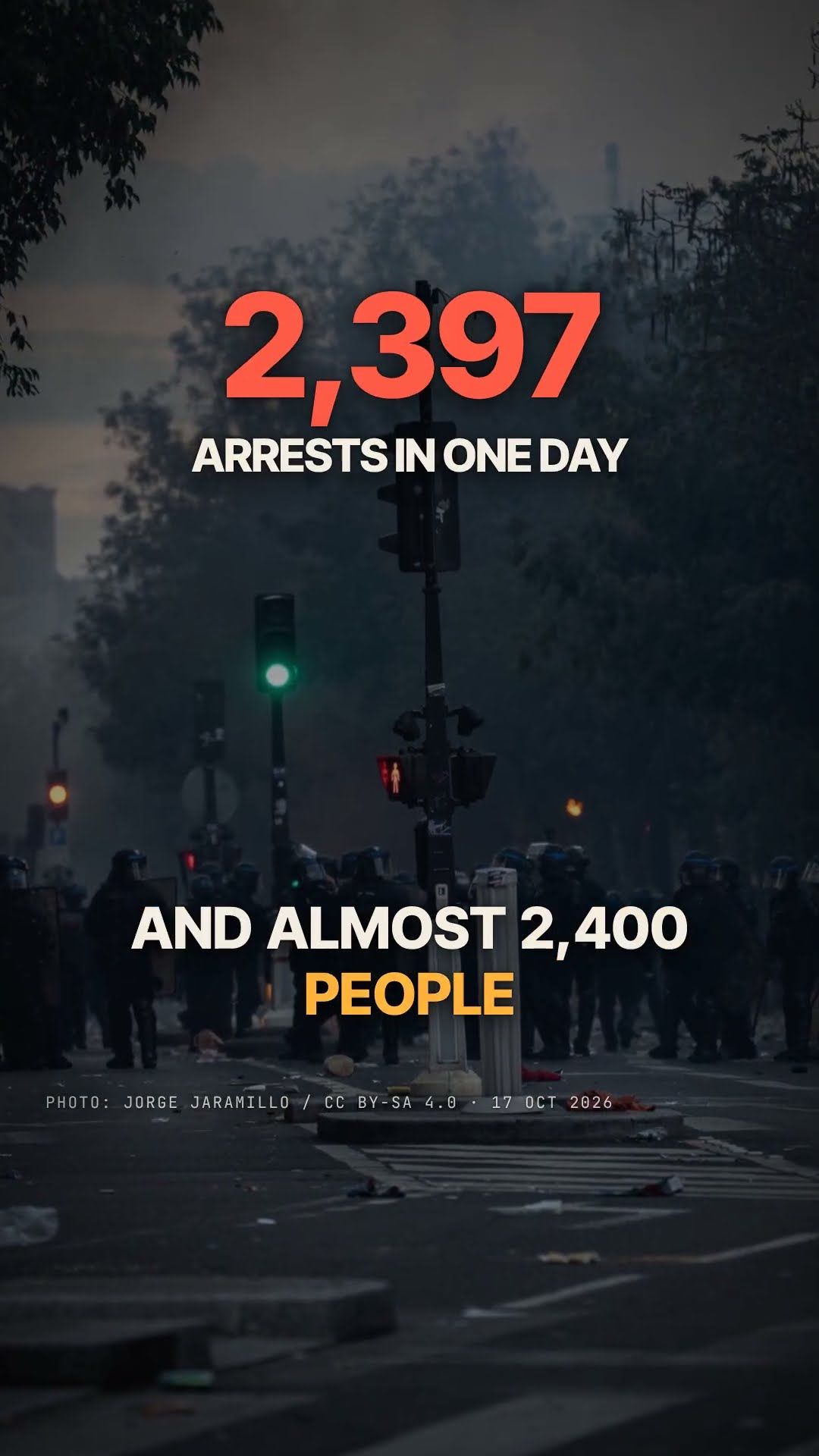
On October 17 about 550,000 people march and 2,397 are arrested. In France, the street usually wins.
6:15 The street usually winsDomino 5
The bonds
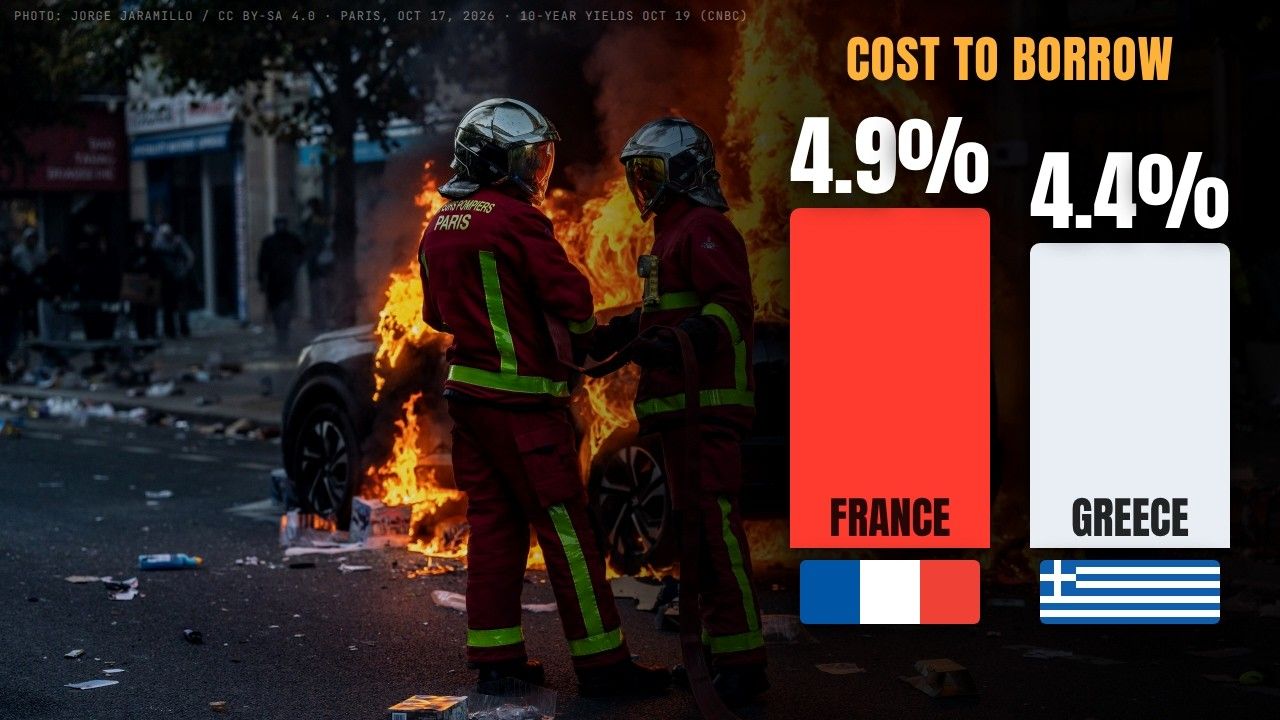
France now pays more to borrow than Greece. In September it paid the highest rate of all 21 euro countries.
7:39 Paying more than GreeceDomino 6
Your funds
How much of the funds you own is France.
9:09 The loop
The story
What this episode explains
On October 17, France burned: about 550,000 people marched, Limoges's 19th-century town hall went up in flames and 2,397 people were arrested. On Monday, the bond market gave its verdict: France now pays more to borrow than Greece. So is France the next Greece?
It started with teenagers asking for a teacher. In September, students at a high school in Créteil, outside Paris, blockaded their gate over missing teachers; within two weeks, protests had hit more than 1,000 of France's lycées. We follow the loop that connects the riots to the debt: the interest bill that comes before anything else (in the 2027 budget the state plans €72.9 billion of interest against €65.5 billion for its schools, excluding teachers' pensions, while cutting 1,588 teaching posts); fifty years without a balanced budget and the governments that fell trying to cut; why the street usually wins in France (1968, 1986, 1990, 1994, 2006, 2018); how France came to pay the highest rate of all 21 euro countries in September, a first since the euro began; whether France really is the next Greece; and how much of the funds you own is France. Plus the dates to watch: Moody's on October 23, the yellow vests' second day on October 24, and the social-security budget vote on October 27.
- 550,000
- people marched on October 17
- €72.9B
- ≈ US$81.8B of interest in the 2027 budget, more than for schools
- 1,000+
- lycées hit by protests within two weeks
Is France the Next Greece?
Read it instead
The full transcript
Read all 8 chapters
0:00France burned. Is it the next Greece?
On Saturday, October the 17th, France burned. More than half a million people marched. A 19th-century town hall went up in flames. Almost 2,400 people were arrested in a single day.
And on Monday morning the bond market gave its own verdict. France now pays more to borrow than Greece. More than Italy. In September, for the first time since the euro was created, France paid the highest rate of all 21 countries that use it.
Greece. The country that needed three bailouts. So, is France the next Greece?
To answer that, you have to start somewhere much quieter, with teenagers asking for a teacher. Because the riots and the debt aren't two stories. They're one loop. And it runs through every euro France owes.
This is Dominomics. We take one big story and follow its chain reaction all the way to your money.
Today we follow the loop. From a school gate, to the bill France pays before anything else, to half a century of budgets in the red, out onto the street, into the bond market, and back again.
1:07It started at a school gate
One morning in September, at a high school in Créteil just outside Paris, students pushed rubbish bins across the front gate and refused to go in.
Their complaint was about teachers. Not bad teachers, missing ones. One of their teachers listed what the school was short of: a maths teacher, a French teacher, a literature teacher, a history teacher, and the school nurse was off sick.
The school was the Saint-Exupéry High School, over a thousand students. Its teachers had gone on strike over the empty posts and the students joined them. Then someone filmed it. Within days, videos of blockaded schools were spreading on TikTok and Snapchat, and other schools copied them.
On the 1st of October, the government counted 1,027 high schools hit by protests, more than a quarter of the country's high schools. That one day, about 2,000 people were arrested, most of them teenagers.
The students' list was concrete. A teacher in every class. A nurse and a psychologist for every 500 pupils. Classrooms that aren't freezing in winter and close to 40 degrees in a heatwave. The education minister promised 3,000 replacement teachers. The students kept going.
Then the anger widened. Since early September, calls on TikTok had been building toward a day of action on October the 17th, over fuel prices and the cost of living. Leaders of the yellow vests, France's 2018 protest movement, told people to join. So did the student unions.
On Saturday, the Interior Ministry counted 550,000 marchers. Organizers said 800,000. Most marched peacefully. But by night, shops had been looted in Paris, Marseille and Lille. And in Limoges, the town hall was set on fire. A protester in Paris died of cardiac arrest. Almost a thousand police and gendarmes were injured.
On Sunday night, President Macron went on television. Tonight, he said, we all feel anger and shame. Those who sought to bring down the Republic would be held accountable. The students' demands, he said, were legitimate. But there is a problem with legitimate demands in France right now. Every one of them costs money, and France's money has a prior claim on it.
3:23The bill that comes first
Before France pays a teacher, a nurse, or a soldier, it pays its lenders. Interest on the debt isn't optional. Miss it. And the whole system stops.
In the budget for 2027 that the government sent to Parliament, the state's interest bill is almost 73 billion euros. The budget for its schools is 65 and a half billion, if you leave out teachers' pensions. This year it was the other way round. Next year the French state plans to spend more on interest than on its schools.
Next year's increase alone is almost 10 billion euros. That's about what the USL, a high school union, is asking for to fix France's high schools.
Altogether, it's about 2,300 euros of interest every second. Since this video started, the French state has paid this much.
It wasn't like this five years ago. In 2020 and 2021, France could borrow for 10 years at close to zero. Now it pays almost 5%. Each year, cheap old bonds come due and are replaced with expensive new ones, so the bill keeps climbing even if France borrowed nothing new. The Treasury's own projection, about 97 billion euros a year by 2029.
And the same budget cuts 1,588 teaching posts. The government says it's because there are fewer pupils. The students see something else. A quarter of first-year lycée classes have 35 pupils or more.
4:49Half a century in the red
France hasn't balanced a budget since 1974. Its public debt is now a record 3.6 trillion euros, 119% of everything the country produces in a year.
Here's the strange part. France already collects the second highest taxes in the developed world. Its state spends 57% of everything the economy produces, one of the two highest shares in Europe. It still runs a deficit of more than 5% a year. And only about one French person in five says they trust the government.
Cutting that deficit has been politically fatal. Since President Macron dissolved Parliament in 2024, no bloc has had a majority. In December 2024, Michel Barnier's government was voted out over a budget, the first to fall that way since 1962. In September 2025, François Bayrou lost a confidence vote over his savings plan. His successor, Sébastien Lecornu, named a government that lasted 14 hours, resigned, and was reappointed. His 2026 budget only passed by forcing it through without a vote.
Now he has asked for 54 billion euros of savings and new taxes to bring the deficit from 5.4 to 5 percent next year. Even France's official fiscal watchdog calls its growth forecast optimistic. The first vote was due on Tuesday. It has just been pushed back. Almost 3,000 amendments are still waiting.
6:15The street usually wins
To investors, the riots aren't the risk. The risk is what usually comes after them in France.
In 1968, students and then millions of workers brought the country to a halt. The settlement raised the minimum wage by 35%. In 1986, students marched against a university reform. After a student was beaten to death by police, the bill was withdrawn.
And in 1990, high school students marched over crumbling, understaffed schools, just like now. Within two days of their biggest march, the government found four and a half billion francs. In 1994 and in 2006, students forced the government to drop job schemes for young people. One of them was already law.
In 2018, a fuel tax rise brought out the yellow vests. The tax was scrapped. And by the government's own count it spent about 17 billion euros calming the country down.
The exceptions were the retirement age. In 2010 and again in 2023, the government raised it and held firm. But two years later, it agreed to suspend the 2023 reform to survive in parliament.
By our count, in seven of these nine big waves, the government backed down. So when half a million people march against cuts, the bond market does the arithmetic. If the government gives in again, the deficit stays where it is.
7:39Paying more than Greece
Here's how investors keep score. They compare what France pays to borrow for 10 years with what Germany pays. The gap is called the spread.
Before the 2024 election, the spread was about half a percentage point. On the day before the first blockade, it was just under one point. Two weeks later, it was close to one and a half. On Monday, after the riots, it was about 1.45.
Part of France's rate is the whole world. With oil above a hundred dollars, interest rates are rising almost everywhere. But the gap with Germany is France's alone. Earlier this month it hit its widest since the euro crisis.
And remember who was in trouble back then. At the worst of the euro crisis, Greece had to pay 29% to borrow. Portugal, almost 14. Italy and Spain, about 7. France paid about 3.
Watch what happened next. Greece, Portugal and Spain went through bailouts and years of deep cuts. France never had to. One by one, their borrowing costs slipped below France's. In September, France ranked first. The highest borrowing cost of any country in the eurozone.
So, is France the next Greece? Not in the way Greece was. Greece lost access to markets and had to be rescued three times. France still sells new debt every week, and buyers still bid for more than twice what's on offer. What has changed is the price. The market now charges France as if its politics were the risk.
9:09The loop
And that's how the chain closes into a loop. A higher rate means a bigger interest bill. A bigger bill means deeper cuts. Deeper cuts mean emptier classrooms and angrier streets. Angrier streets mean a weaker government. And a weaker government means a higher rate.
It reaches well beyond the French state. French families borrow at rates that follow the government's. French banks hold large amounts of French debt, and on Monday their shares fell about 3%.
And it reaches you. In a eurozone stock fund, France is the biggest country: about 27 cents of every dollar. In a fund of government bonds from outside America, French debt is the second biggest holding after Japan's.
There's a backstop. The European Central Bank can buy a country's bonds if markets turn disorderly. But only if Brussels judges that country to be keeping its budget promises, and France's are exactly what's in doubt.
10:05What could break the loop
The case for calm: France is rich. Its households save about 17% of their income. And its debt has an average life of about 8.5 years. So higher rates arrive slowly, not all at once.
The case for worry: no majority in parliament, a budget that has already lost key votes, and a presidential election in April 2027, with leading candidates promising to spend more or tax less.
Three dates to watch. Friday, October the 23rd. Moody's reviews France's credit rating. Saturday the 24th. The yellow vests' second national day. And Tuesday the 27th. The Assembly votes on the Social Security budget, while the state budget waits.
A country can borrow against its future. In France, the future was standing outside a school gate in Créteil, asking for a teacher.
Tell me in the comments. Should France cut, tax, or wait for growth?
This is Dominomics. I'll see you at the next Domino.
Sources & notes
Where the numbers come from
Sources
- French government: Projet de loi de finances 2027 (état B, PAP "Enseignement scolaire"), DG Trésor / Agence France Trésor debt report (Oct 2026) and auction results (Oct 1 and 15, 2026), Ministry of the Interior and Ministry of Education figures, Haut Conseil des finances publiques
- INSEE (public debt Q2 2026, national accounts, household saving)
- DEPP (Repères et références statistiques 2026)
- ECB (long-term interest rates for convergence purposes)
- Eurostat
- European Commission and ESM (Greece's programmes)
- OECD (Revenue Statistics, Trust Survey 2026, Education at a Glance 2026)
- CNBC and Yahoo Finance market data
- iShares holdings (Oct 16, 2026)
- Reuters
- AFP
- France 24
- franceinfo
- Le Monde
- Public Sénat
- LCP
- Euronews
- Al Jazeera
- CNBC
- Fortune. Full fact-check log available on request.
Please note
For education and entertainment only. Not financial advice: we don't recommend buying or selling any security. Market data as of October 16–19, 2026. The narration is an AI voice.
Spotted a mistake?
Tell us at business@dominomicsofficial.com. Corrections are logged on our corrections page.
Images, footage and data credits
Charts drawn by Dominomics from ECB, Eurostat, INSEE, CNBC and Yahoo Finance data, iShares holdings and the 2027 budget bill (PLF 2027) · Map: Natural Earth. Photos and footage (cropped/graded; free licences, details in the fact-check log):
- Eric Koch / Anefo (Nationaal Archief) / CC0 (1 photo, 1968)
- Olivier Dumay / CC BY-SA 4.0 (1 photo, 1986)
- Traroth / CC BY-SA 2.0 (1 photo, 2006)
- Olivier Ortelpa / CC BY 2.0 (1 photo, 2018)
- Jules* / CC BY-SA 4.0 (2 photos, 2023–2026)
- Daniel Vorndran / DXR / CC BY-SA 3.0 (1 photo, 2014)
- Dinkum / CC0 (1 photo, 2012)
- Jorge Jaramillo / CC BY-SA 4.0 (6 photos, 2026)
- Guallendra / CC0 (2 photos, 2026)
- David Monniaux / CC BY-SA 4.0 (1 photo, 2026)
- Marimarina / CC BY-SA 3.0 (1 photo, 2012)
- Jacques Paquier / CC BY 2.0 (1 photo, 2018)
- Thomas Padilla / European Union, 2025 (EC Audiovisual Service) / CC BY 4.0 (1 photo, 2025)
- Geoffroy Van der Hasselt / European Union, 2026 (EC Audiovisual Service) / CC BY 4.0 (1 photo, 2026)
- Oooer / CC0 (1 photo, 2026)
- Pierre Tribhou / CC BY-SA 4.0 (1 photo, 2026)
- Romainbehar / CC0 (1 photo, 2026)
- Ggia / CC BY-SA 3.0 (1 photo, Athens 2011)
- Lechat / CC BY-SA 3.0 (1 photo, 2026; thumbnail)
- Alacoolwiki / CC BY 4.0 (1 photo, 2026)
- European Union / © European Union (EU Government reuse, attribution) (1 photo, 2025)
- FreCha / CC BY-SA 4.0 (1 photo, 2026)
- Gugalcrom123 / CC BY 4.0 (1 photo, 2022)
- falconp4 (Pixabay) / CC0 (1 photo, 2017)
- Wyslijp16 / CC BY 4.0 (1 photo, 3 videos, 2026)
- Gabriel from92 / CC0 (2 videos, 2026)
- Florian Delée / Pexels License (free for commercial use, no attribution required) (5 videos, 2025–2026)
- Jakub Zerdzicki / Pexels License (free for commercial use, no attribution required) (1 video, 2025)
- Hervé Germain (monsieur-g) / CC0 (1 video, 2026)
The next domino
Keep following the chain
Don't miss the next one
Get the next chain reaction in your inbox.