There's a War. So Why Did Gold Fall?
Gold is supposed to protect your money in a war. In 2026 it fell, and the families who lost most were in Asia.
The chain reaction
From war to your savings
Domino 1
War
War breaks out between Iran, the United States and Israel on February 28.
0:00 A war, and gold fellDomino 2
Oil ▲
Oil soars, and inflation rises with it.
2:00 It wasn't the missilesDomino 3
Rates ▲
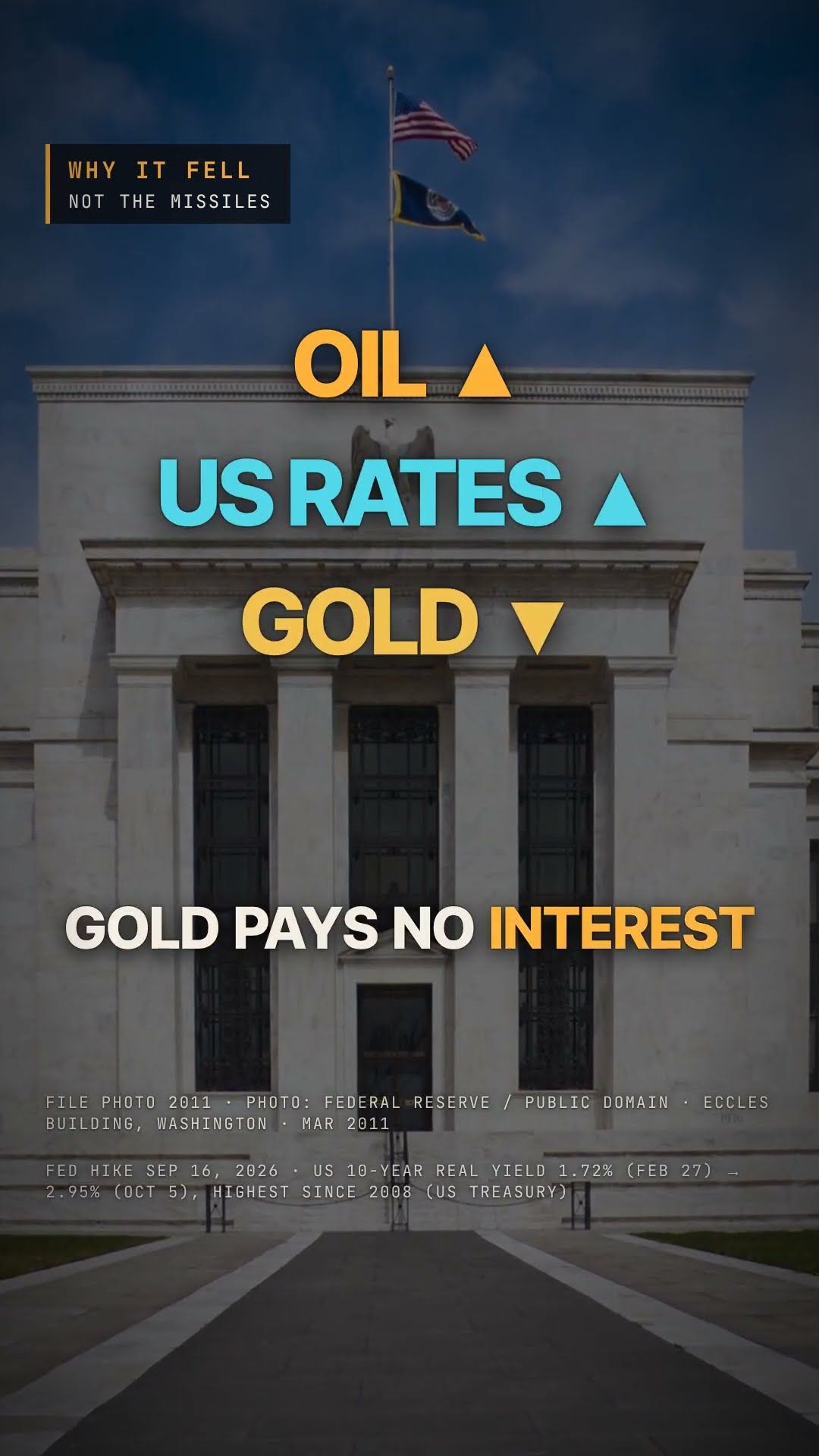
The Fed's first hike since 2023, and the highest US real interest rate since 2008.
2:00 It wasn't the missilesDomino 4
Gold ▼
Gold pays nothing and was one of the most crowded trades: its worst week since 1983.
1:12 The most crowded safe havenDomino 5
Your savings
Since the war began, gold is down 27% in Korean won and 18% in Indian rupees.
5:00 Your currency decided
The story
What this episode explains
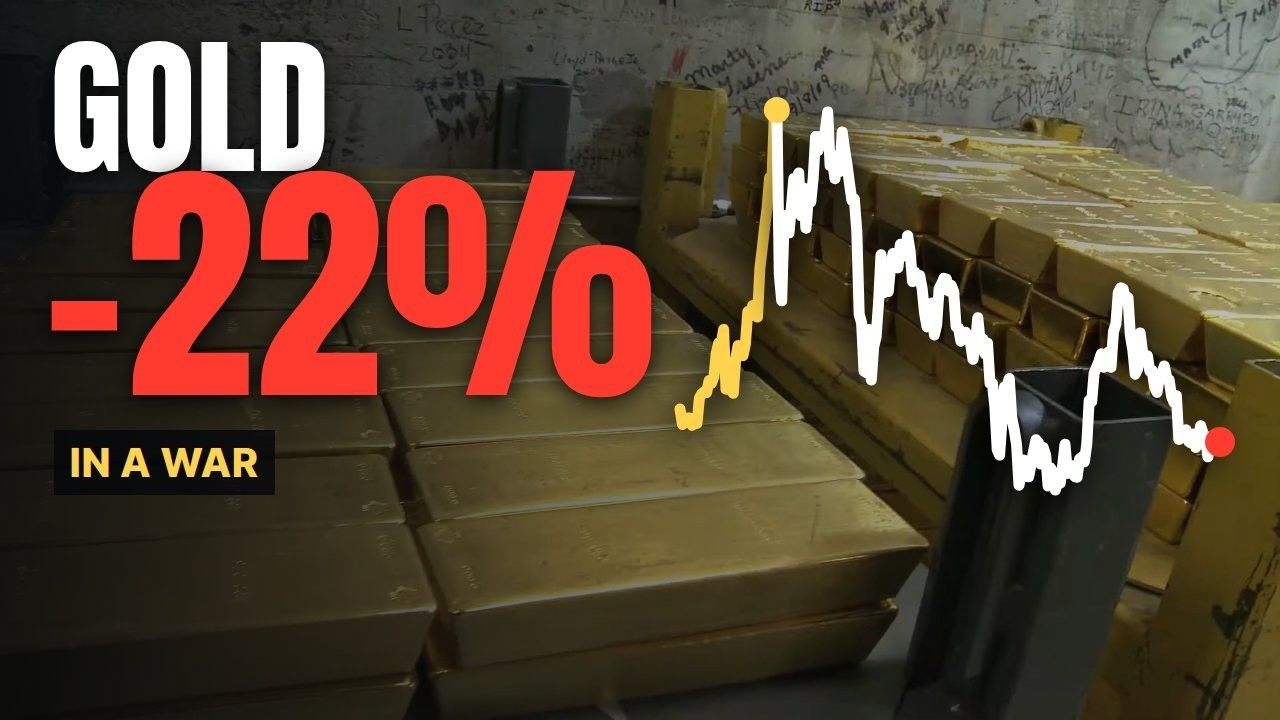
Gold closed at a record in January 2026. Then war broke out between Iran, the United States and Israel, oil soared, and gold, the world's safe haven, fell: its worst week since 1983 and its worst month since 2013. On October 21, gold futures were still 22% below their record close. In Asia, that's family savings: Indian households alone hold an estimated 25,000 tonnes of gold, about three times the US government's gold reserves.
So why did gold fall in a war, and who in Asia lost the most? We follow the chain reaction: oil, inflation and the Fed's first rate hike since 2023; the highest US real interest rate since 2008; Turkey's central bank using its gold; India and China buying half the world's gold; our own conversion of the gold price into 16 Asian currencies (since the war: Korean won −27%, Chinese yuan −23%, Indian rupee −18%, Turkish lira −11%; over a year, gold is still up in lira, pesos, rupiah and rupees); gold loans in India (₹5.6 lakh crore ≈ US$59 billion at banks alone) and Indonesia's state pawnshop (Rp145 trillion ≈ US$8.1 billion); and what happened after gold's falls in 2022, 2013 and 1980.
- −22%
- gold below its record close, October 21
- 25,000 t
- gold held by Indian households (estimate)
- −27%
- gold in Korean won since the war began
A War Broke Out. Gold Fell. Here's Why.
Read it instead
The full transcript
Read all 9 chapters
0:00A war, and gold fell
On February the 28th, war broke out between Iran, the United States, and Israel. Oil jumped. Stock markets across Asia fell. And the one thing that's supposed to protect your money in a war did something almost nobody expected.
Gold fell. In March, it had its worst week since 1983 and its worst month since 2013. By mid-July it was a quarter below its January record. And on October the 21st, it was still more than a fifth below it.
In most of the world, that's a story about traders. In Asia, it's a story about family savings. Indian households alone hold an estimated 25,000 tonnes of gold, about three times the gold reserves of the United States. At the world price, that gold is worth about $900 billion less than at January's peak.
So why did gold fall in a war? Who in Asia lost the most? And is gold still a safe place for your money? The answer depends on something most people never think about. The currency you count your money in.
This is Dominomics. We take one big story and follow its chain reaction all the way to your money.
1:12The most crowded safe haven
To understand the fall, start with the climb. Since 2022, when Western countries froze Russia's reserves, central banks had been buying around 1,000 tonnes of gold a year. In 2025, gold rose more than 60%, and in January 2026, by the London benchmark price, it rose another 14 percent, setting 12 records in a single month.
On January the 29th, gold futures in New York closed at a record $5,318 an ounce. That's more than two and a half times its price two years earlier. Gold had gone from the thing people keep for emergencies to one of the most crowded trades in the world.
Then the war came. On the first trading day gold rose as everyone expected. Then it turned.
2:00It wasn't the missiles
The first reason is cash. When everything falls at once, investors sell what they can, not what they want to. Gold had risen so far so fast that it was the easiest profit to take. In March, investors pulled $12 billion out of gold funds, and computer-driven funds sold as the price broke down. As the bank ANZ put it, liquidity needs outweigh safe-haven demand in the early stages.
The second reason is bigger. The price of money. The war pushed up oil. And oil pushed up inflation. Within three weeks, traders went from expecting America to cut interest rates to pricing a 50-50 chance of a hike by October. In September, the Federal Reserve raised rates for the first time since 2023. And America's 10-year borrowing cost climbed above 5%.
Here's why that hits gold. Gold pays no interest. A U.S. government bond does. In October, a 10-year U.S. bond protected against inflation paid almost 3% a year above inflation, the most since 2008. Every year you hold gold instead, that's what you give up.
We checked the link ourselves week by week. For two years before the war, gold barely moved with that interest rate. Largely because central banks kept buying whatever it did. After the war began, the link came back. When the rate rose, gold fell. The World Gold Council's verdict on March. Gold appeared to overreact to a conflict -led bounce in U.S. real yields. The war hit gold through interest rates, not through missiles.
And some countries needed dollars fast. Turkey's central bank drew on its gold to defend the lira, mostly by swapping it for foreign currency. China's kept buying every single month.
That's the story the markets tell. But most of Asia's gold isn't traded on a screen. It's kept at home.
3:51Asia's savings account
In 2025, India and China together bought more than half of all the gold jewellery sold in the world, and more than half of all the gold bars and coins.
In India, a 2017 central bank study found that gold made up about 11% of what an average household owned. Bank deposits, shares, and every other kind of financial saving, together, about five.
Half of the country's jewellery is bought for weddings, and by law, a bride's gold is her own property.
Families who have watched their money lose value learn to trust what they can hold. In 1998, during the Asian financial crisis, three and a half million South Koreans gave about 227 tonnes of gold to help their country repay its debts.
So when gold fell, Asia felt it at the shop counter. In Vietnam, a tael of gold bars sold for 190 million dong at January's peak. On October the 21st, 142 million. In South Korea, the exchange price fell almost 30% by July. In Indonesia, a gram of gold sold back to the state miner fetches about a quarter less than it cost at the peak.
5:00Your currency decided
But here's what the headlines miss. Gold is priced in dollars, and almost nobody in Asia spends dollars. So we converted the gold price into 16 Asian currencies and tracked it alongside the dollar every day for the past three years.
Since the war began, gold has fallen almost 27% for someone counting in Korean won. In Chinese yuan, 23. In Pakistani rupees and Vietnamese dong, about 21. In Indian rupees, 18. In Philippine pesos, 13. And in Turkish lira, only 11.
Look over a full year and the split is starker. Gold is up almost 20% in Turkish lira, about 10 in Philippine pesos and Indonesian rupiah, and almost 9 in Indian rupees. In won and yuan, it's down.
The reason is the other half of the chain. The same war and the same American interest rates that pushed gold down also pushed weaker currencies down. In May, the Indian rupee hit a record low. The Philippine peso hit one on October the 21st. When your currency falls, anything priced in dollars, gold included, costs more in your money. Families in Mumbai, Manila, and Istanbul were cushioned. In Seoul, where the won got stronger, gold simply fell.
And over three years, gold is still up by at least three quarters in every one of those currencies, and has more than doubled in most. Gold protected Asia's families against their own currencies. It didn't protect anyone against American interest rates.
6:32When gold is a loan
There's one more way the fall reaches families. In Asia, gold isn't just savings. It's a credit line. By August, Indian banks had lent 5.6 trillion rupees against gold jewellery, 83% more than a year earlier. Finance companies had lent another 3.65 trillion. In Indonesia, the state pawnshop Pegadaian had 145 trillion rupiah of pawn loans outstanding in June, 62% more than a year earlier.
A loan against gold has a limit. In India, a small loan can be up to 85% of the gold's value. If gold falls 20%, a loan at that limit is now worth more than the gold behind it. The borrower has to add gold or cash, or the lender can sell the jewellery at auction.
So far, lenders say they're cushioned. Most lend well below the limit. And the ratings agency Crisil expects them to recover what they lent even after a 20% fall. We found no reports of a wave of auctions in 2026.
Governments felt it too, because gold is bought from abroad with dollars. In May, with the rupee sliding, India's prime minister asked people to postpone buying gold, and the import tax went from 6% to 15%. In September, India's gold imports were down 81% from a year earlier.
In China, the biggest bank which is state -owned stopped trading gold and silver on the Shanghai Gold Exchange for its retail customers in July after the price swings.
8:03We've been here before
If all this sounds familiar, it should. In 2022, Russia invaded Ukraine, and two weeks later gold jumped above $2,000. Then America started raising interest rates. By November, it had lost about a fifth, much like the fall we've seen this year.
What came next is the part gold's fans like to tell. Central banks, many of them worried that their own reserves could be frozen like Russia's, bought more than a thousand tonnes a year for three years running. Three years later, gold was worth about two and a half times its 2022 low.
In 2013 it went differently. Gold fell 28% in a year as America signalled the end of cheap money. Asian families treated it as a sale. India's imports surged on top of a record current account deficit, and the government raised the import tax three times that year to 10%.
And 1980 is the warning. After that peak, high real interest rates, and later central banks selling, kept gold falling on and off for almost 20 years. By 1999 it had lost 70%. That's not a forecast. It's a reminder that gold doesn't have to come back quickly.
9:13What to watch
So what to watch? The Federal Reserve meets on October the 27th and 28th. Markets expect it to hold and see a good chance of a hike in December. America's inflation-protected interest rate, about 2.8% on October the 21st. Central banks, China's has added gold for 23 months in a row. And Dhanteras, on November the 6th, when Indian families traditionally buy gold to see whether they buy the dip again.
9:40So, why did gold fall?
So why did gold fall in a war? Not because the war made gold less useful, because it made money more expensive. Oil pushed up interest rates, and gold, which pays nothing, had become one of the most crowded trades in the world.
And is it still a safe haven? That depends on what you need protecting from. Against your own currency falling, it did its job over the past year. In rupees, pesos and lira. Against American interest rates rising, it never was one.
Tell me in the comments. Does your family keep gold? And where are you watching from?
This is Dominomics. I'll see you at the next domino.
Sources & notes
Where the numbers come from
Sources
- World Gold Council (Gold Demand Trends 2025 and 2026; monthly commentaries incl. "Anatomy of a fall", Apr 8, 2026; ETF and central-bank statistics; India and China updates)
- Reuters
- Federal Reserve
- US Treasury yield curves
- Trading Economics, Bernama/Anadolu
- Yahoo Finance (gold futures GC=F, Brent, exchange rates)
- IMF IRFCL
- Reserve Bank of India
- Crisil Ratings
- PTI, CNBC
- Kontan
- WallstreetCN
- VnEconomy, VTV, Nhan Dan
- FnNews, Hankyung
- Okezone, Bisnis, Fortune IDN
- Inquirer, Manila Times
- Korea Herald
- Royal Mint, LBMA
- RBC Wealth Management.
Full source list and our analysis code are kept in the channel's research files.
Please note
For education and entertainment only. Not financial advice. We don't predict the price of gold. Gold prices are COMEX futures daily closes unless stated; local figures are the international price converted at each day's exchange rate, not shop prices. Household figures are estimates and paper changes, not realised losses. Figures as of October 21, 2026. US$ conversions at Oct 21 rates: ₹94.45, ₩1,326, ₫25,856, Rp17,943. The narration is an AI voice.
Spotted a mistake?
Tell us at business@dominomicsofficial.com. Corrections are logged on our corrections page.
Images, footage and data credits
Charts drawn by Dominomics from the sources above. Photos and footage (cropped, resized, graded; free licences):
- Esteban M / Pexels licence (Oil Tanker at Anchor, 2020)
- U.S. Mint / Public domain (Gold Bars, West Point Mint, 2011; Gold Coins, West Point Mint, 2011)
- Sururi Ballıdağ / Pexels licence (Gold Jewellery on Display, 2026; Gold in A Shop Window, 2026; Grand Bazaar, Istanbul, 2026)
- Rafael Minguet Delgado / Pexels licence (Trading Chart, 2026)
- Tima Miroshnichenko / Pexels licence (US Dollar Notes, 2020)
- Alex Grant / Pexels licence (Gangnam, Seoul, 2023)
- Lara Jameson / Pexels licence (Gold Necklaces, 2021)
- srikanth explore / Pexels licence (Goldsmith at Work, 2026)
- Mysara Hassan / Pexels licence (Indian Wedding Jewellery Set, 2024)
- U.S. Central Command / U.S. Navy (NAVCENT Public Affairs) / Public domain (Mine Clearance, Strait of Hormuz, 2026)
- Federal Reserve / Public domain (US government work) (Eccles Building, Washington, 2011)
- Vikiçizer / CC BY-SA 3.0 (Central Bank of Turkey, Ankara, 2014)
- 維基小霸王 / CC BY-SA 4.0 (People's Bank of China, Beijing, 2020)
- Adam Jones / CC BY-SA 2.0 (Gold Shop, Chinatown, Bangkok, 2017)
- ATGEN IRIS Huuao / CC0 (Jewellery Shops, Queen's Road Central, Hong Kong, 2026)
- Huangdan2060 / CC BY 4.0 (Jewellery Store, Changsha, China, 2025)
- Bohdan Phúc Đan / CC BY-SA 4.0 (Gold Shop, Trung Kính Street, Hanoi, 2026)
- Seoul Institute (서울연구원) / CC BY 4.0 (Jongno Jewellery Street, Seoul, 2020)
- Robert Lens / Pexels licence (Gold Bars on Rupiah Notes, Indonesia, 2023)
- Phẩm Bùi / Pexels licence (Gold Rings on Dong Notes, Ho Chi Minh City, 2026)
- Albert_Deccan / CC BY-SA 3.0 (Muthoot Finance Branch, Pune, 2019)
- Akhmad Fauzi / CC BY 3.0 (Pegadaian Pawn Office, West Java, 2008)
- sajhad / Pexels licence (Jewellery Shop, Jaisalmer, India, 2026)
- Allen Drebert / Public domain (Pouring Gold, La Luz Mine, Nicaragua, 1957)
- Rob Young / CC BY 2.0 (Gold Souk, Deira, Dubai, 2013)
- National Archives of Korea / KOGL Type 1 (President Kim Dae-jung, 1998)
- minho jeong / Unsplash licence (₩10,000 Note, 2022)
The next domino
Keep following the chain
Don't miss the next one
Get the next chain reaction in your inbox.