Why Can't Anyone Copy TSMC?
One company on one island makes most of the world's most advanced chips. Japan, America, Samsung and Intel are spending fortunes to copy it. Why can't they, and what if it stopped?
The chain reaction
From gas to your money
Domino 1
Gas
Taiwan imports about 95% of its energy. After the Strait of Hormuz all but closed, its Qatari gas, a third of what it imported in 2025, stopped arriving.
7:53 The weak link isn't a missileDomino 2
Power
Gas makes half of Taiwan's electricity. In May 2026 Taiwan held about 12 days of gas; the legal minimum was 11.
7:53 The weak link isn't a missileDomino 3
TSMC
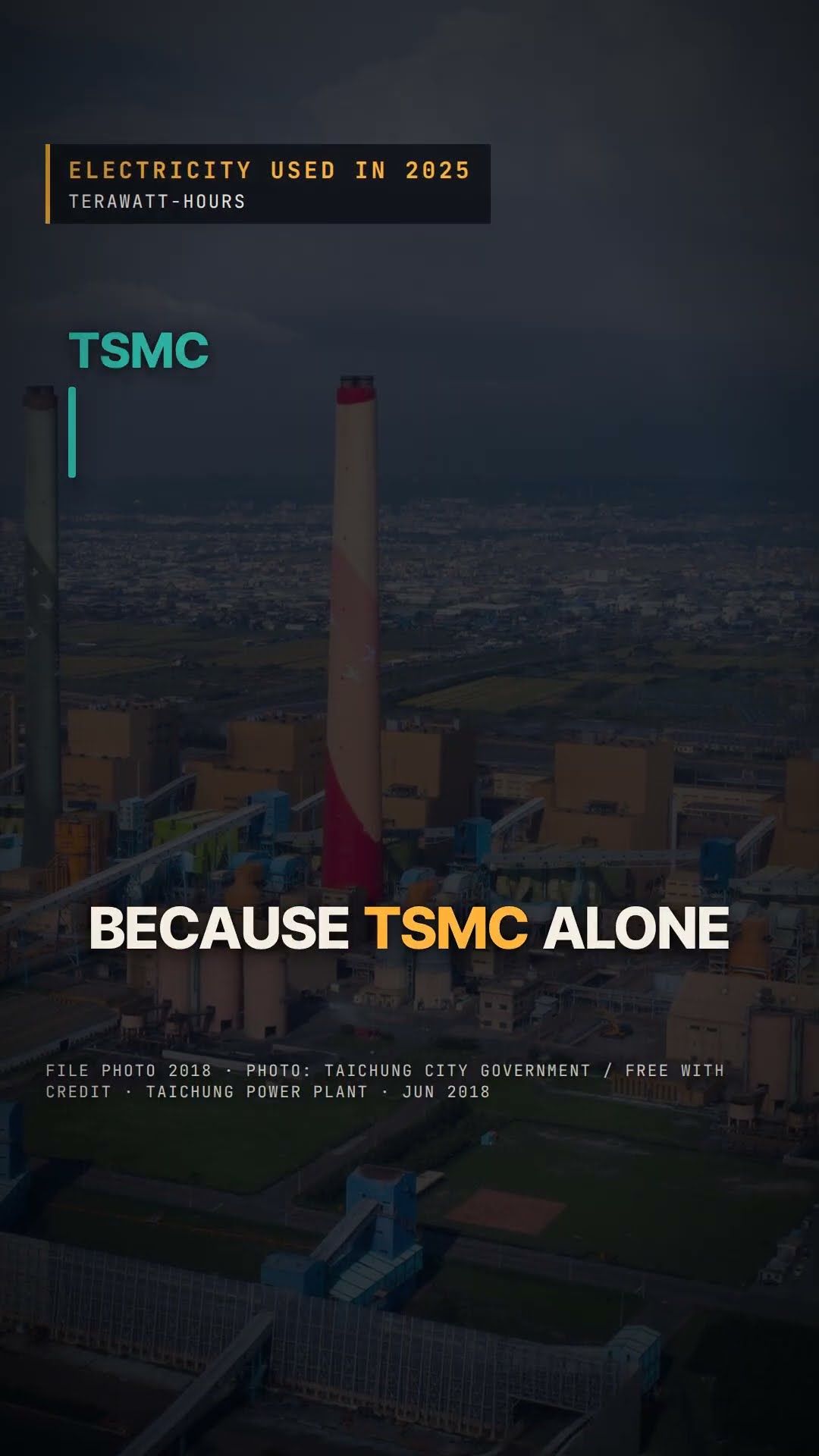
TSMC used about 29 TWh in 2025, roughly a tenth of Taiwan's power, to make the newest chips nobody else can make at scale.
1:15 One island, the world's chipsDomino 4
AI & phones
The first dominoes: AI data centres, smartphones and laptops, then the companies that sell them.
9:28 If it stoppedDomino 5
Asia
In Bloomberg Economics' war scenario, South Korea's output falls almost a quarter and Japan's about 15%. Estimates, not forecasts.
9:28 If it stoppedDomino 6
Your money
TSMC is the biggest single company in the main emerging-markets index. A global or emerging-markets index fund probably owns a piece of this chain.
9:28 If it stopped
The story
What this episode explains
Nvidia's AI chips, the processors in Apple's iPhones and most of the world's most advanced chips come from one company, almost all of them from one island: TSMC. Japan, America, Samsung, Intel and Elon Musk are spending fortunes to copy it, yet TSMC still takes about 70% of contract chipmaking revenue. And Taiwan imports about 95% of its energy: after the Strait of Hormuz all but closed, its Qatari gas (a third of its LNG in 2025) stopped arriving.
Why can't anyone copy TSMC, and what if it stopped? Morris Chang's 1987 "least evil choice"; Kumamoto, Arizona, Intel, Samsung and Rapidus; what TSMC did to Taiwan; our own analyses (September 2026 sales alone beat every full year to 2012; more electricity than Sri Lanka and 115+ countries; Taiwan's LNG month by month; a bigger MSCI EM weight than all of India); CSIS's blockade wargames, the 2021 chip shortage and Bloomberg Economics' scenarios.
- 72.5%
- of the 10 biggest contract chipmakers' revenue, Q2 2026 (TrendForce)
- 29 TWh
- used by TSMC in 2025: more than Sri Lanka and 115+ countries
- 12 days
- of gas Taiwan held in May 2026, against a legal minimum of 11
The World's Chip Factory Has 12 Days of Gas
Read it instead
The full transcript
Read all 9 chapters
0:00One company, one island
Nvidia's AI chips. The processors inside Apple's iPhones. By most estimates, the majority of the world's most advanced chips, almost all of them, are made by one company, on one island, TSMC.
Countries are spending fortunes to copy it. Japan has promised up to just over 1 trillion yen for TSMC's factories in Kumamoto. America has pulled it into a $265 billion plan in Arizona. Samsung, Intel, and Elon Musk all want its business. Yet TSMC still takes about 70% of the world's contract chipmaking revenue.
And the island it sits on imports about 95% of its energy. In 2025, a third of the gas Taiwan imported came from Qatar. Then war all but closed the Strait of Hormuz, and from April to August 2026, not one tonne arrived.
So why can't anyone copy TSMC? What has one company done to Taiwan and to the rest of Asia? And if it ever stopped, which dominoes would fall first? The answer runs all the way to your phone and probably to your savings.
This is Dominomics. We take one big story and follow its chain reaction all the way to your money.
1:15One island, the world's chips
TSMC doesn't sell chips under its own name. Other companies design them and TSMC makes them. In 2025 its biggest customer, which media identify as Nvidia, paid it 19% of its revenue, and Apple 17.
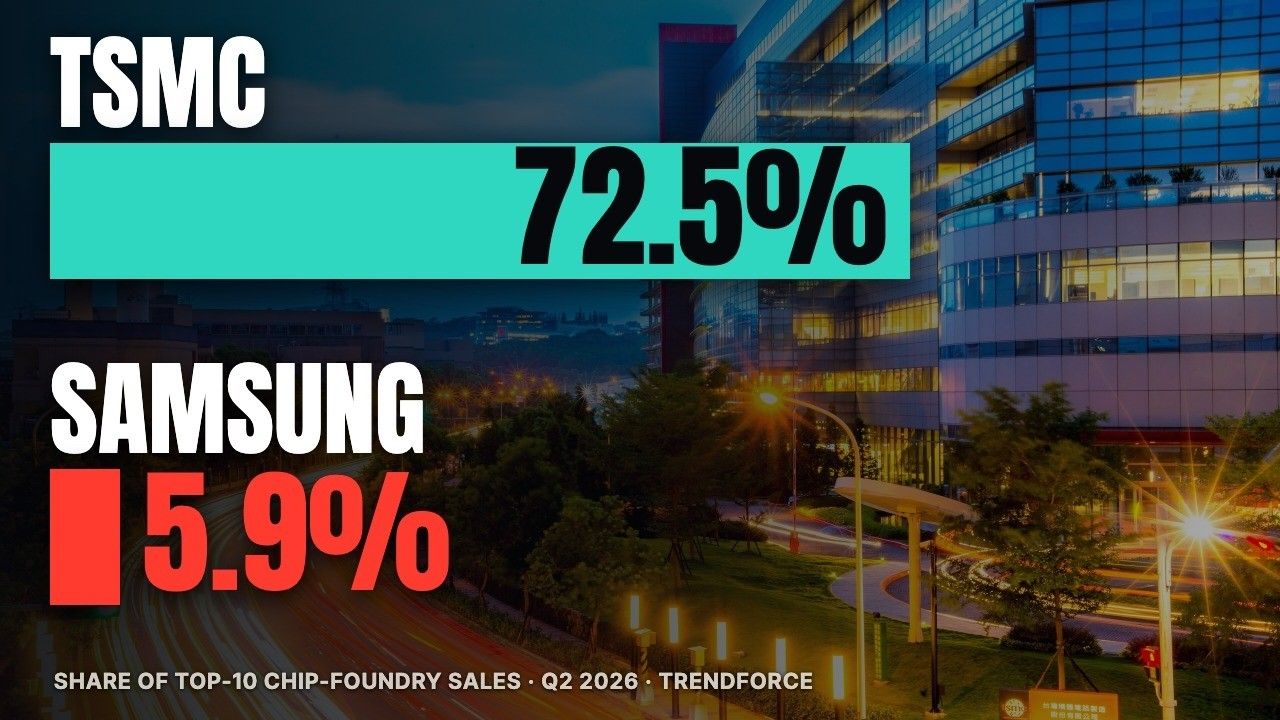
And nobody comes close. In the second quarter of 2026, by TrendForce's count, TSMC took 72.5% of the revenue of the world's 10 biggest contract chipmakers. Samsung took 6.
And it's bigger than ever. We added up TSMC's own monthly sales reports since 2002. In September 2026 alone, it sold more than in any full year up to 2012. High-performance computing, led by AI, is now 68% of its revenue. Smartphones. 21.
That makes it one of the most valuable companies on earth, worth about $1.9 trillion in Taipei, on October the 21st, two-fifths of Taiwan's stock market. And in the MSCI emerging-markets index, followed by funds around the world, TSMC alone weighs more than every Indian company combined.
So if one company is worth that much, why hasn't anyone simply built another one?
2:30Why nobody can copy it
Start in 1985. Morris Chang had spent about 25 years at Texas Instruments and left once he saw no way to the top job put out in the pasture, in his words. Taiwan's government asked him, at 54, to run its industrial research institute. Within weeks, a senior minister, K.T. Li, asked him for a plan for a chip company, in a week or so.
As Chang saw it, Taiwan had no strength in chip design or patents, and little in sales. Its only possible strength was making chips. So he proposed a company that would make chips for anyone and compete with none of its customers. He called it the least evil choice. TSMC was founded in February 1987, with a government fund and the Dutch company Philips as its biggest shareholders.
The industry thought it made no sense. But it meant anyone could start a chip company without building a factory. By Chang's count, before 1991, there were fewer than a hundred of these fabless firms. By 2007, close to a thousand. Today, Nvidia, AMD, Qualcomm, and Apple all design chips that TSMC makes.
And while TSMC did one thing, its rivals did many. TSMC began mass production with extreme ultraviolet machines, the tools behind today's smallest chips about four years before Intel. And when GlobalFoundries gave up in 2018, only three companies were left at the leading edge. TSMC, Samsung, and Intel.
Now everyone is trying to rebuild that machine somewhere else. Japan's first TSMC factory, in Kumamoto, has made chips since December 2024. But older ones, and it lost money in 2025 before a small profit in early 2026. On October the 16th, Japan approved making 3-nanometre chips at the second, by the end of 2028. By then, TSMC plans to be making 1.4 nanometre chips in Taiwan, two full generations newer.
In Arizona, TSMC's first factory has made 4-nanometre chips since late 2024 and turned its first profit in 2025. The second, at 3 nanometres, is due in 2027. But abroad costs more. TSMC expects its overseas factories to cut its gross margin by about 2 points in 2026 and by 3 to 4 later.
Its rivals are paying even more. Intel's chip-making business lost about $30 billion from 2023 to 2025, and Intel says that without an outside customer for its next process, it may move production to other foundries, particularly TSMC. Samsung's contract chip business is a twelfth of TSMC's size and by analysts' estimates still losing money. And Japan's Rapidus has been promised more than 2.3 trillion yen and aims to make two-nanometre chips from 2027.
So why is it so hard? First, building? In the 2010s, a new chip factory took about 900 days to build in America, against about 640 in Taiwan. Then cost? In 2022, Morris Chang said that at TSMC's older American factory, running since the late 1990s, the same chip still cost about 50% more to make than in Taiwan. And he called America's plan a very expensive exercise in futility.
But the hardest part is what money can't buy quickly. TSMC's leading-edge factories sit along about 240 kilometres of one island, with their suppliers and engineers close by. When TSMC staffed Arizona with many of its own engineers, its early yields there were reported to match Taiwan's. The factory can be copied. The company is much harder.
And Taiwan keeps it that way on purpose. Its government says TSMC's factories abroad must stay at least one generation behind its newest in Taiwan. And every big investment abroad needs its approval. America's commerce secretary has talked of moving 40% of Taiwan's chipmaking to America. Taiwan's vice premier called that impossible.
6:34What it did to Taiwan
All this is making Taiwan the fastest -growing rich economy in the world this year, by the IMF's count. Its own statistics agency expects 11% growth in 2026, the most since 1987. And so far this year, Taiwan's biggest export isn't chips, it's computers and servers, driven by AI data centres.
It has changed Taiwan's place in Asia, too. In 1995, Japan's output per person, in dollars, was more than three times Taiwan's. By the IMF's count, Taiwan passed Japan in 2024 and South Korea in 2025, for the first time since 2002. Korea's own chip boom may take the lead back. The IMF has Korea ahead again in 2027.
But not everyone feels richer. In 2025, TSMC paid its non-managerial staff an average of about 4 million Taiwan dollars, more than five times the national average. Seven in ten Taiwanese employees earn less than the average wage, and half of all employees, part-timers included, get under 40,000 Taiwan dollars a month in regular pay.
By Bloomberg's estimate, one company is now about a tenth of Taiwan's economy. So Taiwan's fortunes and the world's chips hang on the same thing. And it isn't what most people think.
7:53The weak link isn't a missile
Chipmaking eats electricity. In 2025, TSMC used about 29 terawatt hours, roughly a tenth of Taiwan's power. We compared that with every country's electricity use. TSMC alone uses more than Sri Lanka. A country with about as many people as Taiwan, and more than 115 countries in all.
And almost all of Taiwan's energy arrives by sea. It imports about 95% of it. Natural gas now makes half of Taiwan's electricity. Nuclear power since May 2025 makes none.
So when war all but closed the Strait of Hormuz, Taiwan lost the supplier of a third of its gas. Its state energy company bought wherever it could. Gas from the United States more than tripled and Asian spot prices more than doubled in March. In May, Taiwan held about 12 days of gas. The legal minimum was 11.
It worked. Total gas imports actually rose. The grid held through a record peak in May. And the government froze electricity prices twice. Leaving the state power company to absorb about 71 billion Taiwan dollars of extra fuel costs from March to August.
But it showed what planners had warned about. In a 2025 study, the think tank CSIS ran 26 wargames of a blockade of Taiwan. In every one, natural gas ran out in about 10 days.
Without resupply, by week nine, virtually all manufacturing had stopped. Chips included. By that reckoning, an island with less than two weeks of gas wouldn't have to be invaded to be stopped.
9:28If it stopped
So what would happen if TSMC stopped? We've had a small preview. In 2021, a shortage of mostly older, cheaper chips cost the world's carmakers an estimated $210 billion in sales and 7.7 million cars that were never built.
A stop at TSMC would hit the newest chips, the ones nobody else can make at scale. The first dominoes would be AI data centres, smartphones and laptops, and then the companies that sell them.
Then Asia. In February 2026, Bloomberg Economics estimated that a blockade of Taiwan would cut the world's output by about 5% in a year. A war would cost about $10.6 trillion, almost a tenth of the world economy, with South Korea's output down almost a quarter and Japan's about 15%. These are scenario estimates, not forecasts.
And then your money.
TSMC is the biggest single company in the main emerging-markets index. Its customers are among the biggest companies on America's stock market.
If your pension or savings sit in a global or emerging-markets index fund, wherever you live, you probably own a piece of this chain.
10:39Why the chain might hold
There are strong reasons it may never be tested. China needs these chips too. In 2025, China spent more importing chips, about $425 billion than importing crude oil.
That's the idea behind Taiwan's silicon shield. The world can't afford to let TSMC break. So it has every reason to protect Taiwan. In 2022, TSMC's then-chairman Mark Liu put it bluntly. Nobody can control TSMC by force. Its factories depend on a live connection to the outside world. Critics answer that the shield thins with every factory built abroad.
And the copies, imperfect as they are, are insurance. Once Arizona is fully built, about 30% of TSMC's 2-nanometre and newer capacity is planned to be there. And in 2026 so far, China hasn't staged a named large-scale military exercise around Taiwan.
11:35What to watch
So what to watch? Intel's results on October the 29th. TSMC's October sales on November the 10th. Nvidia's results later in November. Taiwan's gas as Asia's winter demand peaks. And in December, Taiwan's next decision on electricity prices.
11:52So, why can't anyone copy TSMC?
So why can't anyone copy TSMC? Because what it has isn't one machine or one secret. It's almost 40 years of learning. A dense web of suppliers and engineers within a few hours drive. And customers who trust it never to compete with them. Money can buy the factory.
It can't buy the 40 years.
And if it stopped, the chain would run from one island's gas terminals to the world's AI and phones, to Asia's biggest economies, to the funds most of us own. That's why so many governments are paying to copy it, and why Taipei, Beijing, and Washington all have reasons to keep it running.
Tell me in the comments. Is your country trying to build its own chips? And where are you watching from?
This is Dominomics. I'll see you at the next domino.
Sources & notes
Where the numbers come from
Sources
- TSMC (Q3 2026 results and transcript; 2025 Form 20-F; monthly revenue; 2025 sustainability report via REccessary)
- TrendForce
- TWSE
- MSCI
- Computer History Museum (Morris Chang, 2007)
- Brookings/CSIS podcast (2022)
- CSET
- Intel 10-K
- METI, EE Times Japan
- Focus Taiwan, CNA, Taipei Times
- Reuters
- DGBAS
- IMF WEO (Oct 2026)
- Taiwan MOF
- MOEA Energy Administration
- Taipower
- CSIS (Jul 2025)
- AlixPartners
- Bloomberg Economics (Feb 2026)
- China NBS
- CNN
- Ember via Our World in Data
- Natural Earth
- Yahoo Finance, FinMind
Please note
For educational purposes only. Not financial advice. Scenario figures are published estimates, not forecasts. Figures as of October 21–22, 2026; US$ conversions at NT$32.5 and ¥158 per US$. "Countries" in our electricity comparison means sovereign countries (Ember data via Our World in Data, latest year, mostly 2025).
Spotted a mistake?
Tell us at business@dominomicsofficial.com. Corrections are logged on our corrections page.
Images, footage and data credits
Charts by Dominomics from the sources above. Photos and footage (cropped, resized, graded; free licences):
- Office of the President (Taiwan) / CC BY 2.0 (Taichung LNG Terminal, 2015; TSMC Fab 15, 2015; Jensen Huang, 2023; Datan Power Plant, 2021; TWSE, 2021)
- 4300streetcar / CC BY 4.0 (TSMC Fab 14B, Tainan, 2025; TSMC Fab 18, Tainan, 2025; Taipei 101, 2026)
- Cabinet Public Relations Office (Japan) / PDL 1.0 (Takaichi and C.C. Wei, 2026)
- Keeteria / CC BY-SA 4.0 (JASM (TSMC) Fab, Kikuyo, Kumamoto, 2024)
- Hunter Trick (TrickHunter) / CC BY-SA 4.0 (TSMC Fab 21 under Construction, Phoenix, Arizona, 2023)
- 曾 成訓 (Flickr: tsengphotos) / CC BY 2.0 (TSMC Fab 12B, Hsinchu, 2015)
- Matthew Smith (Flickr) / CC BY 2.0 (Ras Laffan LNG, Qatar, 2012)
- Thingreenline4546 / CC BY-SA 4.0 (TSMC Fab 22 under Construction, Kaohsiung, 2024)
- Kenny Mori / Office of the President (Taiwan) / CC BY 2.0 (Morris Chang, TSMC Founder, 2018)
- Simon Liu / Office of the President (Taiwan) / CC BY 2.0 (Morris Chang, 2023)
- Outlookxp / CC BY-SA 4.0 (Bust of K.T. Li, His Former Residence, Taipei, 2016)
- Rob Bulmahn / CC BY 2.0 (Silicon Wafer, 2020)
- Oskar Alexanderson / CC BY-SA 2.0 (Samsung Town, Seoul, 2009)
- Bybbisch94 / CC BY-SA 4.0 (ESMC (TSMC) Fab Site, Dresden, 2025)
- Coolcaesar / CC BY-SA 4.0 (Intel Headquarters, Santa Clara, 2023)
- Sam Beebe, Ecotrust / CC BY 2.0 (Intel Fabs, Hillsboro, Oregon, 2009)
- Douitashimashite / CC BY-SA 4.0 (Rapidus Fab under Construction, Chitose, 2024)
- T Gordon Cheng / CC BY-SA 4.0 (Hsinchu Science Park 40th-Anniversary Sign, 2020)
- Liu Shu-fu / Office of the President (Taiwan) / CC BY 4.0 (President Lai, 2026)
- Achabonn / CC BY 4.0 (Xinyi, Taipei, 2024)
- Taichung City Government / free with attribution (Taichung Power Plant, 2018)
- Kaohsiung City Government / Taiwan government open data (Port of Kaohsiung, 2023)
- Ajrocket1 / CC BY-SA 4.0 (Unfinished Cars Waiting for Chips, Czechia, 2021)
- S h y numis / CC BY 4.0 (Yeouido, Seoul, 2024)
- Rosemoon / CC BY-SA 3.0 (Philips Light Tower, Eindhoven, 2012)
- Pexels licence: Tima Miroshnichenko, Kelly, Steve B, Stephen Pierce, Esteban M, Khan ishaan, MrColo, Rafael Minguet Delgado, Alex Grant, Levi Wedge, Edie Reed, Engin Altundağ
- Unsplash licence: Zhong-wei Xu
- CC0: Mark_JH, Bpp88520, Crazyblocks, Rhetos
- Public domain: NASA Johnson Space Center, The White House, Adam Schultz, The White House, Briston
The next domino
Keep following the chain
Don't miss the next one
Get the next chain reaction in your inbox.