Which Southeast Asian Economy Breaks First?
Oil near $110, a Fed raising rates and money running to the dollar. We stress-tested six Southeast Asian economies against all three.
The chain reaction
From Hormuz to you
Domino 1
Hormuz
A war chokes the Strait of Hormuz.
1:20 Three shocks at onceDomino 2
Oil ~$110
Malaysia pays about RM40 billion (≈ US$9.8 billion) to keep petrol at RM1.99 (≈ US$0.49). Bali rations petrol by number plate.
1:20 Three shocks at onceDomino 3
The Fed
US rates rise and money runs to the dollar. The Philippine peso hits a record low, with inflation at 7.2%.
1:20 Three shocks at onceDomino 4
Stress test
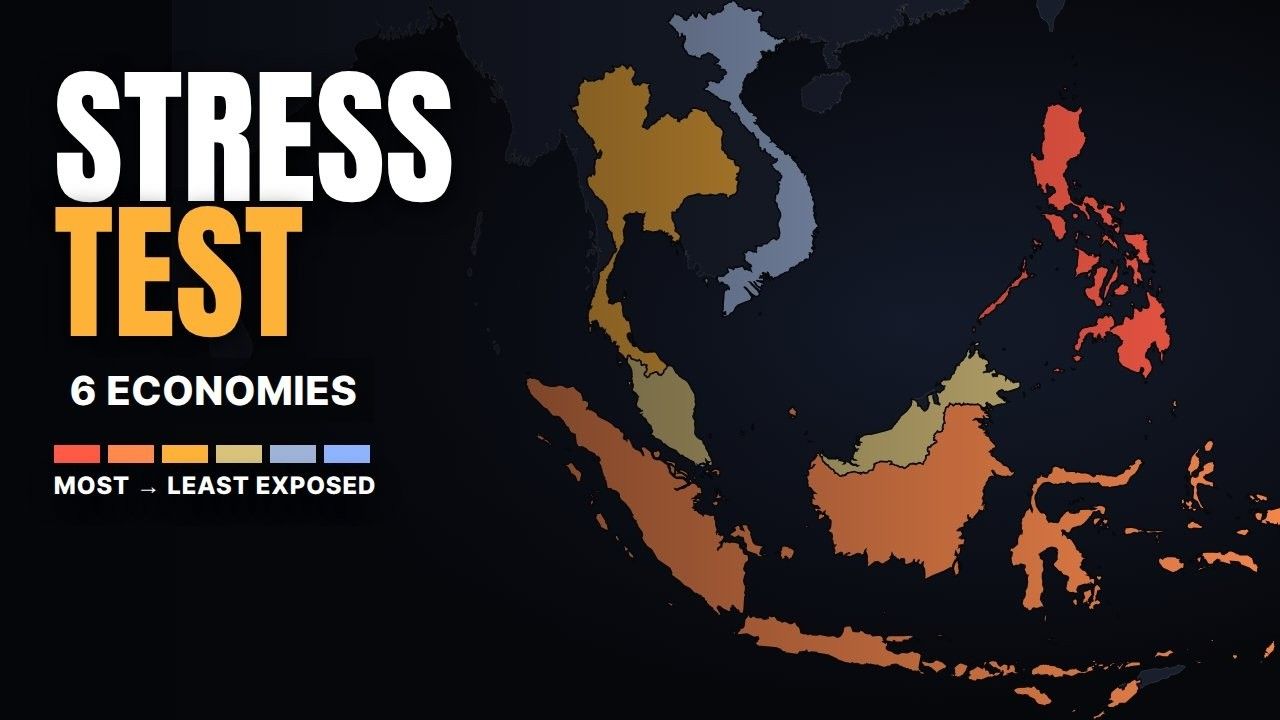
Six economies, the same three shocks, ten numbers each, then scored 26 other ways.
3:44 Our stress testDomino 5
Who breaks?
Ranked from the least exposed to the most. No. 1 surprised us.
4:14 No. 6: the least exposedDomino 6
You
At the pump first, unless your government pays. Then in your shopping basket.
10:34 Where it reaches you
The story
What this episode explains
Bali rationed petrol by number plate. Malaysia pays about RM40 billion to keep petrol at RM1.99. The Philippine peso hit a record low with inflation at 7.2%, and Thailand's fuel fund is about ฿100 billion in debt. It's one chain reaction: a war that choked the Strait of Hormuz, oil near $110, and a Federal Reserve raising rates while money runs to the dollar.
So we built a stress test: six Southeast Asian economies (Indonesia, Malaysia, the Philippines, Thailand, Vietnam, Singapore), the same three shocks, ten numbers each from official and market data, ranked, then scored 26 other ways to see what holds. We look at what "breaking" actually means (Sri Lanka 2022, Indonesia 1998), count down from the least exposed to the most, and ask whether any of it looks like 1997.
- 6
- economies, the same three shocks
- 7.2%
- Philippine inflation as the peso hit a record low
- RM40B
- ≈ US$9.8B Malaysia pays to hold petrol at RM1.99
6 Asian Economies Stress-Tested. #1 Surprised Us.
Read it instead
The full transcript
Read all 12 chapters
0:00Three shocks, six economies
In October, petrol stations on one of the most famous islands in the world began running dry. In Bali, queues spilled out onto the roads, and from October the 17th, drivers could only buy subsidised petrol on odd or even days by number plate, three litres per motorbike.
Across the water, Malaysian drivers pay 1.99 ringgit for a litre of petrol. In mid-October, without the subsidy, it cost 4.62. This year, the government expects fuel subsidies to cost about 40 billion ringgit.
In Manila, the peso closed at its weakest ever, and prices are rising 7.2% a year. In Thailand, the fund that keeps diesel cheap is about 100 billion baht in debt.
It's one chain reaction. A war that choked the Strait of Hormuz. Oil near $110. And an American central bank raising interest rates. When that happens, money leaves places like these for the safety of the dollar.
So we built a stress test. Six economies, the same three shocks, ten numbers each, from official and market data. Which Southeast Asian economy breaks first? The answer isn't the one most people would guess.
This is Dominomics. We take one big story and follow its chain reaction all the way to your money.
1:20Three shocks at once
Start with the oil.
On the last trading day before the war with Iran began, in February, a barrel of Brent crude cost $72. On October the 19th, after reports of tankers hitting mines in the Strait of Hormuz, it closed at almost 110, that's 51% more.
Every country here pays for oil in dollars, and only Malaysia sells more than it buys. Thailand needs it most. Its net oil imports are worth almost 4% of its economy.
The second shock comes from Washington. With oil pushing American prices up, the Federal Reserve raised interest rates in September, and the 10-year U.S. government bond hit 5.31%, its highest in more than 20 years.
That sets off the third. When the safest borrower in the world pays 5%, investors pull money out of riskier places. They sell local bonds and shares. Swap the local currency for dollars, and the currency falls. Then the oil, priced in dollars, costs even more.
Central banks can fight back by spending their dollar reserves or by raising interest rates to make money stay. By September, Bank Indonesia had raised its rate by a full percentage point since the war began, and the Philippines by three quarters.
On October the 21st, Bank Indonesia held its main rate at 5.75 percent, but raised the rate it pays banks to park money overnight, to 5 percent.
2:45What breaking looks like
But what does it mean for an economy to break? It isn't a stock market crash. It's running out of dollars.
Sri Lanka. 2022. For years it had imported more than it earned and borrowed to cover the gap. By May, the central bank had less than 50 million dollars it could actually use. Sri Lanka defaulted for the first time in its history. For two weeks that summer, fuel was sold only to essential services. Inflation reached almost 70%.
Indonesia has lived through it too. In 1997 and 1998, the rupiah lost about 85% of its value. In May 1998, under an IMF rescue, the government raised the price of petrol by 71%. Riots followed, and less than three weeks later, President Suharto resigned.
So breaking has a pattern. A country can't find the dollars for its oil and its debts. And its government must choose between letting prices explode and running out of money.
3:44Our stress test
Our test measures how close each country is to that. Ten numbers in four groups. Oil, dollars, the budget, and what the markets are already saying. On each one, every country gets a rank from one, the most exposed, to six. We average the ranks, then score it 26 other ways, to see which results hold up. It measures exposure, not the odds of a crisis.
4:14No. 6: the least exposed
Here's the countdown from the least exposed to the most.
Number 6. Singapore. It earns far more from the world than it spends. A surplus the IMF puts at almost 17% of its economy. The government runs a budget surplus, has no net debt and doesn't subsidise petrol, and the Singapore dollar has slipped only about 1% since the war.
Singapore's weak spot is jobs, not money. The economy grew 5.4% last quarter. But in the second quarter, layoffs were the highest since 2020.
4:45No. 5
Number 5. Vietnam.
It grew almost 10% last quarter, the fastest of the six. The dong has barely moved, and so few foreigners own its government bonds that there's hardly any hot money to run. In October, its central bank was telling banks to cut interest rates, not raise them.
But Vietnam has the thinnest cushion. Its reserves would pay for only about two months of imports, less than half of anyone else here. And that's an estimate. Because Vietnam doesn't publish them regularly.
5:17No. 4 and 3: the middle
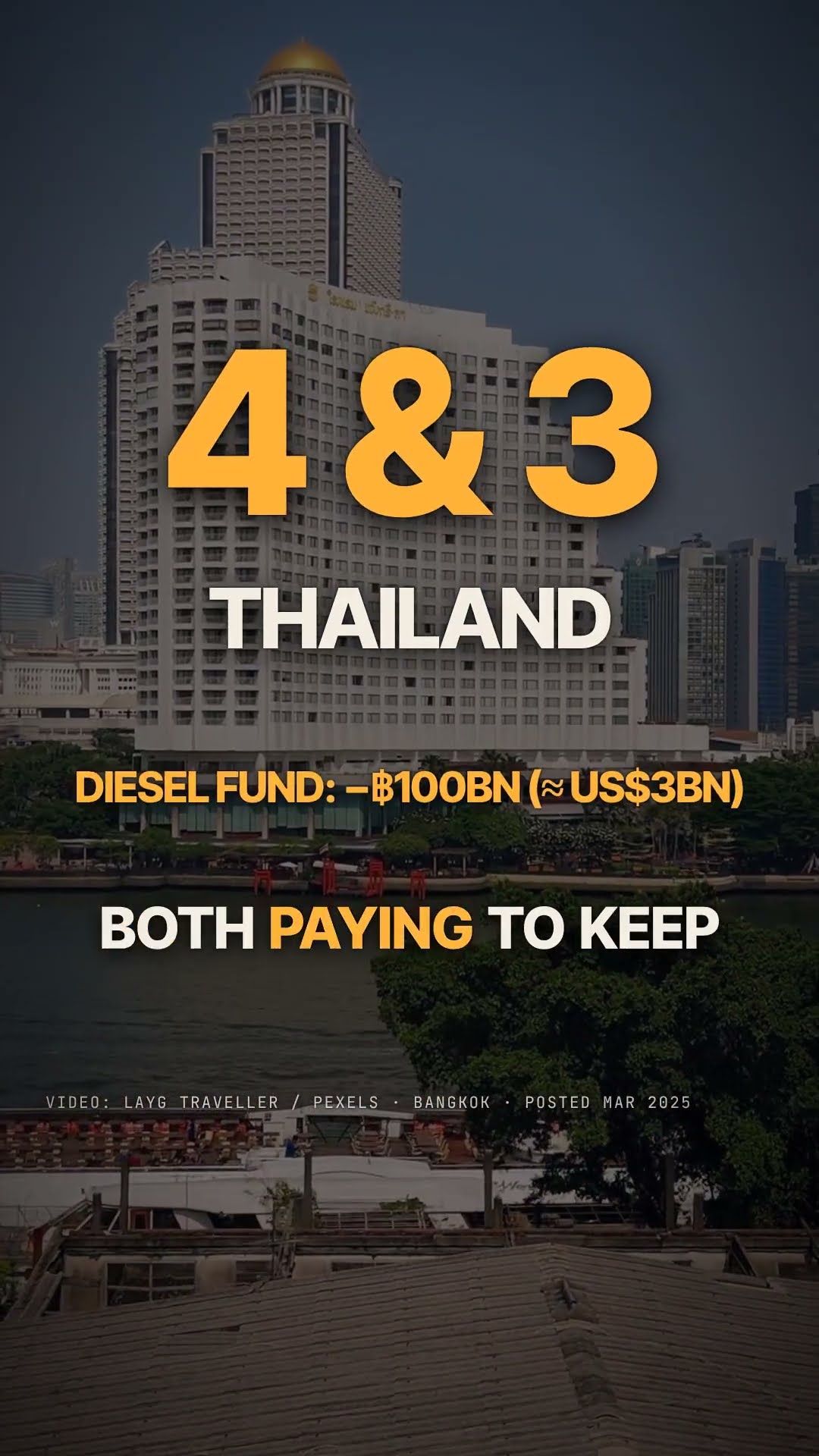
Four and three are so close that they swap places depending on how you score them. So we'll take them together. Malaysia and Thailand. Both hold down the price at the pump. They pay for it in different ways.
Before the war, Malaysia's unsubsidised petrol cost 2 ringgit 59. In mid-October it was 4.62, and drivers still paid 1.99. So the fuel subsidy bill has gone from 15 billion ringgit in the budget to about 40 billion half of Malaysia's whole budget deficit, and more than four-fifths of what it spends on health.
But Malaysia exports more oil than it imports. So expensive oil also brings money in. Petronas, the state oil company, is expected to pay the government 27 billion ringgit this year. And inflation is only 1.8%. Its weak spot is foreign money. Foreigners own about a fifth of its government bonds. The most of the six.
Thailand has no such luck. To keep diesel cheap, it uses an oil fuel fund. In February, the fund had money in the bank. By October the 4th, it was 99 billion baht in debt, on average about 450 million baht more every day. In September, without the fund and a refinery discount, diesel would have cost 54 baht a litre, not 41.
Thailand's reserves would cover eight months of imports, the most of the six, but its economy is growing the slowest, and floods since September have affected more than three million people.
Which leaves two. And if you've been following the news, you probably think you know which one is first.
6:52No. 2
Number 2. Indonesia. In June, the rupiah passed 18,000 to the dollar, weaker than at any point in 1998. In October, its stock market had its worst day since 1998. And its most popular petrol is frozen at 10,000 rupiah a litre, regardless of the price in the world, as the energy minister put it.
That promise is expensive. In the first nine months of this year, Indonesia spent almost 377 trillion rupiah on energy subsidies and compensation, more than its entire budget deficit over the same months. And by law, the deficit can't go above 3% of the economy. The government expects about 2.85.
Bali is what the end of that chain looks like. A problem with a tanker's anchor delayed its berthing by about 15 hours. But the head of the state oil company named a second cause. Demand for the cheap, subsidised petrol. When one grade costs more than a third less than the next, demand piles onto it, and any delay becomes a queue.
But here's why Indonesia isn't first. Most of the hot money has already gone. In 2017, foreigners owned 40% of Indonesia's government bonds. By June, less than 13. There's far less money left that can suddenly run.
8:10No. 1: the most exposed
Number 1. The most exposed economy on our test. The Philippines.
It came first in 25 of our 27 ways of scoring, and it ranks worst on 5 of the 10 numbers.
The Philippines doesn't cap fuel prices. They're set by the market. So the oil shock lands strait on households. Inflation in September was 7.2%, the fastest in three and a half years. Rice was up 20%, and for the poorest families, almost 24.
And its gaps come in pairs. This year, the IMF expects it to spend more abroad than it earns by almost 5% of its economy, wider than in 1996 the year before the Asian crisis. Its budget deficit is the widest of the six. The peso is down 8.5% since the war, to a record. And the government's 10-year borrowing cost is up almost 2 percentage points this year, to 8%.
On October the 9th, the central bank's governor, Eli Remolona, described the bind. The crowd seems to want low interest rates, strong peso and low inflation, he said. But we have to do the right thing for the economy. So the bank has raised rates three times since April, even with growth at its weakest outside the pandemic since 2009.
So why the Philippines and not Indonesia? Because the shock is already showing in Philippine prices the peso and the bond market. And it has the widest gaps to fill. Indonesia's biggest risk sits in one promise, the fuel price freeze.
9:42Why it isn't 1997
So, does the Philippines look like 1997 on the numbers that broke countries then? It doesn't. Its reserves are more than three times its short-term foreign debt, and foreigners own only about 4% of its government bonds. And there's no peg to defend. The peso is allowed to fall, so the central bank doesn't have to spend its dollars defending a line.
Across the region, the numbers are a different world. At the end of 1996, foreign banks' short -term loans to Indonesia were almost twice its reserves. Now they're less than a third. In Thailand, they've gone from more than its reserves to less than a tenth.
Breaking in 2026 looks slower and quieter, petrol rationed in Bali, subsidy bills that squeeze other spending, rice in the Philippines that costs a fifth more than a year ago, not a sudden collapse, but governments running out of room, one shock at a time.
10:34Where it reaches you
Where does it reach you?
At the pump first. Unless your government is paying. And in Malaysia and Indonesia, that money has to come out of something else. Then in your shopping basket, through rice and transport. And if your family sends dollars home to the Philippines, in October each one bought more pesos than ever before. That's one of the Philippines' biggest cushions. About $36 billion a year sent home from abroad.
10:58What to watch
Dates to watch. October the 22nd. The Philippine Central Bank. October the 28th. The Federal Reserve and the Bank of Thailand. November the 5th. Malaysia's Central Bank. And December the 31st. The end of Indonesia's promise not to raise subsidised fuel prices this year. And every day the Strait of Hormuz. Every tanker that gets through takes a little pressure off all six.
So, which Southeast Asian economy breaks first? On these numbers, the Philippines is the most exposed. Indonesia is close behind, and Singapore is the least. But on the numbers that broke countries in 1997, none of them is close. The real question isn't who breaks. It's how long each government can keep protecting its people.
Tell me in the comments, where would you rank your country, and did we get it right?
This is Dominomics. I'll see you at the next domino.
Sources & notes
Where the numbers come from
Sources
- IMF World Economic Outlook and Fiscal Monitor (Oct 2026)
- World Bank WDI
- BIS (exchange rates, consolidated banking statistics, policy rates)
- ADB AsianBondsOnline
- UN Comtrade
- EIA STEO (Oct 2026)
- Federal Reserve
- US Treasury
- Bank Indonesia
- Indonesia Finance Ministry (APBN KiTa) and Energy Ministry
- Pertamina
- Bank Negara Malaysia
- Malaysia Finance Ministry, data.gov.my fuel prices
- Bangko Sentral ng Pilipinas
- Philippine Statistics Authority
- Bank of Thailand
- Thailand Oil Fuel Fund Office, EPPO
- State Bank of Vietnam
- Singapore METI, MAS, MOM, SingStat
- Central Bank of Sri Lanka
- Antara, Bernama, Reuters, Bloomberg, Nikkei Asia, The Star, Malay Mail, BusinessWorld, GMA, Inquirer, The Nation, Jakarta Globe, Tempo, CNN Indonesia, VnExpress, The Straits Times, CNA. Our own analysis: the ten-measure stress test and its 27 versions; currencies since the war began; foreign banks' short-term loans against reserves, 1996 vs 2025; pump prices in US dollars; Malaysia's fuel subsidy against its deficit and health budget.
Please note
For education and entertainment only. Not financial advice. The stress test measures exposure to three shocks, not the odds of a crisis. Figures as of October 20, 2026. The narration is an AI voice.
Spotted a mistake?
Tell us at business@dominomicsofficial.com. Corrections are logged on our corrections page.
Images, footage and data credits
Maps: Natural Earth · Charts drawn by Dominomics from the sources above. Photos and footage (cropped, resized, graded; free licences):
- Annidafattiya / CC BY-SA 4.0 (Fuel queue, Klungkung, Bali, Oct 2026)
- Kaihsu Tai / CC BY-SA 3.0 (Bank Negara Malaysia, Kuala Lumpur, 2009)
- Reversemos.Sapanaht / CC BY 4.0 (Bank of Thailand, Bangkok, 2022)
- Sjasminum / CC BY-SA 4.0 (Bangko Sentral ng Pilipinas, Manila, 2023)
- Federal Reserve / public domain (Eccles Building, Washington, 2011)
- Pimnl / CC0 (Ho Chi Minh City, 2024)
- U.S. Navy / public domain (Navy Oiler in the Strait of Hormuz, 2020)
- U.S. Navy (Centcom) / Public Domain (Mine Clearance, Strait of Hormuz, 2026)
- Pixtuqq / CC0 (Makati, Metro Manila, 2025)
- Angie Reyes / Pexels licence (Philippine Peso, 2021)
- Wiki Farazi / CC0 (Petronas Station, Pagoh, Johor, 2021)
- Queencitycebu / CC BY-SA 4.0 (Rice Stall, Toledo City, Cebu, 2026)
- Peggy Anke / Pexels licence (Malaysian Ringgit, 2020)
- Supanut Arunoprayote / CC BY 4.0 (Sathorn Unique Tower, Bangkok, 2021)
- Diego Delso / CC BY-SA 4.0 (Raffles Place, Singapore, 2023)
- Antano / CC BY-SA 4.0 (Protest, Galle Face, Colombo, 2022)
- Zawzawaungthwin / CC0 (Flooded Lak Si Station, Bangkok, 2026)
- Chainwit. / CC BY 4.0 ('Out of Diesel', Sukhothai, Thailand, 2026)
- Sergei Starostin / Pexels licence (Bali, 2026)
- Layg Traveller / Pexels licence (Bangkok, 2025)
- Pew Nguyen / Pexels licence (Saigon, 2022)
- Johan Pamz / Pexels licence (Jakarta, 2025)
- Cos Walks / Pexels licence (Jeepneys, Manila, 2024)
- Mohammed Alim / Pexels licence (Kuala Lumpur, 2025)
- Cos Walks / Pexels licence (Manila, 2024)
- Timo Volz / Pexels licence (Marina Bay, Singapore, 2025)
- Esteban M / Pexels licence (Oil Tanker at Anchor, 2020)
- Medelam / CC BY-SA 4.0 (Bank Indonesia, Jakarta, 2026)
- DPR Secretariat General / public domain (Jakarta, May 1998; Suharto resigns, May 21, 1998)
- U.S. Embassy Jakarta / public domain (SCBD, Jakarta, 2024)
- Tom Fisk / Pexels licence (Jakarta, 2020)
- Defrino Maasy / Pexels licence (Rupiah, 2025)
- Tima Miroshnichenko / Pexels licence (US dollars, 2020)
The next domino
Keep following the chain
Don't miss the next one
Get the next chain reaction in your inbox.