Singapore Pays Malaysia 3 Sen for Water. Is That Fair?
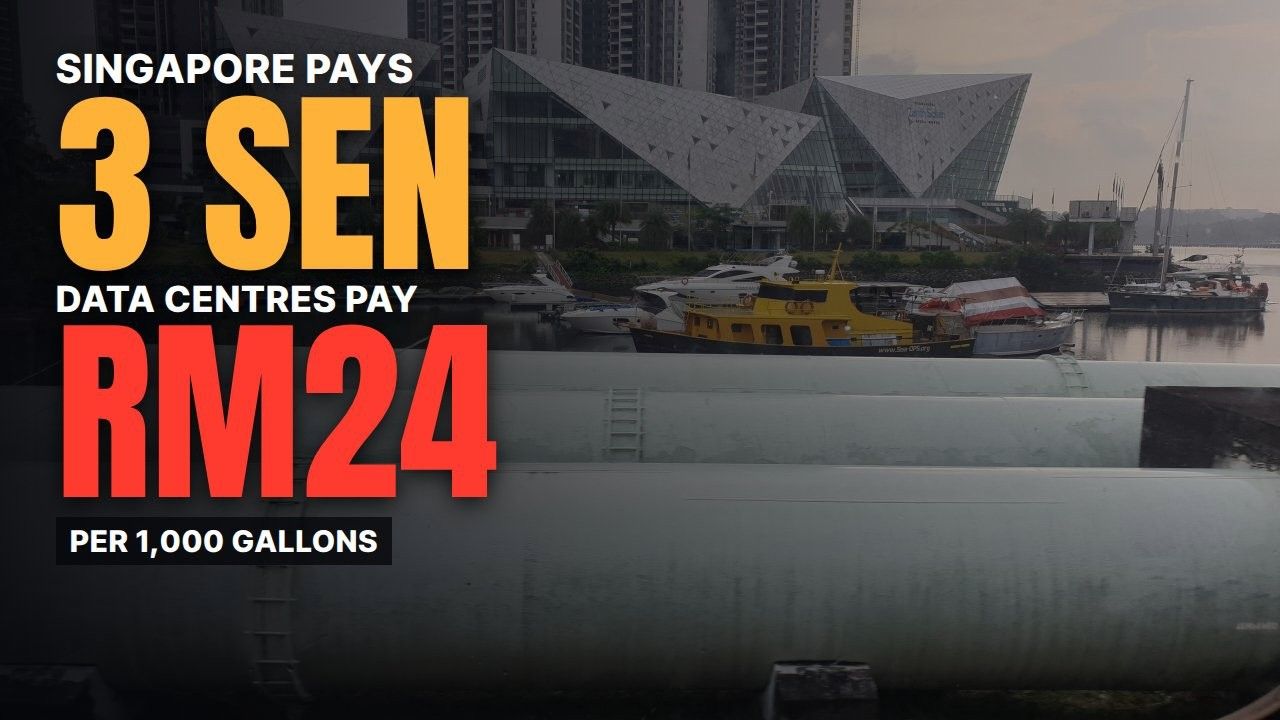
Since 1962 Singapore has paid Johor 3 sen for every 1,000 gallons of raw water. Now AI data centres want the same river.
The chain reaction
From the 1962 deal to your taps
Domino 1
The 1962 deal
Singapore pays 3 sen (≈ US$0.007) per 1,000 gallons of raw Johor River water. The price has never changed.
0:00 3 sen since 1962Domino 2
The review
A review nobody asked for in 1987, the prices Malaysia asked for around 2000, and "no need for a review" in 2024.
2:10 The review nobody asked forDomino 3
Both ways
Johor buys treated water back at 50 sen (≈ US$0.12) and, by our count, pays slightly more each year than Singapore pays for all the raw water.
3:16 Follow the money both waysDomino 4
The river
Linggiu Reservoir measured from space, Johor's rationing, and pollution that cut water to 1.8 million people.
5:56 A river under strainDomino 5
Data centres
AI data centres in Johor want the same river.
7:23 The thirstiest new customerDomino 6
Your taps
When the river runs short, whose taps run dry first?
9:54 Where it reaches you
The story
What this episode explains
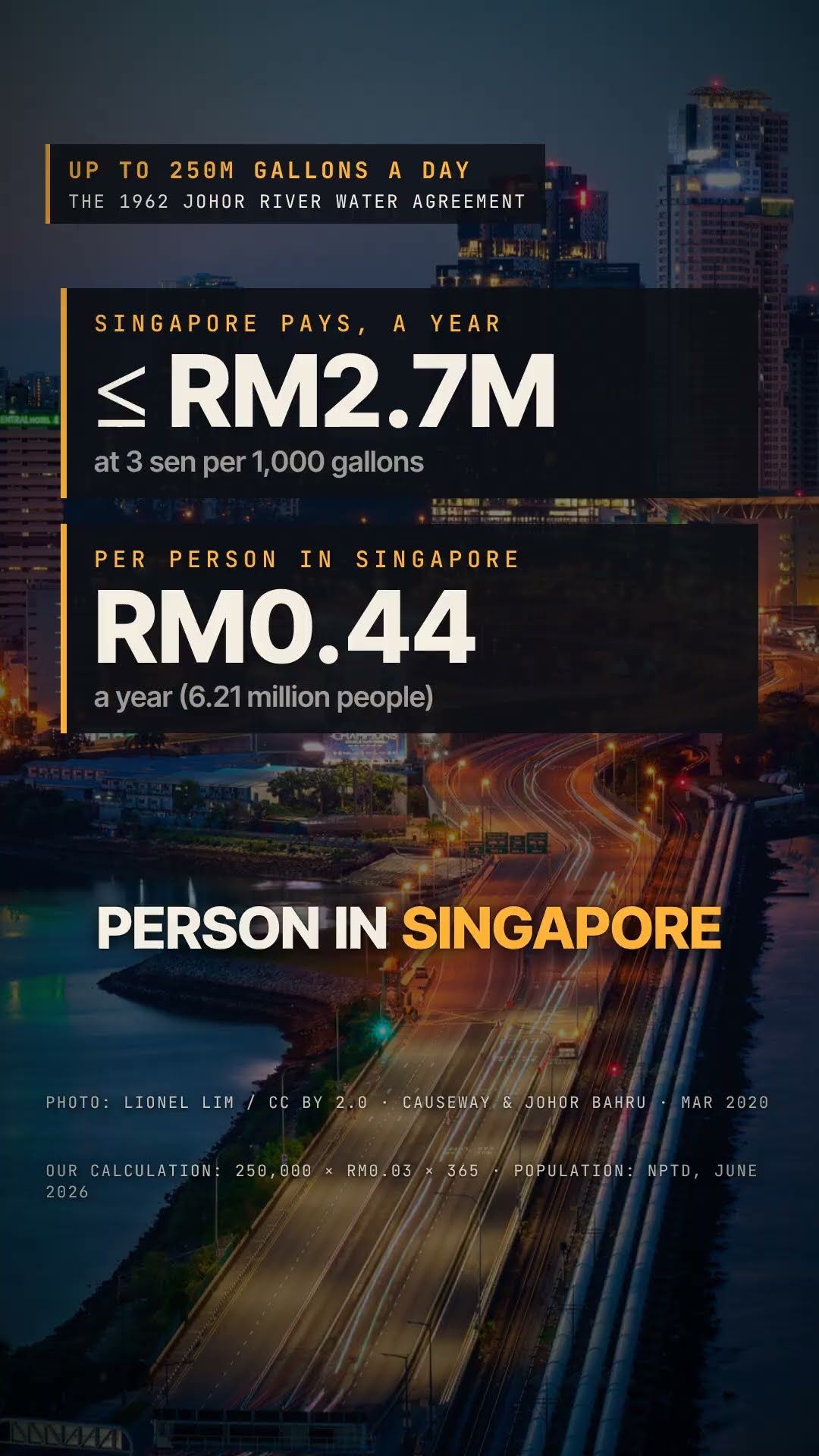
Since 1962, Singapore has paid Johor 3 sen for every 1,000 gallons of raw water from the Johor River, and the price has never changed. Up to 250 million gallons a day, for at most RM2.7 million a year: less than 50 sen per person in Singapore. But the water also flows back: Johor buys treated water from Singapore at 50 sen, about 16 million gallons a day, and by our count pays slightly more each year than Singapore pays for all the raw water. Now AI data centres in Johor want the same river.
We follow the water one way and the money the other: the 1962 deal and the 1965 separation, the review that nobody asked for in 1987, the prices Malaysia asked for around 2000, why Malaysia decided in 2024 there was "no need for a review" for now, Singapore's Four National Taps, Linggiu Reservoir measured from space (2016–2026), Johor's rationing and the river pollution that cut water to 1.8 million people, and the data centres. Then we answer both questions: is 3 sen fair, and when the river runs short, whose taps run dry first?
- 3 sen
- ≈ US$0.007 per 1,000 gallons, unchanged since 1962
- 250M
- gallons a day Singapore may draw from the Johor River
- RM2.7M
- ≈ US$0.66M: the most Singapore pays in a year
Singapore Pays 3 Sen for Water. Here's the Twist.
Read it instead
The full transcript
Read all 9 chapters
0:003 sen since 1962
Every day, up to 250 million gallons of Malaysian river water flow through pipes like these, across this causeway, into Singapore.
For every thousand gallons Singapore pays Johor 3 sen. That price was set in 1962. Sixty-four years later it hasn't changed by a single sen.
Add it up, and Singapore's bill for all that water comes to, at most, about 2.7 million ringgit a year. That's less than 50 sen a year for each person in Singapore.
But water also flows the other way. Johor buys treated water back from Singapore. And by our count, it pays Singapore slightly more each year than Singapore pays for all the raw water.
And now a third customer has arrived at the same river: the AI data centres rising across Johor.
So, is 3 sen fair? And when the river runs short, whose taps run dry first?
This is Dominomics. We take one big story and follow its chain reaction all the way to your money.
1:02A price older than Singapore
The deal is older than Singapore itself. On September 29, 1962, the state government of Johor signed a water agreement with the City Council of Singapore, a year before Singapore joined Malaysia. It runs for 99 years until 2061.
Singapore got the right to draw up to 250 million gallons a day from the Johor River, at 3 sen per thousand gallons. Singapore would treat the water, and Johor could buy some of it back, up to 2% at 50 sen per thousand gallons.
An older deal, signed in 1961, covered two smaller rivers. It expired in 2011, and Singapore handed those waterworks to Johor, free of charge. The 1962 deal is the one that's left.
Three years later, Singapore left Malaysia. The water went into the separation itself: Each government guaranteed that its side would keep to the water agreements. And Singapore registered the deal at the United Nations.
Singapore's first Prime Minister, Lee Kuan Yew, later said water dominated every other policy. Every other policy had to bend at the knees for water survival.
2:10The review nobody asked for
The agreement had one door left open. After 25 years in 1987, the prices could be reviewed, to account for inflation and the cost of labour, power and materials. Both prices: the 3 sen Singapore pays, and the 50 sen Johor pays.
1987 came and went, and nobody asked. Singapore says Malaysia chose not to, because Johor was buying cheap treated water, and that the right to review has lapsed. Malaysia says the clause allows a review any year after 1987, and that the right is still there.
Around 2000 the argument got loud. Malaysia asked for 45 sen, then 60 sen, then 3 ringgit, then 6 ringgit 25. About 200 times the old price. In 2018, Prime Minister Mahathir Mohamad called 3 sen manifestly ridiculous.
Then, in December 2024, Malaysia's government told parliament that, for now, there was no need for a review of the raw water price. Its reason: any change would have to consider the cost of the treated water Johor buys back.
3:16Follow the money both ways
To see why, follow the money both ways. We worked it out from the prices in the agreement and the volumes both governments have published.
Singapore can draw up to 250 million gallons a day. At 3 sen per thousand, that's 7,500 ringgit a day, or about 2.7 million ringgit a year, at most.
Johor is entitled to 5 million gallons a day of treated water. But Malaysia's government says Johor actually buys an average of 16 million more than three times its entitlement. At 50 sen, that's 8,000 ringgit a day: about 2.9 million ringgit a year.
So Johor gets back about 6% of the water and pays slightly more than Singapore pays for all of it. And in 1990 Singapore paid Johor another 320 million ringgit for land and a lease to build a reservoir upstream at Linggiu, and it built and runs the dam itself.
Now look at the prices. Adjusted for Malaysian inflation, 3 sen in 1962 is about 19 sen today. By Malaysia's own comparison, Hong Kong pays mainland China about 14 ringgit 50 for a thousand gallons of raw water. And Johor now charges its data centres 24 ringgit for a thousand gallons of treated water. 800 times 3 sen.
Malaysia's foreign minister told parliament in 2019 that Malaysia has been subsidising Singapore by at least 42 million ringgit a year.
But 50 sen is frozen too. Johor says treating water itself costs about 1 ringgit 80 per cubic metre. That's more than 8 ringgit per thousand gallons, 16 times what it pays Singapore. Raise one price and you raise the other. That's why, for all the arguing, neither side has forced a review.
4:59Singapore's insurance
Singapore never planned to live on that bargain forever. It built what it calls the Four National Taps: rain caught in reservoirs, water from Johor, NEWater, which is used water purified until it's clean enough to drink, and desalinated seawater. NEWater was introduced in 2002, with 60,000 bottles handed out at the National Day Parade.
Today Singapore uses about 440 million gallons a day. Even the full 250 from Johor covers just over half. It now has four NEWater plants and five desalination plants, and it expects demand to almost double by 2065.
But making your own water takes energy. Singapore's Water Agency says the new sources need 5 to 17 times more energy than treating rainwater. That's one reason Singapore raised water prices by 30% in 2017 and 2018, and again in 2024 and 2025.
5:56A river under strain
Meanwhile, the river itself is under strain. In the drought of 2015 and 2016, Linggiu Reservoir, the dam Singapore built to keep the Johor River flowing, fell to 20% of its capacity, its lowest on record. Singapore warned that it could run dry in 2017.
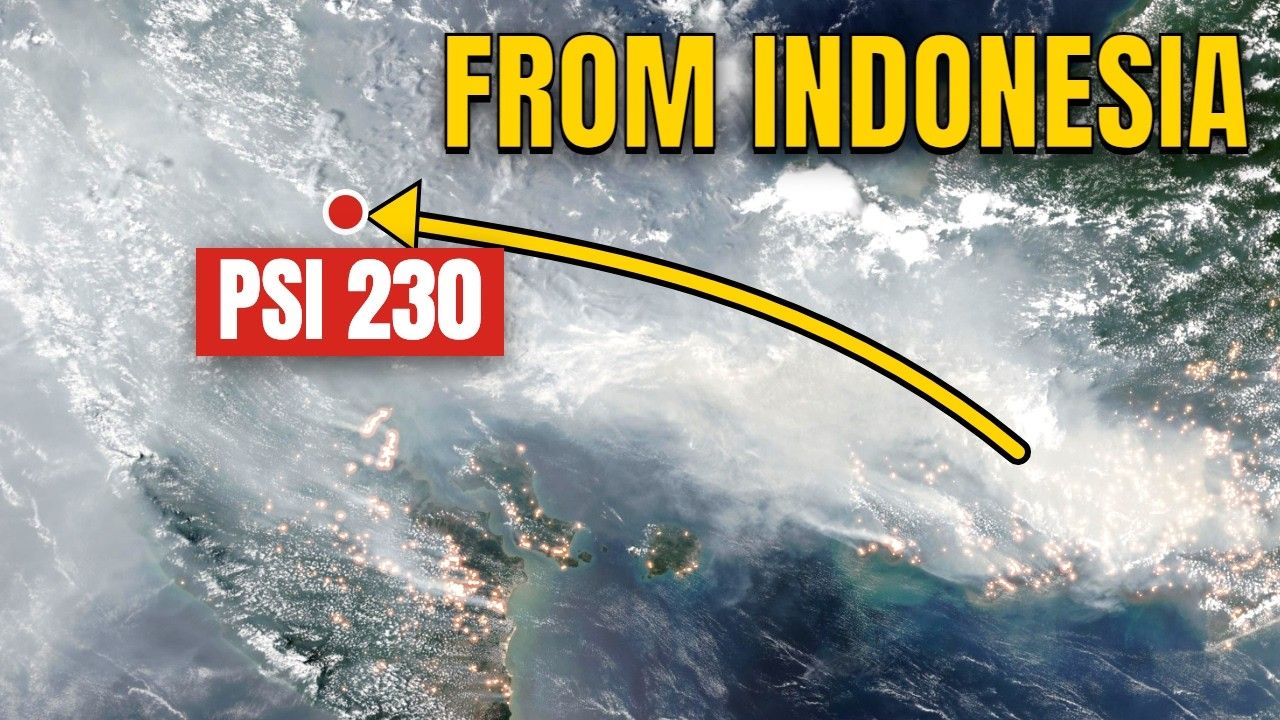
No official level has been published since 2019, so we measured it ourselves, from every clear Sentinel-2 satellite image since 2016. In September 2016, its water covered about 26 square kilometres, half its full size. Since 2021, it has been back near full. This October the satellite could barely see it through the haze.
Johor's own dams are another story. In February, taps in Kluang and Pontian ran on a timetable: at worst, 24 hours on, 48 hours off. By late August, six of Johor's dams were at warning level. Now Johor is watching all 17 of its dams as a near-record El Niño heads into next year, the same El Niño behind this year's haze.
Then there's pollution. On October the 31st, 2025, a pond at a sand mine upstream burst into the Johor River. Johor cut water, in stages, to about 456,000 accounts, nearly 1.8 million people. The last were reconnected five days later. Singapore shut its own waterworks on the same river and said its supply was unaffected.
7:23The thirstiest new customer
Now add the new customer. In 2019, Singapore paused new data centres. The builders went across the causeway. In 2021, Johor had about 10 megawatts of data centres. By the middle of 2026, it had more than 1,100 megawatts running, and 600 more under construction.
Data centres run hot. And many of them cool their servers with water. Malaysia's government says data centres use about 64 million litres of water a day now, and those in Johor and Selangor alone will need about 390 million by 2030. That's six times as much.
Johor has started pushing back. A Johor state official said new water-cooled data centres would have to wait until mid-2027. Data centres now pay 5 ringgit 33 per cubic metre, five times what a household pays for its first 20. In February, residents near one site held Malaysia's first protest against a data centre. And Malaysia has stopped approving new data centres that have nothing to do with AI.
Put it together and Johor's water system is running close to its limit. Its treatment plants can make about 2,350 million litres a day. In 2025 they made about 2,040 million. By 2030 Johor expects to need 2,700 million. And its target to stop buying water from Singapore by 2030 is already in doubt.
8:48So, is 3 sen fair?
So, is 3 sen fair? On its own, 3 sen is a relic. Nobody would sign that price for water today.
But 3 sen was never on its own. It's one half of a bargain. The other half, 50 sen for treated water, is a price Johor doesn't want to lose either. Follow the yearly water bills both ways and they roughly cancel out. And in December 2025, both leaders said they were open to discussing the price of raw and treated water together. Singapore's prime minister calls water not a pressing issue and Malaysia's calls it no longer a contentious issue.
What doesn't cancel out is the water. Johor's rivers are being asked to supply a country of 6 million people, a state of 4 million, and a new industry that wants 6 times more water by 2030.
And our second question already has an answer on the record. When the river failed in November 2025, it was Johor's taps that ran dry, not Singapore's. Singapore spent decades building its way out of depending on this river. Johor still depends on it, and on the treated water Singapore sells back.
9:54Where it reaches you
Here's where it reaches your money. In Singapore, every drop of independence is paid for in electricity, and the water bill has already gone up twice in a decade. In Johor, the plan for new dams and treatment plants costs more than 5 billion ringgit, and someone will pay for it: taxpayers, households, or the data centres that want the water.
Three things to watch. On November the 5th, a joint technical group reviews the emergency plan for Linggiu Dam. Over the coming months, whether Johor's dams hold through El Niño. And in mid-2027, whether Johor opens its water to new water-cooled data centres.
Singapore pays 3 sen because in 1962 water was cheap and 2061 was far away. The deal still has 35 years to run. The price may never change. The river already has.
Tell me in the comments: is 3 sen fair? And where are you watching from?
This is Dominomics. I'll see you at the next Domino.
Sources & notes
Where the numbers come from
Sources
- 1962 Johor River Water Agreement (clauses as quoted by Malaysia's water ministry, Dewan Rakyat, Nov 12, 2019)
- Separation Agreement 1965 (UN Treaty Series No. 8206)
- Singapore MFA (Water Agreements; 1998–2003 talks; Jan 2017 written reply on Linggiu)
- Singapore Parliament (Balakrishnan, Jul 9, 2018)
- Malaysia Dewan Rakyat (Saifuddin, Mar 12, 2019; Akmal Nasrullah, Dec 2, 2024; Fadillah, Jun 24 and Oct 13, 2026)
- PETRA via Bernama (Oct 19, 2026)
- PUB (Four National Taps, NEWater, desalination, tariffs)
- Ranhill SAJ (tariffs, Feb 2026 scheduled supply)
- SPAN
- Bernama, The Star, The Straits Times, CNA, NST, Malay Mail, SCMP
- TNB
- Cushman & Wakefield, Fitch (data-centre capacity)
- World Bank (Malaysia CPI)
- NPTD (Singapore population, June 2026). Our own analysis: the two-way ledger; prices per 1,000 gallons on one scale; Linggiu Reservoir's water surface from every clear Sentinel-2 image since 2016 (MNDWI on cloud-free pixels).
Please note
For education and entertainment only. Not financial or legal advice. Figures as of October 20, 2026; raw and treated water prices are per 1,000 imperial gallons (4.546 m³). The narration is an AI voice.
Spotted a mistake?
Tell us at business@dominomicsofficial.com. Corrections are logged on our corrections page.
Images, footage and data credits
Satellite: contains modified Copernicus Sentinel data 2016–2026, processed by Dominomics (via Microsoft Planetary Computer) · Maps: © OpenStreetMap contributors (ODbL), Natural Earth · Charts drawn by Dominomics from the sources above. Photos and footage (cropped/resized/graded; free licences):
- Lionel Lim / CC BY 2.0 (Causeway, 2020) Ryuch / CC BY-SA 4.0 (Causeway water mains, 2023) Slleong / CC0 (2 photos, 2020: Causeway, Johor Bahru CIQ) Nick Allen / CC BY-SA 4.0 (Causeway from JB Sentral, 2017) ZKang123 / CC BY-SA 4.0 (Causeway traffic, 2023) Peter in s / CC BY-SA 3.0 (Johor River, 2011) Chongkian / CC BY-SA 4.0 (Johor River at Kota Tinggi, 2018) Bjoertvedt / CC BY-SA 4.0 (Johor River estuary, 2018) Schristia / CC BY 2.0 (Johor Bahru, 2010) Afifi Zulkifle / Unsplash (Johor Bahru at night, 2021) Z22 / CC BY-SA 4.0 (Bedok NEWater Factory, 2019) Larrid31 / CC BY-SA 4.0 (MacRitchie Reservoir, 2026) Chainwit. / CC BY 4.0 (HDB flats, Eunos, 2025) Winston Chen / Unsplash (server cooling, 2026) Choinowski / CC BY-SA 4.0 (data centre, Amsterdam, 2020) Khairil Yusof / CC BY 4.0 (sand mining, Selangor, 2023) Australian News and Information Bureau / public domain (Lee Kuan Yew, 1965) Harry Pot (Anefo, Nationaal Archief) / CC0 (Tunku Abdul Rahman, 1960) Kremlin.ru / CC BY 4.0 (Mahathir Mohamad, 2018) Prime Minister's Office of Japan / CC BY 4.0 (Anwar Ibrahim, 2026) Number 10 / CC BY 2.0 (Lawrence Wong, 2024) U.S. Department of State / public domain (Vivian Balakrishnan, 2018) Smuconlaw / CC BY-SA 4.0 (Proclamation of Singapore, 2015) Separation Agreement 1965, UN Treaty Series / public domain Pexels videos: Kyle Chua, Richard L, Timo Volz, Max Vakhtbovych, MrColo Licences: CC BY 2.0 creativecommons.org/licenses/by/2.0
- CC BY 4.0 creativecommons.org/licenses/by/4.0
- CC BY-SA 3.0 creativecommons.org/licenses/by-sa/3.0
- CC BY-SA 4.0 creativecommons.org/licenses/by-sa/4.0
- CC0 creativecommons.org/publicdomain/zero/1.0
The next domino
Keep following the chain
Don't miss the next one
Get the next chain reaction in your inbox.