Why Indonesia's Fires Choke Singapore and Malaysia
In one week, NASA counted more than 48,000 fires in Indonesia. The people who light them never pay the bill.
The chain reaction
From the fuel to you
Domino 1
The fuel
A near-record El Niño and drained peat swamps.
1:14 The fuelDomino 2
The match
Fire is the cheapest way to clear land for palm oil and pulpwood.
2:33 The matchDomino 3
The smoke
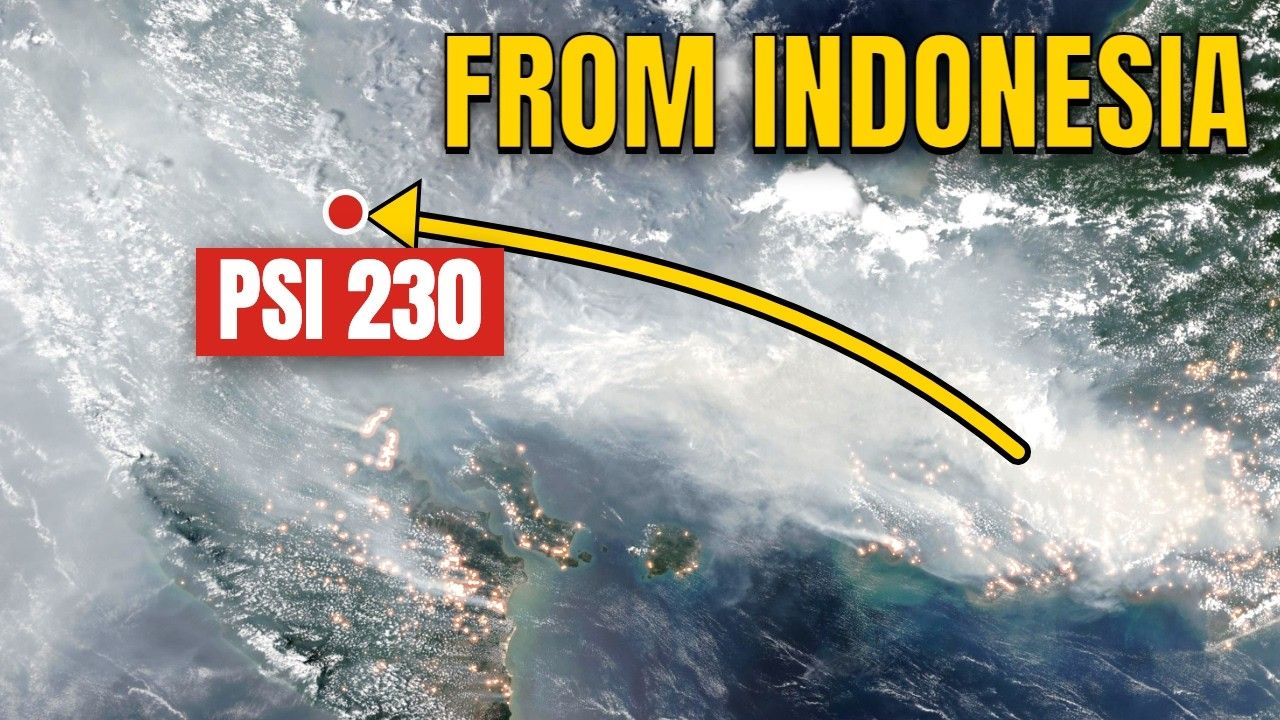
Haze crosses borders: western Singapore hits 230 on the pollution index on October 18.
3:42 The smokeDomino 4
The bill
Health, economic and climate costs, and the people who light the fires don't pay them.
4:53 The billDomino 5
You
Palm oil prices, your shopping basket and your lungs.
6:39 You
The story
What this episode explains
On October 18, the air in western Singapore hit 230 on the official pollution index, "very unhealthy". Malaysia had already sent an estimated two million students home, and one airline had cancelled its Kuala Lumpur–Singapore flights for a week because of the smoke. In one week, NASA's fire-tracking system recorded more than 48,000 fire detections in Indonesia.
We follow the chain reaction link by link: a near-record El Niño and drained peat swamps (the fuel) → fire as the cheapest way to clear land for palm oil and pulpwood (the match) → smoke across borders to Singapore and Malaysia (the smoke) → the health, economic and climate costs, and why the people who light the fires don't pay them (the bill) → palm oil prices, your shopping basket and your lungs (you). Plus why laws haven't stopped it, what 1997, 2013, 2015 and 2019 teach us, why the chain might break, and three dominoes to watch.
- 230
- PSI in western Singapore on October 18: "very unhealthy"
- ~2M
- Malaysian students sent home (estimate)
- 48,000+
- fire detections in Indonesia in one week (NASA)
Why Singapore's Air Hit 230 (It Started in Indonesia)
Read it instead
The full transcript
Read all 10 chapters
0:00The chain reaction
On Sunday, October the 18th, at 10 in the morning, the air in western Singapore hit 230 on the official pollution index. Very unhealthy, the worst reading of the year and the fifth day in a row above 200.
Across the border, Malaysia had already sent an estimated 2 million students home. One airline cancelled its flights between Kuala Lumpur and Singapore for a week, not because of storms, but because of smoke. And the smoke comes from another country. In a single week, NASA's fire tracking system recorded more than 48,000 fire detections in Indonesia.
It's called the haze. It comes back almost every year. And this year is the worst since 2015. It looks like an environmental story. But it's an economic chain reaction. It starts with a swamp. A match and a price. And it ends in your lungs and in your shopping basket.
This is Dominomics. We take one big story and follow its chain reaction, all the way to your money.
Today we follow the smoke. From the fuel, to the match, across the border, to the bill, and finally to you. Let's follow the chain.
1:14Domino 1 — The fuel
Domino One. The Fuel.
Every few years the Pacific Ocean warms up. It's called El Niño, and it pushes rain away from Indonesia. This year's is one of the strongest ever measured. On October the 13th, Australia's Weather Bureau reported the highest weekly reading in its records. Indonesia's rains, which normally return in October, are now expected in November, and in some places December.
But drought alone doesn't explain the smoke. The real fuel is underground. Indonesia has around 15 million hectares of tropical peat, most of it on Sumatra and Borneo. That's an area about the size of Bangladesh. Peat is soil made of half-rotted plants, built up over thousands of years in places many meters deep. In its natural state it's soaked like a sponge. wet peat doesn't burn.
Then come the canals. To plant oil palms and fast-growing pulpwood trees, the swamps are drained. Dry peat burns like charcoal. It smolders underground sometimes for months where water bombers can't reach it. In 2015, peat covered about 12% of the land, but it had more than half of the fires, and it produced most of the smoke.
So El Niño dries the land, and drained peat turns it into fuel. But someone still has to strike the match.
2:33Domino 2 — The match
Domino 2. The Match.
Most of these fires aren't natural. They're lit. On purpose, because fire is the cheapest way to clear land. By one estimate from forestry researchers, clearing a hectare with machines costs about $150. Burning it costs $7.
Who lights them? Plantation companies, small farmers, and middlemen who burn land to claim it and sell it. In one study in Sumatra, burned land planted with oil palm earned more than $3,000 a hectare in three years. The people who actually lit the fires got 1% of that. And between 2015 and 2019, about 30% of the burned land was inside palm oil and pulpwood concessions.
That land is valuable because of what grows on it. Indonesia and Malaysia produce 82% of the world's palm oil, the most produced vegetable oil on earth. It's in cooking oil, instant noodles, biscuits, soap, lipstick, and more and more in diesel. And the pulpwood becomes paper and tissue.
Here's the catch. Whoever lights the fire saves money. The smoke is someone else's problem.
3:42Domino 3 — The smoke
Domino 3. The Smoke.
Smoke doesn't stop at borders. On August 26, ASEAN's Weather Center raised its highest haze alert. Level 3. It has stayed there ever since, more than twice as long as in 2019. And this month, south-easterly winds have carried the smoke from Kalimantan, on Borneo, straight toward Singapore and Malaysia.
In early September, the air pollution index in Serian, in the Malaysian state of Sarawak, passed 500, and Malaysia's king declared an emergency. By October, schools had shut across Kuala Lumpur and much of the peninsula.
In Singapore, the air has been unhealthy every day for two weeks, as long as the worst stretch of 2015. The government is handing out N95 masks, has opened haze shelters, and is subsidizing clinic visits for the first time since 2015. At one electronics chain, air purifier sales jumped 600%.
And in Indonesia, where the fires burn, more than 280,000 people have been recorded with respiratory illness. And about 2,000 flights have been disrupted. The smoke even closed schools in Timor -Leste.
4:53Domino 4 — The bill
Domino Four. The Bill.
So who pays? In 2015, the last time it was this bad, the World Bank put the cost to Indonesia alone at 16 billion dollars. That's 1.9% of its whole economy. And it's more than Indonesia's entire palm oil industry added to its economy the year before.
The biggest cost is the one you can't see. Fine particles. Small enough to get deep into the lungs. Studies estimate the 2015 smoke caused somewhere between 12,000 and 100,000 early deaths across the region. The official count was 19. And babies exposed in the womb during the 1997 haze were, by age 17, about 3.5 centimeters shorter.
This year's bill is still being counted. A preliminary estimate based on work by economist Euston Quah puts Singapore's cost at 3 to 4 billion Singapore dollars, up to double 2015. A Malaysian economist estimates 20 to 50 million ringgit every day. And an Indonesian think tank puts its own country's losses at up to 120 trillion rupiah. And that only counts January to August.
And the planet pays too. By early September, Indonesia's fires had already released about 76 million tons of carbon, roughly a third of all fire emissions on Earth this year. In 2015, on 26 days out of 44, the fires emitted more carbon dioxide each day than the entire American economy.
So here's the chain in one picture. On one side whoever lights the fire saves about a hundred and forty dollars a hectare. On the other, people who never made that choice, many of them in another country pay billions. Economists call that an externality. And it's why the market, on its own, will never fix this.
6:39Domino 5 — You
Which brings us to the last domino. You.
If you live in Singapore or Malaysia, you're already paying with your lungs, your doctor's bills, and your kids' school days. But this chain reaches much further. Oil palms hate drought, and El Niño cuts their harvest 4 to 12 months later. After the 2015 El Niño, Malaysia's palm oil yields fell to a 15-year low, and world palm oil prices rose almost 40% over the next 16 months.
This time, prices haven't moved much yet, because Malaysia's warehouses are full, but this month, America's Department of Agriculture cut its forecast for Indonesia's next harvest. At the same time, Indonesia now blends half of its diesel with palm oil, so it keeps more of its own crop at home. Its producers expect exports to fall to their lowest since 2016.
Less supply. More demand at home. Fewer exports. The futures market already prices palm oil for next April, about 10% higher than for November. And no, palm oil isn't in half of everything at the supermarket, as people often say. A 2025 study of three Western supermarket chains found it listed in about 8% of food products, and possibly hidden in up to 40. So the cost won't arrive as one big bill. It arrives a few cents at a time, spread across your shopping basket.
8:00Why it keeps happening
So why does this keep happening? There are laws.
In 2002, ASEAN countries signed an agreement on transboundary haze. Indonesia, where most of the fires start, was the last to ratify it, more than 12 years later, and the agreement has no penalties.
In 2014, Singapore passed its own law, letting it fine companies abroad up to 100,000 Singapore dollars a day. In 2015, it went after several Indonesian companies, and supermarkets pulled one paper giant's tissues from their shelves. But no company has ever been convicted. On October the 16th, Singapore served notices on seven companies in Sumatra. Three of them got the same notices in 2015.
Jakarta says it can handle the fires, and it hasn't accepted help. One official reminded the neighbors that the rest of the year, Indonesia's forests send them oxygen. In 2015, Indonesia's vice president put it like this. For 11 months, they enjoyed nice air from Indonesia, and they never thanked us.
9:03We've seen this before
We've seen this chain before. In 1997, the fires cost the region an estimated $4.5 to $9 billion. In 2013, Singapore's pollution index set its all-time record 401. In 2015 came the worst fires since 1997. And in 2019, they came back again, and Malaysia closed nearly 2,500 schools.
After 2015, Indonesia did act. It set up an agency to re-wet the peat, made its ban on new permits in peatland permanent, and the biggest palm oil traders promised no deforestation and no peat. The burned area fell from 2.6 million hectares in 2015 to under 200,000 in 2017. But look at the weather. The quiet years were wet ones. When drought came back in 2019 and 2023, more than a million hectares burned again. And the peat restoration agency was shut down in 2025.
The rules worked best when it rained. This year is the test of what happens when it doesn't.
10:06Why the chain might break — and what to watch
Now to be fair, there are real reasons this chain could break.
Satellites now spot fires within hours, and anyone can match them to a company's map. Indonesia's police have named nine palm oil companies and 223 people as suspects, and the president has called the fires a top priority. One study found that restoring the peat would cost less than the fires it prevents. And from December 30, Europe's deforestation law will require proof that palm oil sold in the EU didn't come from land deforested after 2020.
So instead of predicting, let's watch. Here are three dominoes to keep your eye on.
1. The Rain. Indonesia's weather agency expects the rains to reach parts of Sumatra and Kalimantan in November. Until they do, the peat keeps burning.
2. Manila. ASEAN's leaders meet there from November the 16th to the 18th, and the haze is on the agenda. Watch whether anyone agrees to something with consequences.
And three. Palm oil. Malaysia publishes its production figures around the tenth of every month. When the El Niño drop shows up in the data, it shows up in prices next.
11:15The whole chain
The economy is a chain reaction. Most people only notice the last domino when it lands on their paycheck, their prices, or this time, the air they breathe. On this channel we follow the whole chain, from the first push to the final fall.
To see how another hidden chain in Big Tech's footnotes could reach your pension, watch our last episode. And tell me in the comments, has the haze reached you, and what did it cost you? This is Dominomics. I'll see you at the next Domino.
Sources & notes
Where the numbers come from
Sources
- National Environment Agency Singapore (hourly PSI, haze updates)
- Ministry of Health Singapore
- ASEAN Specialised Meteorological Centre
- NOAA Climate Prediction Center
- Australian Bureau of Meteorology
- BMKG
- NASA FIRMS and NASA Worldview/GIBS
- Copernicus CAMS
- GFED
- World Bank, "The Cost of Fire" (2016)
- USDA FAS (Oct 2026)
- World Bank commodity prices
- MPOB
- Bursa Malaysia (via Bernama)
- GAPKI
- Singapore Statutes Online (Transboundary Haze Pollution Act 2014)
- ASEAN Secretariat
- peer-reviewed studies (Kiely et al. 2019, 2020, 2021; Koplitz et al. 2016; Crippa et al. 2016; Tan-Soo & Pattanayak 2019; Meijaard et al. 2025; Warren et al. 2017; Field et al. 2016)
- CIFOR
- WRI
- Greenpeace SEA
- Eco-Business
- Reuters
- AFP
- Al Jazeera
- The Straits Times
- The Star
- Bernama
- Jakarta Post
- Mothership
- Full fact-check log available on request.
Please note
For education and entertainment only. Not financial or medical advice. For haze health advice, follow your national health authority (NEA/MOH in Singapore, KKM in Malaysia).
Spotted a mistake?
Tell us at business@dominomicsofficial.com. Corrections are logged on our corrections page.
Images, footage and data credits
- Satellite: contains modified Copernicus Sentinel data 2026, processed by Dominomics
- Satellite images: NASA Worldview / GIBS, VIIRS NOAA-20 corrected reflectance true colour (Oct 14, 2025 and Oct 14, 2026)
- Fire detections: NASA FIRMS, VIIRS S-NPP 375 m near-real-time active fires (Oct 11–17, 2026), nominal and high confidence
- Satellite images: NASA Worldview / GIBS, MODIS Terra and Aqua true colour (Sep 24, 2015) and VIIRS S-NPP (Sep 17, 2019)
- Sea-surface temperature anomaly: NASA JPL GHRSST MUR L4 via NASA Worldview/GIBS (Oct 13, 2026), re-coloured by Dominomics
- Oil palm harvest and peat fire footage: Voice of America, "Indonesia Prepares for Another Dangerous Fire Season" (David Boyle, Aug 8, 2016), public domain - https://www.voanews.com/a/3456758.html
- Haze over Pasir Panjang, Singapore, Oct 9, 2026: photo by Choo Yut Shing (Flickr), public domain, cropped, via Wikimedia Commons
- Firefly ATR 72-500 9M-FYD at Senai International Airport, Johor, Jan 30, 2025 (file photo): photo by S5A-0043, CC BY 4.0 (https://creativecommons.org/licenses/by/4.0/), resized, via Wikimedia Commons
- Haze in Kuala Lumpur, Sep 18, 2026 (file photo): photo by Renek78, CC0, cropped, via Wikimedia Commons
- Volunteer firefighters at a land fire in Sekabuk, Mempawah, West Kalimantan, Sep 27, 2026: photo by OttaEl, CC BY 4.0 (https://creativecommons.org/licenses/by/4.0/), cropped, via Wikimedia Commons
- Stock video: Pexels contributors (free licenses; clip list on request)
- Metaphor illustrations (dominoes, match, peat block, smouldering banknote, pantry, conference room) are AI-generated. Every image of a real place, event or year is real and credited on screen.
The next domino
Keep following the chain
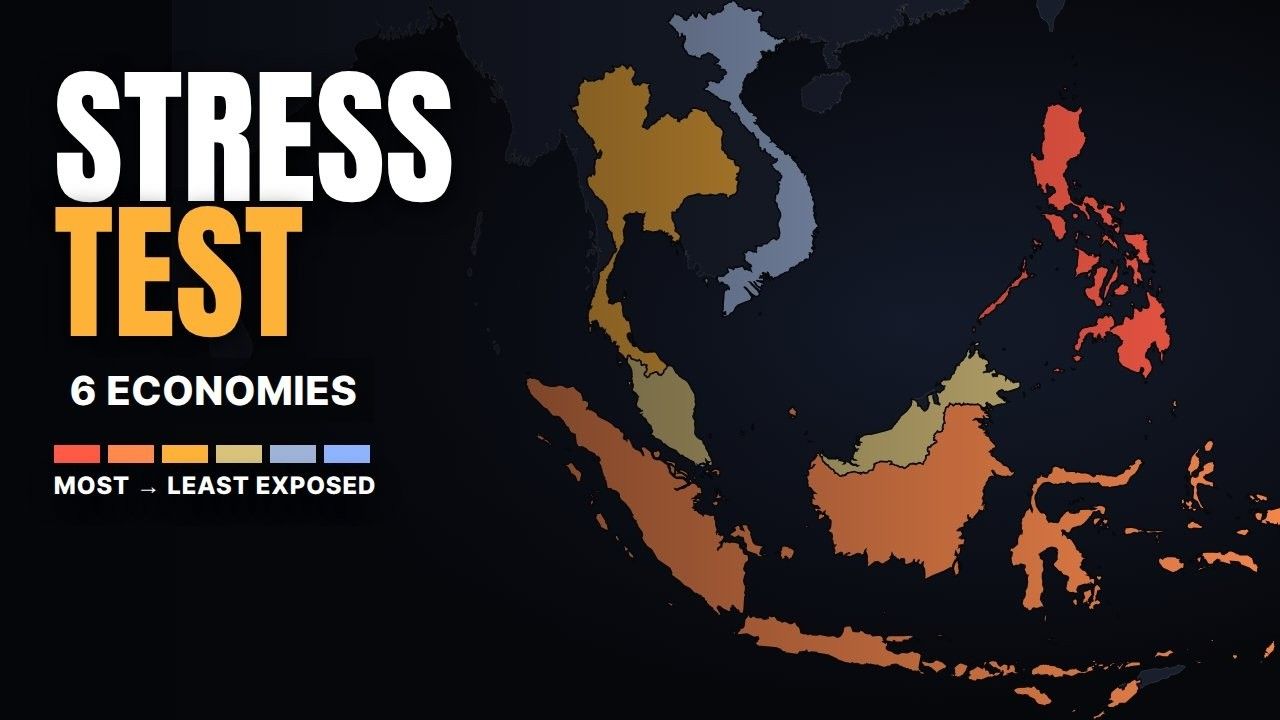
Which Southeast Asian Economy Breaks First?
HormuzOil ~$110The FedStress testWho breaks?You
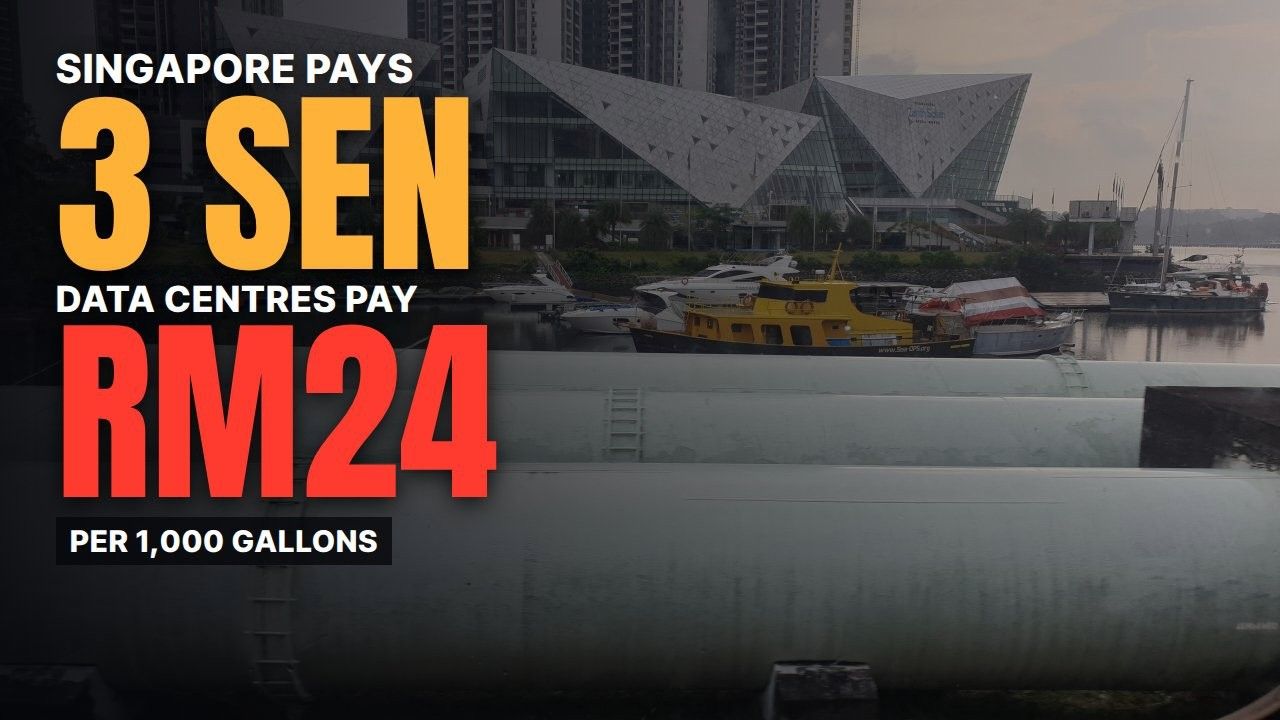
Singapore Pays Malaysia 3 Sen for Water. Is That Fair?
The 1962 dealThe reviewBoth waysThe riverData centresYour taps
Is AirAsia Running Out of Money?
The warNo hedgeLossesThe cashThe statePassengers
Don't miss the next one
Get the next chain reaction in your inbox.