The AI Bubble's Hidden $1.65 Trillion Debt Bomb
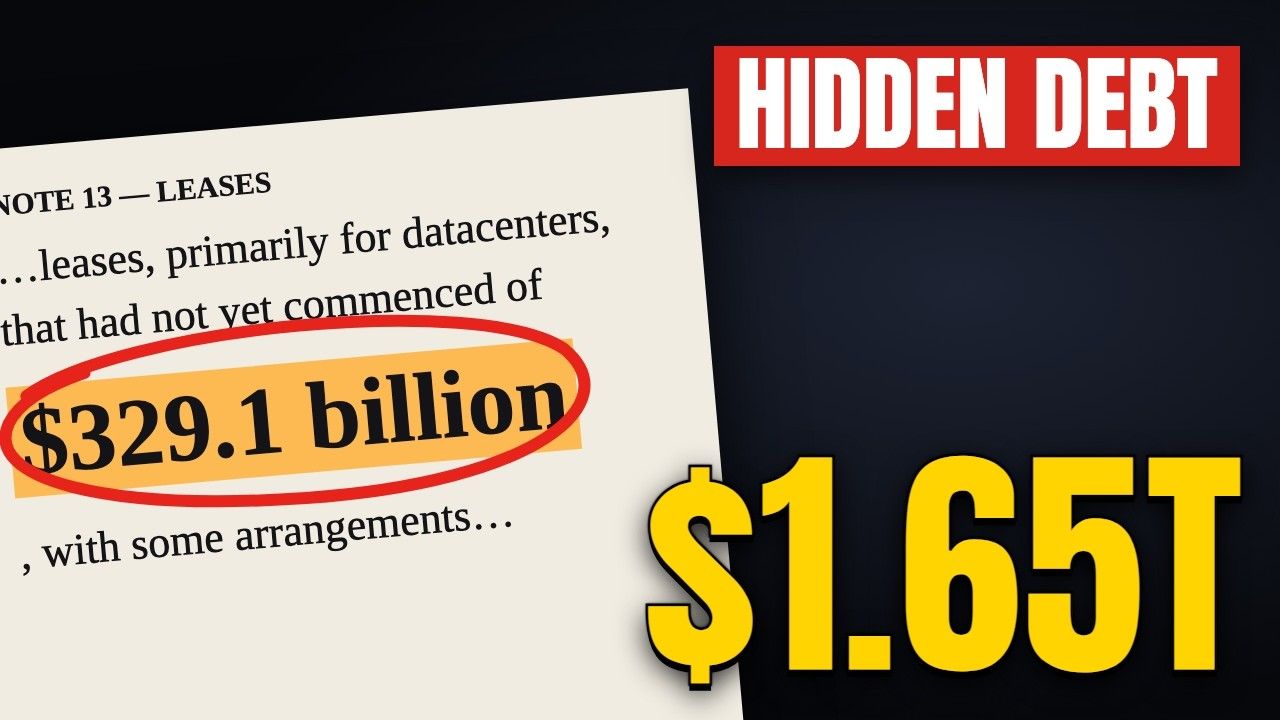
On page 78 of Microsoft's annual report: $329 billion of leases that don't count as debt. Across Big Tech, at least $1.65 trillion.
The chain reaction
From the promises to you
Domino 1
The promises
AI labs promise to buy computing power for years, and Nvidia helps fund its own customers.
1:05 The promisesDomino 2
The footnotes
Leases, chip contracts and guarantees that don't count as debt: $329 billion of unstarted leases at Microsoft alone.
2:28 The footnotesDomino 3
The side door
Side companies, like the one behind Meta's Hyperion data center, carry the borrowing.
3:49 The side doorDomino 4
The lenders
PIMCO, BlackRock, Blue Owl, Apollo and the banks, with insurers and pension funds behind them.
5:02 The lendersDomino 5
You
A pension, an annuity or a life-insurance policy may be lending to the AI build-out.
7:17 You
The story
What this episode explains
On page 78 of Microsoft's annual report, one sentence says it has signed $329 billion of data-center leases that haven't started yet: seven times its long-term debt, and none of it counted as debt. Across Big Tech, promises like this add up to at least $1.65 trillion.
We follow the chain reaction link by link: the AI labs' promises and Nvidia's circular financing → the footnotes (leases, chip contracts, guarantees) → the side companies like Meta's Hyperion → the lenders (PIMCO, BlackRock, Blue Owl, Apollo, the banks) and the insurers and pension funds behind them → you. Plus the first cracks this autumn, what Enron and Lucent teach us, why the chain might hold, and three dominoes to watch, starting October 28.
- $1.65T
- Big Tech promises not counted as debt (at least)
- $329B
- Microsoft's data-center leases that haven't started yet
- 7×
- all the long-term debt Microsoft reports
Microsoft Buried $329 Billion on Page 78
Read it instead
The full transcript
Read all 10 chapters
0:00The chain reaction
On page 78 of Microsoft's latest annual report, in a note about leases, there's a sentence that most investors will never read.
It says Microsoft has signed leases, mostly for data centers, that haven't started yet. The total $329 billion, that's seven times all the long-term debt Microsoft reports. Three months earlier, the same number was under $200 billion.
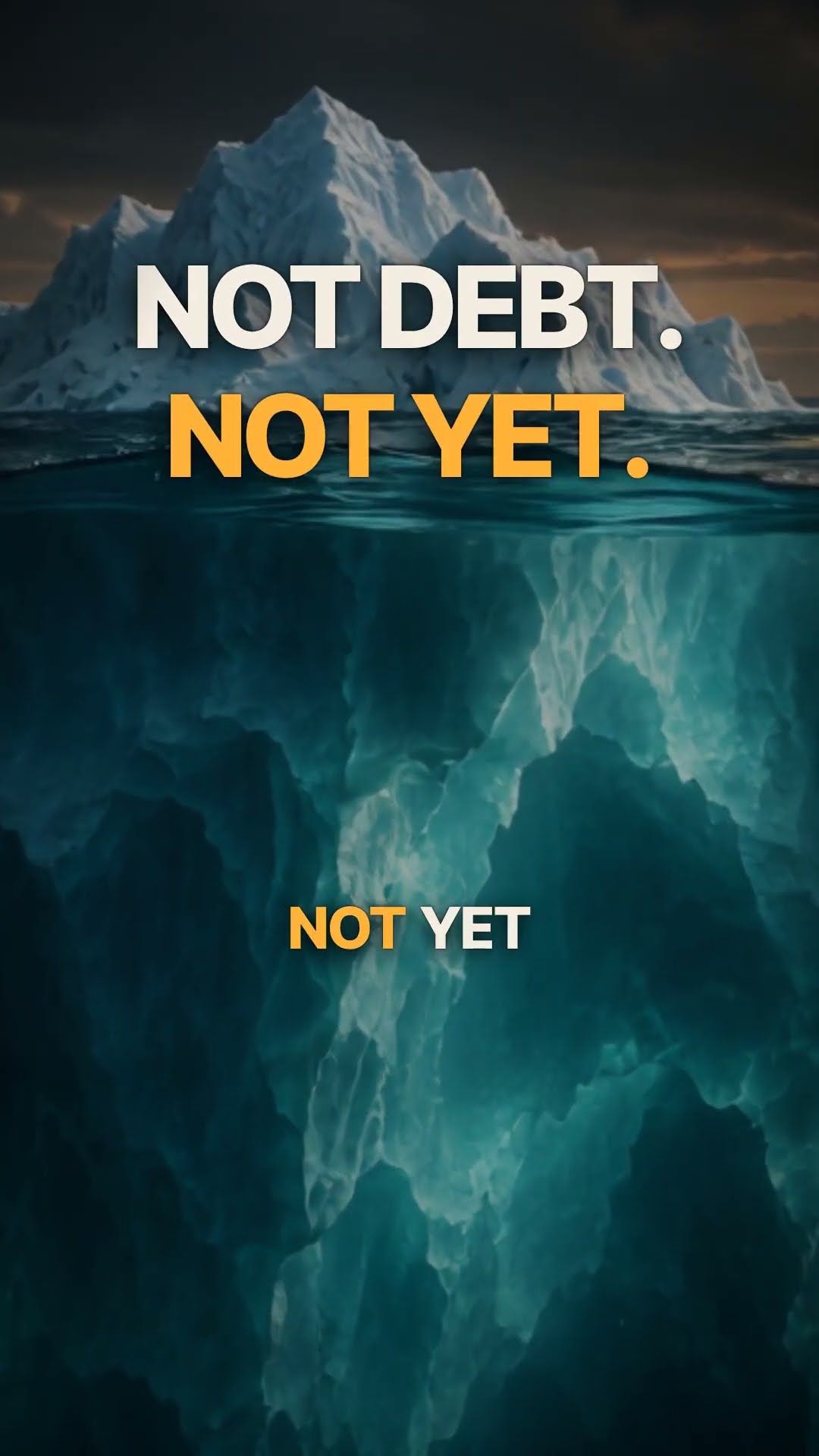
None of it counts as debt. Not yet. And Microsoft isn't alone. Across big tech, promises like this add up to at least $1.65 trillion, more than all the debt these companies actually report. It looks like accounting. But these are dominoes. And this autumn, the first ones started to wobble.
This is Dominomics. We take one big story and follow its chain reaction, all the way to your money.
Today we follow the money behind the AI boom. From the promises, into the footnotes, through a side door, to the lenders, and finally to you. Let's follow the chain.
1:05Domino 1 — The promises
Domino One. The Promises.
Every chain reaction needs a first push. In the AI boom, the push is a promise. Take OpenAI, the company behind ChatGPT, according to the Financial Times. Its own plans call for about $850 billion of spending on computing power by 2030. Its revenue today is running at about $50 billion a year.
So who covers the gap? Partly, the suppliers, this year. Nvidia, which makes the chips, invested $30 billion in OpenAI. Then, in August, it agreed to guarantee up to $105 billion of lease and power payments for a giant OpenAI data center in Ohio. If the tenant defaults, Nvidia pays. In exchange, the site will run Nvidia hardware. The supplier backs the customer, so the customer can buy from the supplier. It's called circular financing.
This month, the International Monetary Fund counted 14 deals like this since 2023. Around $300 billion of investment and $650 billion of debt in exchange for $1.4 trillion of promised future revenue.
Here's the key point. A promise to buy computing power in five years isn't revenue yet. And a promise to pay rent in five years isn't debt yet. Which brings us to the footnotes.
2:28Domino 2 — The footnotes
Domino 2. The Footnotes.
When a company borrows money, the loan goes on its balance sheet. Investors see it. Rating agencies see it. But a lease that hasn't started yet doesn't go on the balance sheet. Neither does a contract to buy chips next year. Those live in the footnotes.
So let's read them. Microsoft $329 billion of leases that haven't started yet. Oracle, $288 billion. Meta, $279 billion, plus another $68 billion signed in July. Amazon, $137 billion. Alphabet, $85 billion. That's more than a trillion dollars in leases alone.
Then there are purchase commitments. Contracts for chips, servers, and electricity. At Alphabet, they jumped from $332 billion to $811 billion in a single quarter.
Every time someone adds it all up, the number gets bigger. In February, Moody's counted $662 billion of data center leases that hadn't started. In July, a Nikkei analysis put Big Tech's off-balance sheet obligations at $1.65 trillion, more than the $1.35 trillion of debt on their balance sheets. In August, Morgan Stanley counted more than $3 trillion, once you add guarantees and the chipmakers.
3:49Domino 3 — The side door
Domino 3. The Side Door.
Some of the biggest deals don't sit in big tech's accounts at all. They sit in separate companies. Remember Hyperion. Meta's giant data center in Louisiana. To build it, Meta and the investment firm Blue Owl set up a company called Beignet Investor. Beignet, not Meta, borrowed $27 billion in bonds that don't fully pay back until 2049.
Meta rents the buildings. But here's the catch. Each lease runs for just four years at first. After that, Meta can renew or walk away.
So what protects the lenders? Another promise, if Meta leaves and the buildings are worth less than expected, Meta guarantees to cover the gap up to about $28 billion. In its own accounts, Meta calls that payment not probable. So the liability it has recorded is zero.
And the model is spreading. In July, Meta did it again in El Paso, Texas, this time with BlackRock. Alphabet now guarantees $44 billion of other companies' data center payments. And Apollo and Blackstone lined up about $36 billion to buy chips for Anthropic, backed by Broadcom.
5:02Domino 4 — The lenders
Off the balance sheet doesn't mean off the hook.
Domino 4. The Lenders.
So who's actually lending all this money? Bond giants like PIMCO and BlackRock. Private credit firms like Blue Owl, Apollo, and Blackstone. And the big banks: JPMorgan and MUFG led a $38 billion loan for data centers built for Oracle.
And where does their money come from? Increasingly, from people saving for retirement. Morgan Stanley expects private credit to fund around $700 billion of data centers between 2026 and 2028. America's life insurers now hold more than $800 billion of private hard-to-sell bonds, a fifth of all their bonds. And some private credit giants own insurers outright. Apollo owns Athene, a major seller of retirement annuities.
Regulators have noticed. In September, the Bank of England warned that rising leverage, opacity, and circular arrangements could amplify losses. The IMF has warned that pension funds and insurers have piled into assets that could be hard to sell in a hurry. And last quarter, investors in one of Blue Owl's tech lending funds asked to withdraw 39% of their money. The fund paid out five.
6:12The first cracks
And this autumn, the first cracks appeared.
Oracle has made more of these promises than anyone, relative to its size. Its off-balance sheet lease commitments, $288 billion, are more than double everything it has borrowed. Last fiscal year, it burned through $24 billion of cash. In July, S&P cut its credit rating to one notch above junk. And the price of insuring its debt against default rose to levels last seen in 2008.
On September the 24th, Oracle sent a force majeure notice on a giant data center in New Mexico, being built for OpenAI, citing delays in getting power. The $18 billion construction loan behind it now trades at around 90 cents on the dollar.
And by mid-October, the selling had spread. Hyperion's bonds, sold with an A-plus rating, slipped to around 92 cents. Debt on an Oracle campus in Michigan. 87. CoreWeave's bonds: below 80, yielding nearly 15 percent. One of Europe's biggest investors, Allianz, called it a Darwin moment for AI borrowers.
7:17Domino 5 — You
Which brings us to the last domino, you.
Maybe you've never bought a bond in your life. But if you have a pension, an annuity, or a life insurance policy, the people managing that money may well be lending to the AI build-out. If you own a broad bond fund, it almost certainly holds big tech's bonds. And if you own an index fund, you already own the companies making these promises. They're the biggest names in the S&P 500.
So here's the chain that worries regulators. AI revenue disappoints. Tenants delay or walk away when their short leases end. Data center bonds fall. Private credit funds take losses and limit withdrawals. And insurers and pension funds holding assets they can't easily sell feel the squeeze. That's how a footnote in Silicon Valley can reach your retirement account.
8:07We've seen hidden debt before
We've seen hidden debt before.
In 2001, Enron was the seventh largest company in America. Through a web of side companies, it moved at least $27 billion, almost half its assets, off its balance sheet. Some of those side companies existed mainly to make the numbers look better. When the truth came out, Enron collapsed in less than two months. It was the largest bankruptcy in American history at the time. Shares that had traded at around $90 fell below one.
To be clear, Enron was fraud. Today's deals are legal, disclosed, and rated by the credit agencies. And here's the twist. Many of the disclosures we've been reading exist because of Enron. After it collapsed, Congress passed the Sarbanes-Oxley Act, which forced companies to reveal their off-balance sheet arrangements.
The closer parallel may be telecom. In 2000, the equipment maker Lucent had promised about $8 billion of financing to its own customers so they could buy its equipment. When those customers went bust, the loans went bad. Lucent's shares fell from around $80 to under $1. Nvidia says that unlike Lucent, it doesn't rely on vendor financing. And it's true that Nvidia mostly invests and guarantees rather than lends. But the question is the same one Lucent faced. What happens if the customer can't pay?
Hidden debt rarely starts the fall. But it decides how far the dominoes travel.
9:33Why the chain might hold — and what to watch
Now, to be fair, there are real reasons this chain could hold.
Microsoft, Alphabet, Amazon, and Meta are among the most profitable companies in history, and much of this rent can be paid out of their cash flow. The deals are disclosed, and most of the bonds are rated investment grade. And the demand is real. Google Cloud alone has more than $500 billion of signed contracts still to deliver.
So instead of predicting, let's watch. Here are three dominoes to keep your eye on.
1. The Footnotes. Microsoft reports on October the 28th. Amazon the next day. And Alphabet is expected that same week. Watch the leases that haven't started yet. If they're still jumping by a hundred billion dollars a quarter, the chain is still getting longer.
2. Data Center Bond Prices. If bonds like Hyperion's slide below 90 cents, the lenders are getting nervous and every new deal gets harder to fund.
And three, the tenants. OpenAI reportedly expects its revenue to reach a $70 billion annual pace by the end of the year. If it gets there, the chain holds tighter. If it falls short, every promise above it gets heavier.
And mark October the 28th. That afternoon, the Federal Reserve announces its decision on interest rates. Higher rates make every one of these promises more expensive to fund.
10:54The whole chain
The economy is a chain reaction. Most people only notice the last domino when it lands on their paycheck, their mortgage or their savings. On this channel, we follow the whole chain, from the first push to the final fall.
To see how a war in the Middle East could push this chain over, watch our last episode. And tell me in the comments, which domino do you think falls next? This is Dominomics. I'll see you at the next domino.
Sources & notes
Where the numbers come from
Sources
- Company filings on SEC EDGAR (Microsoft 10-K FY2026; Alphabet, Amazon, Meta, Nvidia 10-Qs; Oracle 10-K and 10-Q)
- IMF Global Financial Stability Report (Oct 2026)
- Bank of England FPC record (Sep 2026)
- Moody's
- Morgan Stanley
- Nikkei
- Financial Times
- Bloomberg
- Reuters
- S&P
- U.S. Senate Permanent Subcommittee on Investigations (2002)
- Powers Report (2002)
- Lucent 10-K filings
- Full fact-check log available on request.
Please note
For education and entertainment only. Not financial advice.
Spotted a mistake?
Tell us at business@dominomicsofficial.com. Corrections are logged on our corrections page.
Images, footage and data credits
- Satellite: contains modified Copernicus Sentinel data 2026, processed by Dominomics
- Former Enron Complex, Houston, 2008: Alex (Flickr) / CC BY 2.0
- House Energy and Commerce hearing on Enron, 2002: U.S. House of Representatives / public domain
- Sarbanes-Oxley signing, 2002: White House photo by Eric Draper / public domain
- Lucent 5ESS switch, 2006: Antoni44 / public domain
- Bank of England, London, 2015: Diliff / CC BY-SA 3.0
- IMF headquarters, Washington DC, 2024: Tony Webster / CC BY 2.0
- IMF sign, Washington DC, 2013: Marek Ślusarczyk (Tupungato) / CC BY 3.0
- Former BlackRock headquarters, New York, 2008: Jim Henderson / public domain
- PIMCO headquarters, Newport Beach, 2022: Andymii / CC BY-SA 4.0
- 9 West 57th Street (Apollo HQ), New York, 2025: Jim Henderson / CC BY-SA 4.0
- Blackstone headquarters, 345 Park Avenue, 2026: Ajay Suresh / CC BY 4.0
- JPMorgan Chase headquarters, 270 Park Avenue, 2026: Ajay Suresh / CC BY 4.0
- MetLife Building, New York, 2025: Kidfly182 / CC BY 4.0
- Allianz headquarters, Munich, 2006: Oliver Raupach / CC BY-SA 2.5
- Nvidia headquarters, Santa Clara, 2023: Coolcaesar / CC BY-SA 4.0
- Jensen Huang at Stanford, 2026: Anderseidesvik / CC BY-SA 4.0
- Sam Altman at TED2025: Steve Jurvetson / CC BY 2.0
- Microsoft campus, Redmond, 2016: Coolcaesar / CC BY-SA 4.0
- Meta headquarters, Menlo Park, 2022: LPS.1 / CC0
- Google sign, Mountain View: Dietmar Rabich / Wikimedia Commons / “Mountain View (CA, USA), Charleston Road, Google-Schild -- 2022 -- 2896” / CC BY-SA 4.0
- Amazon Spheres, Seattle, 2022: Sea Cow / CC BY-SA 4.0
- Oracle Austin campus, 2018: DronePhotographer / CC0
- Microsoft Azure data center, Wenatchee, WA, 2025: Tedder / CC BY 4.0
- AWS data centers, Oregon, 2023: Tedder / CC BY-SA 4.0
- Photos via Wikimedia Commons (cropped/resized) unless noted. Licenses: CC BY 2.0 creativecommons.org/licenses/by/2.0
- CC BY 3.0 creativecommons.org/licenses/by/3.0
- CC BY 4.0 creativecommons.org/licenses/by/4.0
- CC BY-SA 2.5 creativecommons.org/licenses/by-sa/2.5
- CC BY-SA 3.0 creativecommons.org/licenses/by-sa/3.0
- CC BY-SA 4.0 creativecommons.org/licenses/by-sa/4.0
- CC0 creativecommons.org/publicdomain/zero/1.0
- Stock video: Pexels contributors (free licenses; clip list on request)
- Metaphor illustrations (dominoes, iceberg, ledger, hourglass, archive room, side door, piggy bank, data-center scenes) are AI-generated. Every image of a real place, event or year is real and credited on screen.
The next domino
Keep following the chain
Don't miss the next one
Get the next chain reaction in your inbox.